|

EUR/USD holds steady as Core PCE meets expectations

  • EUR/USD nudges up slightly to 1.0788 after Core PCE inflation data for February aligns with market forecasts.
  • Headline PCE inflation for February shows a modest increase, maintaining market anticipation for the Federal Reserve's next moves.
  • Upcoming speeches by Fed Chair Jerome Powell and Mary Daly are eyed by EUR/USD traders.

The EUR/USD remains barely unchanged on thin trading after the US Bureau of Economic Analysis (BEA) revealed the Federal Reserve’s preferred gauge for inflation, the Core Personal Consumption Expenditure (PCE) price index for February was aligned with estimates. That said, the EUR/USD trades at 1.0788, posting minuscule gains of 0.02%

EUR/USD posts minimal movement after US inflation data

The BEA revealed that Core PCE came at 0.3% MoM and at 2.8% YoY, with both figures aligned with the market consensus. Headline PCE figures rose by 0.3% MoM lower than expected and January’s data. In the 12 months to February, PCE came at 2.5%, as foreseen, but a tenth higher than the prior month’s data.

Other data showed that Wholesale Inventories Advanced for February came at 0.5% MoM up from -0.2% in the previous month.

Thin liquidity conditions witnessed the EUR/USD push below 1.0780 before breaking above 1.0790. Buyers are eyeing a clear break above 1.0800, though they will face some intraday resistance, as depicted by the hourly chart, with the 50-Simple Moving Average (SMA) standing at 1.0800.

In addition, traders will watch San Francisco’s Fed President Mary Daly's speech at 15:20 GMT, followed by Fed Chair Jerome Powell's speech at 15:30 GMT.

According to BBH analysts, Fed Chair Jerome Powell's speech will be important. They noted, “Other Fed speakers have tilted hawkish after last week’s FOMC meeting, and markets will be watching to see if Powell follows suit or maintains the dovish tone from his press conference. With Powell, it’s always a coin toss but as we’ve said countless times before, the data will ultimately decide the timing of the first cut. As things stand, odds of a cut June 12 have fallen to 66% after rising to 85% post-FOMC.”

EUR/USD Price Analysis: Technical outlook

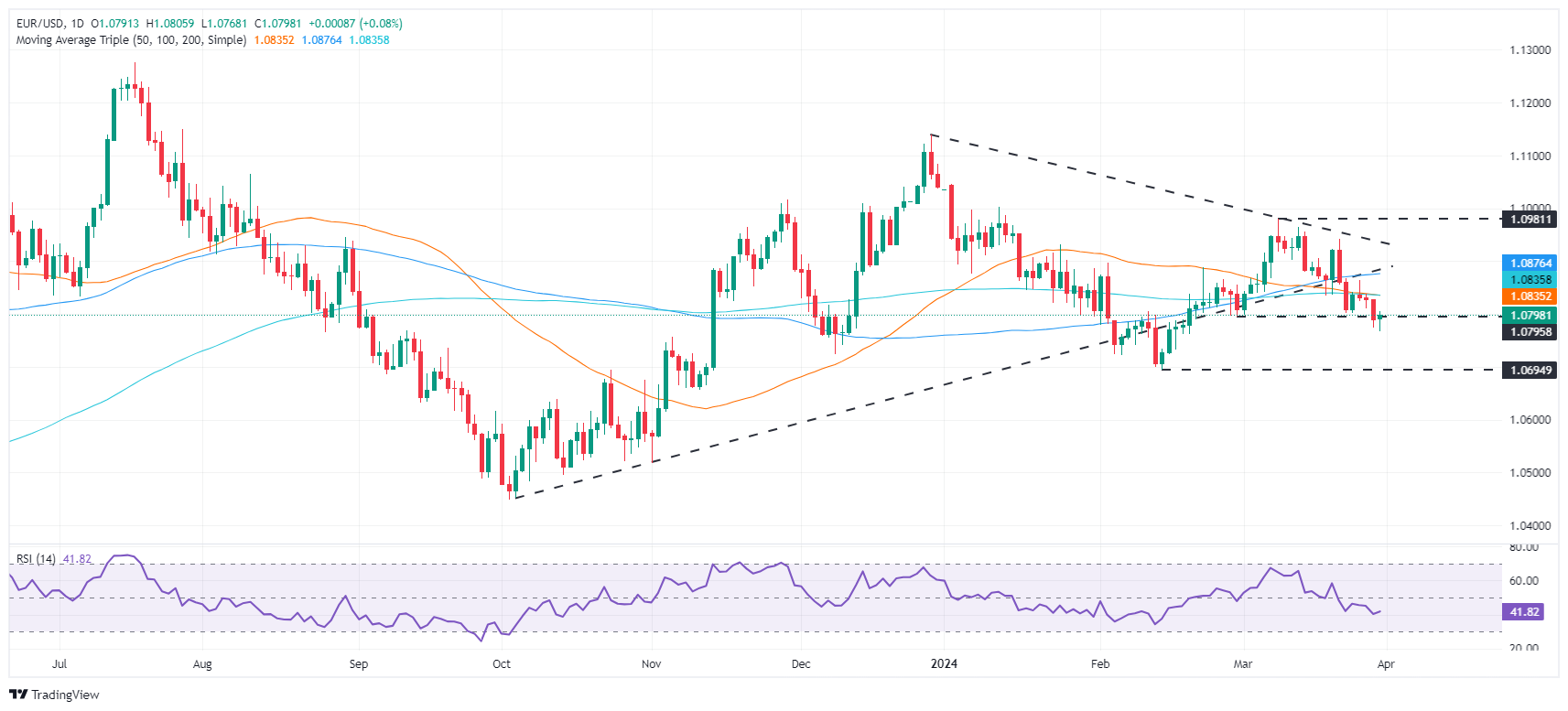
During the European session, the pair printed a low of 1.0767. However, the EUR/USD climbed above 1.0790 following the data release, with traders eyeing 1.0800. A decisive break will expose the March 28 high of 1.0827, followed by the 50-day moving average (DMA) at 1.0834, ahead of 1.0835, the 200-DMA. Once those levels are cleared, up next would be the 100-DMA at 1.0876. On the other hand, further losses are eyed below 1.0750, which would expose the February 14 low of 1.0694.
EUR/USD

Overview
Today last price1.0798
Today Daily Change0.0009
Today Daily Change %0.08
Today daily open1.0789
 
Trends
Daily SMA201.0876
Daily SMA501.0837
Daily SMA1001.0875
Daily SMA2001.0836
 
Levels
Previous Daily High1.0828
Previous Daily Low1.0775
Previous Weekly High1.0942
Previous Weekly Low1.0802
Previous Monthly High1.0898
Previous Monthly Low1.0695
Daily Fibonacci 38.2%1.0795
Daily Fibonacci 61.8%1.0808
Daily Pivot Point S11.0767
Daily Pivot Point S21.0745
Daily Pivot Point S31.0714
Daily Pivot Point R11.082
Daily Pivot Point R21.0851
Daily Pivot Point R31.0873

Author

Christian Borjon Valencia

Markets analyst, news editor, and trading instructor with over 14 years of experience across FX, commodities, US equity indices, and global macro markets.


More from Christian Borjon Valencia
Share:

Editor's Picks

AUD/USD meets support near 0.7150

AUD/USD comes under renewed and quite strong selling pressure ahead of the Asia opening bell on Friday, drifting back toward multi-day troughs near 0.7150, where it seems to have met some decent contention for now. The Aussie’s decline follows the inflation-reignited uptick in the Greenback in response to robust US factory-gate prices in August.


USD/JPY consolidates around 153.50 as bears turn cautious ahead of US inflation

USD/JPY stabilizes above 153.50 during the Asian session on Thursday, but remains near a seven-month low set earlier this week as hawkish BoJ repricing continues to underpin the Japanese Yen. Meanwhile, rising September Fed rate-hike bets and escalating US-Iran tensions help ease US Dollar selling pressure, offering some support to the currency pair ahead of US inflation figures.

Gold remains weak, retargets $4,350

Gold keeps the choppy price action on Thursday, now slipping back toward the $4,350 region per troy ounce amid the robust bounce in the US Dollar as well as rising US Treasury yields across the curve, particularly following US Producer Prices and ahead of Friday’s more relevant US CPI data.

Bitcoin and Gold Outlook: BTC and XAU drop as US PPI broadens rate-hike bets
Cryptocurrency prices are broadly correcting, led by Bitcoin (BTC), which is trading around $77,000 on Thursday, marking four consecutive days of declines. Meanwhile, Gold (XAU) remains sideways, hovering around $4,365, with upside capped below $4,400.
ECB recap: A hawkish hike despite downside growth risks
The European Central Bank (ECB) increased the Deposit Facility Rate to 2.50%, the Refinancing Rate to 2.65% and the Marginal Lending Facility to 2.90%, effective from September 16. The decision was accompanied by a clear warning that the outlook remains highly uncertain, with risks tilted to the upside for inflation and to the downside for growth.
Venezuela’s 65-billion-barrel Oil deal could reshape America’s inflation fight
The United States (US) has secured unprecedented access to part of Venezuela’s vast Oil reserves. The timing is particularly significant as the war with Iran is disrupting Middle Eastern supplies, keeping energy prices elevated and reviving concerns about inflation.