|

EUR/USD finds support near 1.0720 after slow grind on Monday

  • German CPI inflation continues to rise, but below forecasts.
  • Fed rate call, pan-EU GDP and HICP inflation in the mid-week.
  • NFP Friday a key US datapoint this week.

EUR/USD jostled on Monday, settling near 1.0720 after churning in a tight but lopsided range as markets settle in for the wait to Wednesday’s US Federal Reserve (Fed) outing. Investors broadly expect US rates to hold steady this week, but traders will be looking for an uptick in Fed guidance for when rate cuts could be coming. As of writing, the CME’s FedWatch Tool shows rate markets are pricing in 58% odds of a first rate cut in September.

German Consumer Price Index (CPI) inflation rose to 0.5% MoM in April, up from the previous month’s 0.4% but missing the forecast 0.6%. Germany’s YoY Harmonized Index of Consumer Prices (HICP) inflation ticked higher to 2.4%, compared to the forecast hold at 2.3%. Markets will be looking ahead to Tuesday’s HICP inflation for the pan-Euro area, which is expected to stand pat at 2.4% for the year ended April.

European Gross Domestic Product (GDP) figures are also due during Tuesday’s European market session, forecast to grind higher to a scant 0.1% in the first quarter compared to the previous quarter’s flat 0.0%.

The key headlines this week will be the Fed’s latest rate call on Wednesday, followed by Friday’s NFP labor data, which is expected to show a slight easing from the previous month’s 12-month peak of 303k. Friday’s US NFP is forecast to ease to 243k net additional job growth.

EUR/USD technical outlook

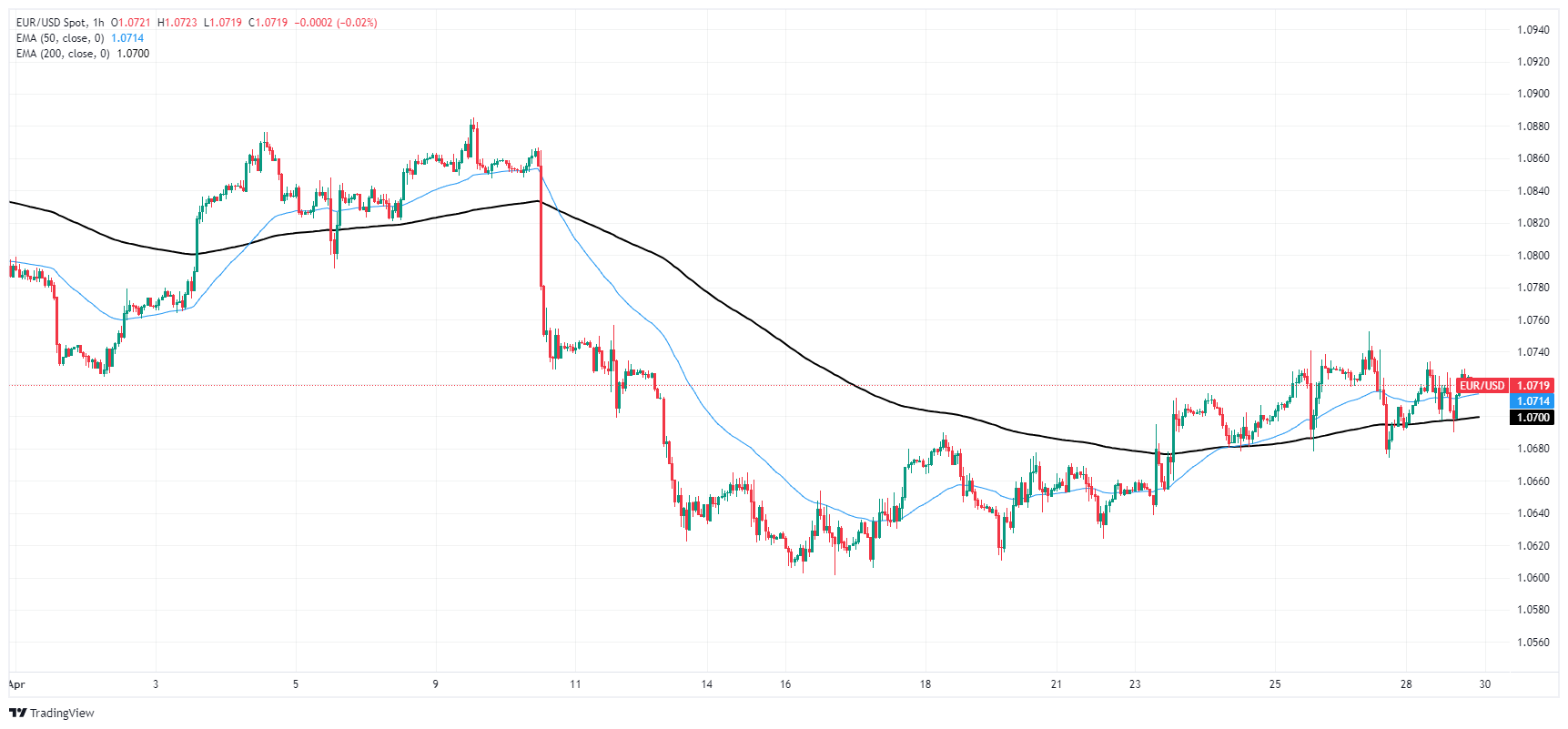
The EUR/USD churned just north of the 1.0700 handle on Monday as the pair continues to grind higher off of technical bounces from the 200-hour Exponential Moving Average (EMA) rising into the 1.0700 region. Chart paper north of 1.0750 is proving a difficult boundary to cross, and downside momentum, though sluggish, continues to keep the pair weighed down.

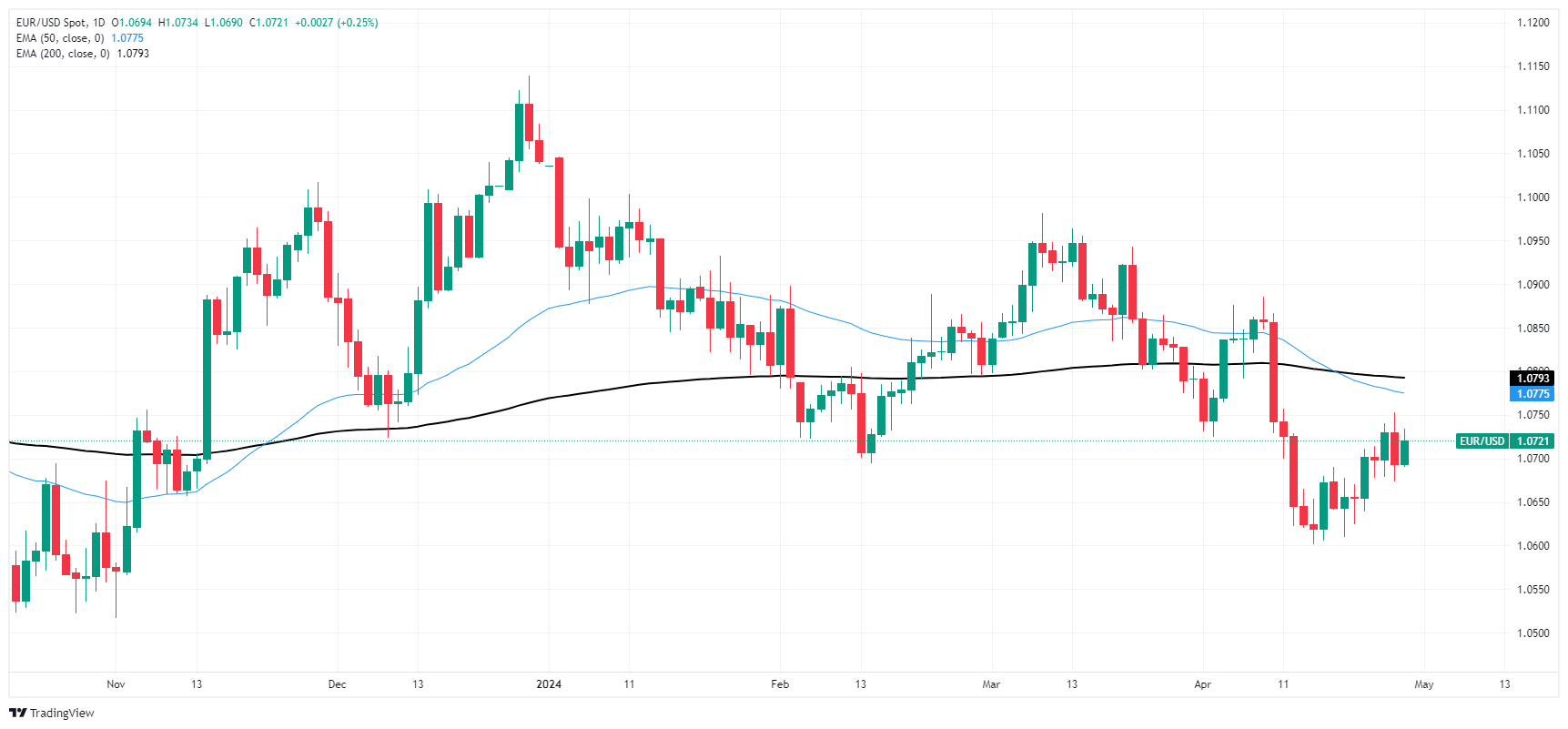
EUR/USD remains down 2.5% from the last major swing high into 1.0980, with a near-term price floor at 1.0600.

EUR/USD hourly chart
EUR/USD daily chart
Author

Joshua Gibson

Joshua joins the FXStreet team as an Economics and Finance double major from Vancouver Island University with twelve years' experience as an independent trader focusing on technical analysis.


More from Joshua Gibson
Share:

Editor's Picks

AUD/USD consolidates above 0.7000; remains close to monthly top

AUD/USD holds steady above 0.7000 during the Asian session on Friday, trading just below the previous day's monthly low amid diverging forces. A hawkish RBA continues to support the Aussie, while the recent decline in US bond yields keeps the US Dollar depressed near a three-week low. However, oil-driven inflation fears reinforce Fed hike bets, which, along with geopolitical risks, could benefit the safe-haven buck and cap the currency pair.

USD/JPY bounces off one-month low; climbs to 157.00 amid reviving USD demand

USD/JPY rebounds from the 156.00 neighborhood, or a one-month low touched during Friday’s Asian session, with bulls looking to extend momentum beyond 157.00 amid the emergence of some US Dollar buying. Meanwhile, Japan's National CPI rose to a nine-month peak and reaffirmed BoJ rate-hike bets, which could support the Japanese Yen and cap gains for the currency pair.

Gold hits fresh three-month low below $4,000 amid surging energy prices

Gold slides to a fresh three-month low at $3,986.74 in the Asian trade on Friday. The precious metal faces intense selling pressure, following a consolidation breakdown that took place on the range between $4,227.90 and $4,066.64 in the past three weeks.


Cardano: Whale selling deepens correction
Cardano (ADA) edges higher by nearly 2% on Friday, following a roughly 6% decline the previous day. The pullback aligns with the sell-side appeal among large-wallet investors, commonly referred to as whales, and Cardano derivatives. The technical outlook for ADA is bearish, with downside momentum persisting. Whales are losing their appetite for holding ADA tokens, fueling near-term selling pressure.
The Bank of England just got its clearest reason to hike. Here's what it's really watching

UK inflation as measured by the CPI accelerated to 3.5% YoY in September, up from 3.1% in August, according to the Office for National Statistics. This is the highest level since October 2025, exceeding economists' expectations of 3.4% and pushing inflation further from the BoE's 2% target.

What November 3 means for the Fed's rate path and the US Dollar

The USD faces a decisive period ahead of the November 3 midterm elections. While markets anticipate another interest rate increase from the Fed in December, the battle for control of Congress could reshape fiscal policy expectations and, indirectly, the path of US monetary policy in 2027.