EUR/USD dips on buoyant US Dollar, as ECB officials remain dovish
- EUR/USD drops below 1.0840 due to USD strength, buoyed by durable goods data and stable consumer confidence.
- ECB rate cut hints fuel speculation amid divided Fed views on easing.
- Market eyes Eurozone indicators, US inflation data for future EUR/USD direction.

The Euro retraces against the US Dollar from weekly highs hit at 1.0864 and tumbles toward the 1.0820 region on Tuesday amidst a buoyant Greenback. At the time of writing, the EUR/USD trades at 1.0828 down 0.08%.
EUR/USD adjusts amid strong US economic data and mixed ECB and Fed signals
Economic data from the United States (US) bolstered the Greenback, which trimmed its earlier losses as depicted by the US Dollar Index (DXY). The DXY which measures a basket of the American currency against six others, climbs 0.10% at 104.32.
The US Census Bureau revealed that Durable Goods Orders for February rose 1.4% Month over Month, exceeding forecasts of 1.1% and January’s -0.9% plunge. The core Durable Goods Orders stood at 0.4% Month over Month, up from -0.3% and above the consensus of 0.4%. Elsewhere, the Conference Board (CB) revealed that Consumer Confidence was steady in March, yet it ticked down to 104.7 from 104.8, a downward revision from the previous month. The survey showed Americans blaming higher prices and soaring borrowing costs.
Following the data, the fundamentals surrounding the EUR/USD pair remained unchanged. Money market traders speculate that the Federal Reserve (Fed) and the European Central Bank (ECB) could cut interest rates in June. Meanwhile, traders are seeking cues from central banks' speeches across both sides of the Atlantic.
On Tuesday, ECB official Yannis Stoumaras commented that there is a consensus for a June rate cut. Madis Muller echoed some of his comments, indicating that the ECB is nearing the stage where it can lower rates.
On the US front, Fed officials continued to lay the groundwork for easing policy, but there’s division among the Federal Open Market Committee (FOMC) board. Atlanta Fed President Raphael Bostic noted that he expects one rate cut instead of two in 2024. Meanwhile, Fed Governor Lisa Cook said that easing policy too soon increases the risk of inflation becoming entrenched.
On the dovish spectrum, Chicago Fed President Austan Goolsbee expects three cuts, though he says he needs more evidence of inflation “coming down.”
Traders eye Eurozone data, ahead of US PCE
The Eurozone (EU) docket will feature the release of inflation data in Spain, Consumer Confidence in France, and Economic Sentiment in the whole bloc. On the US front, investors will eye the release of Gross Domestic Product (GDP) figures for the last quarter of 2023, unemployment claims,, and the Fed’s preferred gauge for inflation, the core PCE.
EUR/USD Price Analysis: Technical outlook
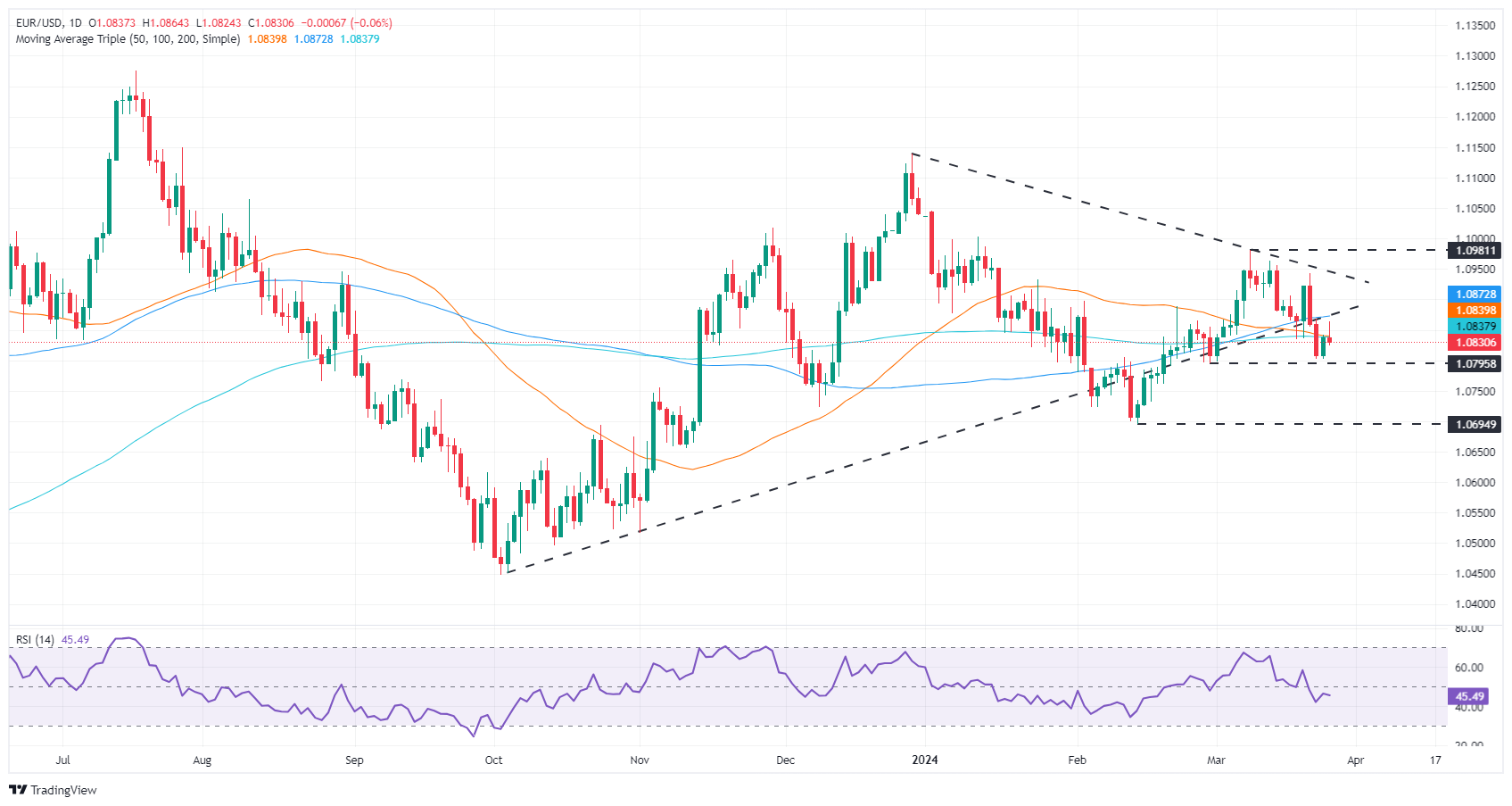
The EUR/USD was unable to achieve a decisive break of the 200-day moving average (DMA), opening the door to challenging the 1.0800 mark. With sellers regaining control, a breach of the latter will pave the way to test the February 20 low of 1.0761, followed by the February 14 swing low of 1.0694. On the other hand, if buyers reclaim the 200-DMA at 1.0837, the next resistance level would be 1.0864, ahead of 1.0900.
Author

Christian Borjon Valencia
FXStreet
Markets analyst, news editor, and trading instructor with over 14 years of experience across FX, commodities, US equity indices, and global macro markets.















