|

DIDI Share Price: DiDi Global Inc extends slide on China stock pullback

  • NYSE:DIDI fell by 3.71% on Wednesday as China weakness continued.
  • The ongoing investigation into Didi could result in an executive shuffle.
  • Softbank announces it will pull out of investing in China stocks. 

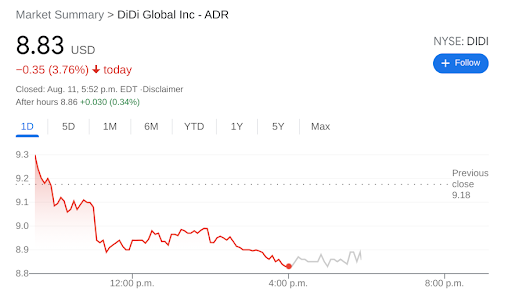
NYSE:DIDI fell once again on Wednesday, a sigh that shareholders are getting all too used to unfortunately. The Chinese ride-hailing stock fell below the $9.00 price threshold for the first time since late-July, as the ongoing investigation by the Chinese government has erased any gains that were made since. Shares of Didi fell by a further 3.71% on Wednesday, and closed the trading session at $8.83. It was another session of tech weakness as the Dow Jones and S&P 500 were once again carried to new all-time highs on the strength of cyclical stocks. Blue-chip and value sectors have been showing strength lately on the back of the impending approval of the new infrastructure bill from President Biden.


Stay up to speed with hot stocks' news!


One potential outcome from the investigation into Didi is that high ranking officials within the company may be ousted. The executive shuffle would come as the Chinese government looks into the chain of command and who ultimately gave the green light for the company to IPO on the U.S. markets. Chinese officials have labeled the IPO a ‘deliberate act of deceit’ and Didi awaits the final verdict which could bring historic financial penalties. 

NYSE:DIDI news
Softbank, a major stakeholder in Didi, reported its earnings yesterday and net profit fell nearly 40% sequentially from the first quarter. The company’s investments in Chinese companies like Didi and AliBaba (NYSE:BABA) have plummeted during the recent sell-off, and CEO Masayoshi Son reported that the company would scale back investments in China until ‘the situation is clearer’. For Softbank this could mean holding off for another year or two, until the political mess sorts itself out. 


Like this article? Help us with some feedback by answering this survey:

Author

More from Stocks Reporter
Share:

Editor's Picks

GBP/USD remains slightly bid near 1.3300

GBP/USD now advances marginally and manages to dispute the 1.3300 region on Tuesday. Indeed, Cable regains some balance on the back of the lacklustre performance of the Greenback, all preceding the Fed’s meeting on Wednesday and the BoE’s gathering on Thursday.

EUR/USD recedes from tops, back below 1.1400

EUR/USD manages to set aside part of the recent weakness and clinches decent gains on Tuesday. Indeed, spot keeps the trade below the 1.1400 mark amid acceptable losses in the US Dollar, all following rising optimism of a US-Iran deal and steady caution prior to the FOMC gathering on Wednesday.

Gold bounces on poor US data

Gold remains under marked downside pressure on Tuesday, although the $4,000 zone per troy ounce emerges as a decent support for now. The precious metal’s pullback comes despite the modest losses in the US Dollar in a context of easing geopolitical tensions ahead of the key Fed event on Wednesday.

XRP falls toward $1.00 despite dwindling exchange reserves
Ripple (XRP) continues to trade under increasing pressure on Tuesday. This marks the second consecutive day of declines, reflecting broader risk-off sentiment as investors appear to shift gears in anticipation of the Federal Reserve (Fed) interest rate decision. On Wednesday, the Federal Open Market Committee (FOMC) is widely expected to leave interest rates unchanged in the 3.50%-3.75% range.
Warning signs in the stock market: Is this the top, or just a very short fuse?
Overnight, South Korea's Kospi fell more than 10%, SK Hynix lost close to 15% and Samsung Electronics lost 13%. Into that, Dow Jones Industrial Average futures traded up around 1% on paint and soft drinks, and S&P 500 futures sat roughly flat. An index that absorbs a memory-chip panic and prints nothing is not a calm market.
US Dollar mid-year outlook: Exceptional currency, exceptional risks?
The US Dollar enters the second half of 2026 in a markedly different position from a year ago. The King currency has recovered, reflecting persistent US inflation, changing expectations for Fed policy, geopolitical tensions and renewed demand for defensive assets.