Crude Oil continues to soften on Middle East ceasefire talks, WTI falls to $78
- WTI softened further, extended backslide to $78 per barrel.
- Ceasefire talks drag down Crude Oil bets.
- US Crude Oil production remains thorn in barrel market’s side.

West Texas Intermediate (WTI) US Crude Oil futures fell on Monday after headlines of a possible ceasefire in the ongoing conflict between Israel and Palestinian Hamas. Crude Oil markets will also be keeping an eye out for weekly production updates from the US as output threatens to outpace demand.
Details are still forthcoming, but negotiations between Israel and Hamas have tilted towards a resolution, dragging down barrel bids that have spent months churning higher on broad-market concerns of a conflict spilling over into neighboring countries and threatening global Crude Oil markets.
Weekly production updates from the American Petroleum Institute (API) and Energy Information Administration (EIA) will be closely watched by Crude Oil markets this week. US Crude Oil production has edged into higher territory in recent weeks, and supply is slowly beginning to outstrip demand. With week-on-week barrel counts slowly building out inventories beyond what demand is able to sop up, energy markets will be looking for a pull down in US production figures.
WTI technical outlook
WTI US Crude Oil is seeing market churn near $78.50 as markets grapple with a potential ceasefire deal on the cards, and barrel bids are pricing in a near-term price floor around the $78.00 price handle.
Recent bearish sentiment in Crude Oil has sent WTI further down from the 200-hour Exponential Moving Average (EMA) at $80.43, and US Crude Oil prices are down 3% in May.
WTI has closed in the red for six consecutive trading sessions, dipping below the 200-day EMA at $79.36. An extended decline will drag barrel prices down to February’s swing low near $72.00 per barrel, while the upside will be capped at the last turnaround near $84.00.
WTI hourly chart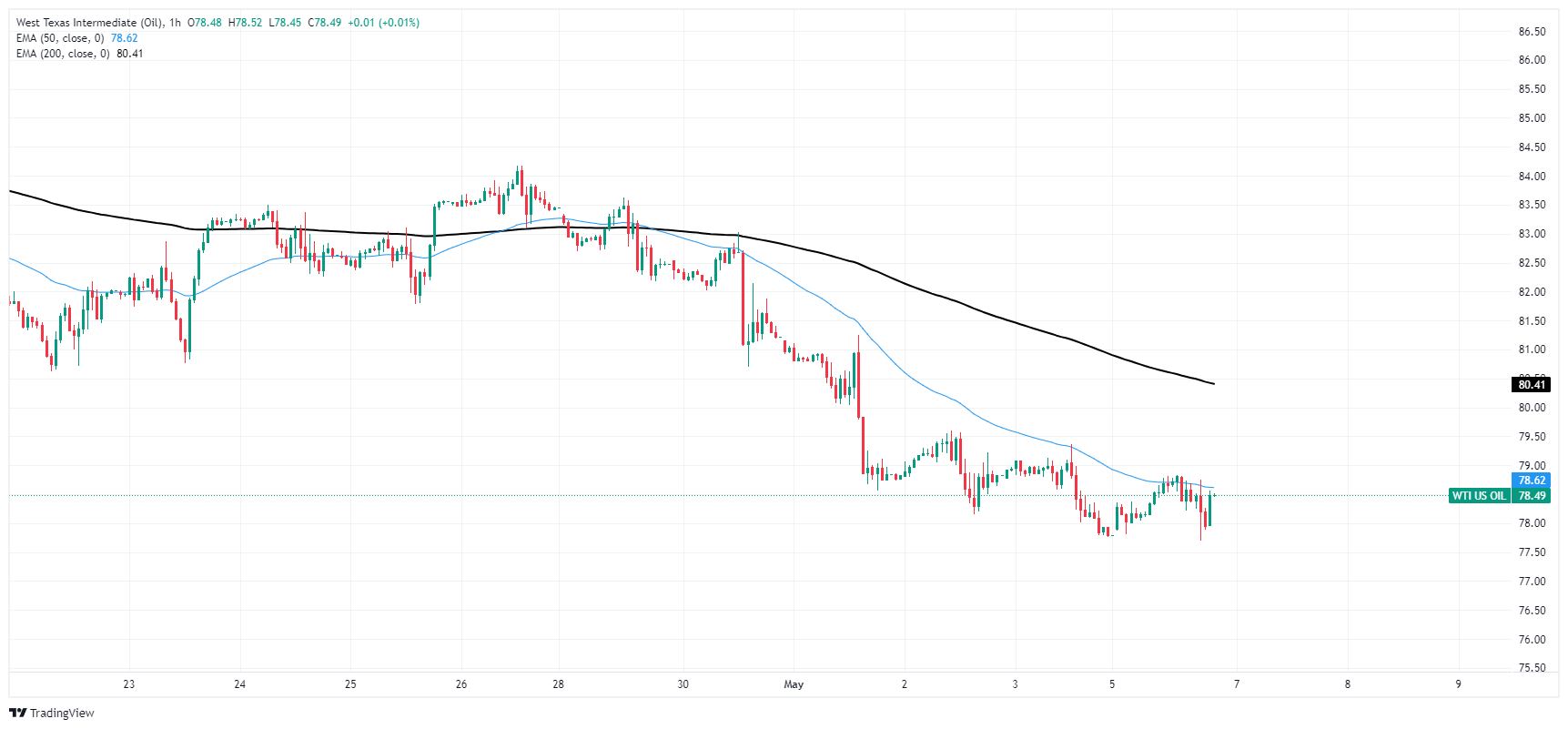
WTI daily chart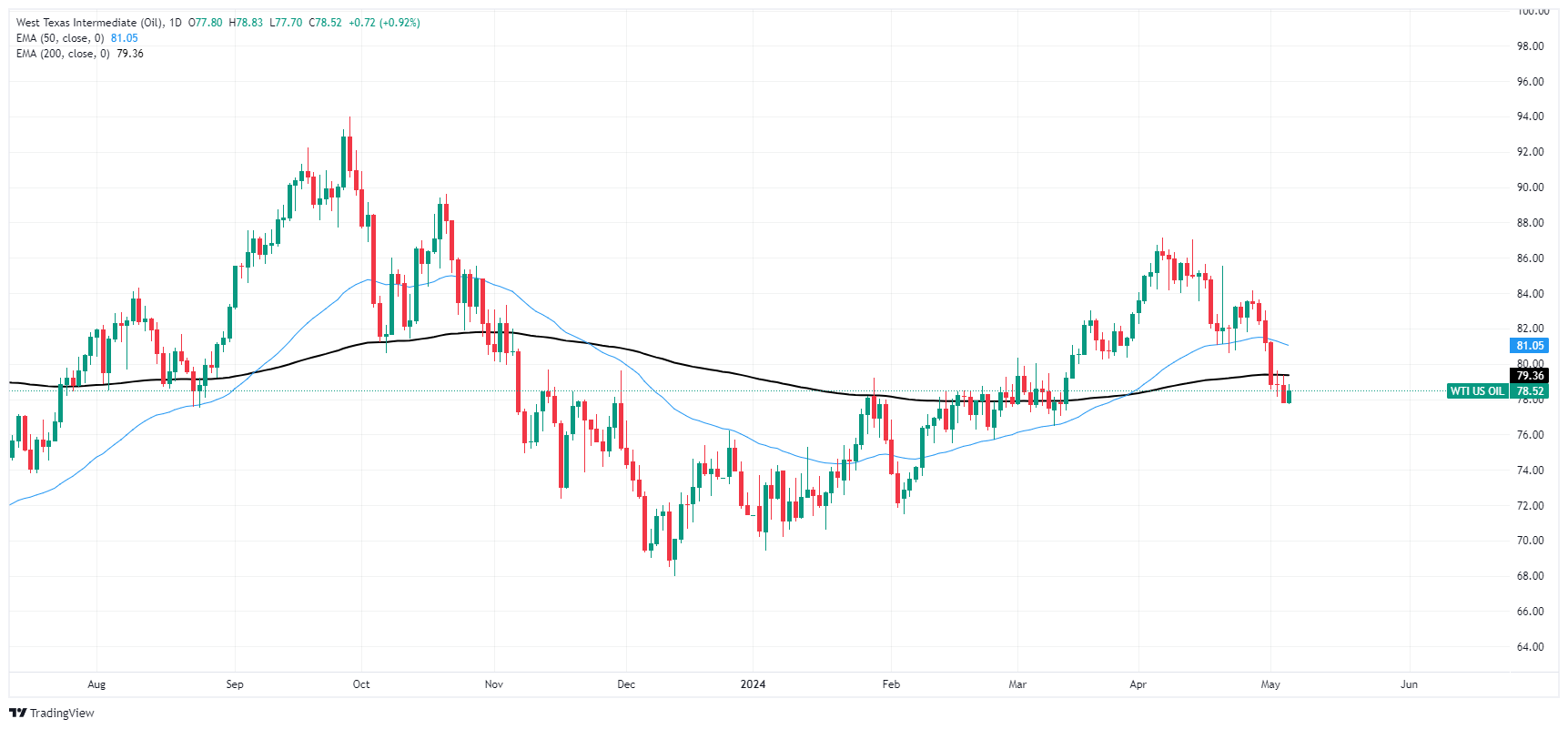
Author

Joshua Gibson
FXStreet
Joshua joins the FXStreet team as an Economics and Finance double major from Vancouver Island University with twelve years' experience as an independent trader focusing on technical analysis.