Canadian Dollar hesitates with Canada GDP, US Fed rate call in the pipe
- Canadian Dollar trimmed recent gains as energy markets continue to roil.
- Canada absent from economic data docket until Wednesday’s Canadian GDP print.
- Crude Oil pared back recent highs on Red Sea headlines, China growth concerns.

The Canadian Dollar (CAD) eased on Monday, backsliding after Crude Oil markets snipped away the week’s opening highs as the trading week kicks off with a light economic calendar on offer. The midweek period will see an update on Canadian Gross Domestic Product (GDP) and another rate call from the US Federal Reserve (Fed), both slated for Wednesday, and Friday will wrap up the week’s trading action with US Nonfarm Payrolls (NFP).
Canada is expected to see a slight uptick in GDP figures on Wednesday, with November’s MoM GDP forecast to print at 0.1% compared to the flat 0.0% from October, but broad-market focus will be on the Fed’s upcoming rate call and monetary policy statement at 19:00 GMT Wednesday. The Fed will follow up their latest interest rate decision with a press conference at 19:30 GMT.
Daily digest market movers: Canadian Dollar eases on early Crude Oil reversal
- Canadian Dollar down against most of major currencies on Monday.
- Crude Oil markets saw an early high to kick off the trading week, but barrel bids quickly fell back into near-term consolidation, dragging the Loonie lower.
- Iran-backed Houthi rebels in Yemen struck a commercial tanker in the Red Sea over the weekend, and energy markets spiked as retaliation is expected.
- China saw one of its lowest growth periods on record, excluding the Covid pandemic crunch.
- Concerns that the world’s largest Crude Oil importer sees slowing barrel demand is trimming energy bids, capping oil upside.
- Money markets are keen for a rate pivot from the Fed on Wednesday.
- Rate swaps this week are pricing in an 89.5% chance of a Fed rate cut of at least 25 basis points at the Fed’s May meeting, according to CME FedWatch Tool.
- Canada has a thin showing on the economic calendar this week, with Wednesday’s November GDP print and Thursday’s S&P Global Manufacturing Purchasing Managers’ Index (PMI) the only notable lines on the Canadian side.
Canadian Dollar price today
The table below shows the percentage change of Canadian Dollar (CAD) against listed major currencies today. Canadian Dollar was the weakest against the Japanese Yen.
| USD | EUR | GBP | CAD | AUD | JPY | NZD | CHF | |
| USD | 0.26% | 0.07% | -0.08% | -0.24% | -0.37% | -0.28% | -0.10% | |
| EUR | -0.27% | -0.19% | -0.34% | -0.50% | -0.61% | -0.54% | -0.36% | |
| GBP | -0.08% | 0.19% | -0.18% | -0.32% | -0.41% | -0.36% | -0.16% | |
| CAD | 0.09% | 0.34% | 0.16% | -0.15% | -0.25% | -0.18% | 0.00% | |
| AUD | 0.24% | 0.49% | 0.31% | 0.15% | -0.12% | -0.04% | 0.13% | |
| JPY | 0.36% | 0.61% | 0.56% | 0.25% | 0.10% | 0.05% | 0.25% | |
| NZD | 0.28% | 0.54% | 0.35% | 0.18% | 0.03% | -0.08% | 0.19% | |
| CHF | 0.08% | 0.34% | 0.15% | 0.00% | -0.16% | -0.27% | -0.19% |
The heat map shows percentage changes of major currencies against each other. The base currency is picked from the left column, while the quote currency is picked from the top row. For example, if you pick the Euro from the left column and move along the horizontal line to the Japanese Yen, the percentage change displayed in the box will represent EUR (base)/JPY (quote).
Technical Analysis: Canadian Dollar pares back on Monday, chews into recent upswing
The Canadian Dollar (CAD) is broadly lower on Monday, declining against most of its major currency pairs.
The Canadian Dollar is down a quarter of a percent against the Japanese Yen (JPY) and around a fifth of a percent against the New Zealand Kiwi (NZD), while stuck at a scant tenth of a percent gain against the US Dollar (USD) as the Loonie moderates against the broader FX market space.
The USD/CAD pair remains stuck in congestion near 1.3450 as bids get hung up on near-term medians with price action hampered by the 200-hour Simple Moving Average (SMA) near 1.3480.
Daily candlesticks remain stuck closely to the 200-day SMA near 1.3500, and a lack of chart momentum sees a congestion pattern settling into the USD/CAD.
With the 50-SMA drifting into the low side of the long-term 200-day SMA, potential is on the rise for a bearish break toward December’s swing low into the 1.3200 handle.
USD/CAD Hourly Chart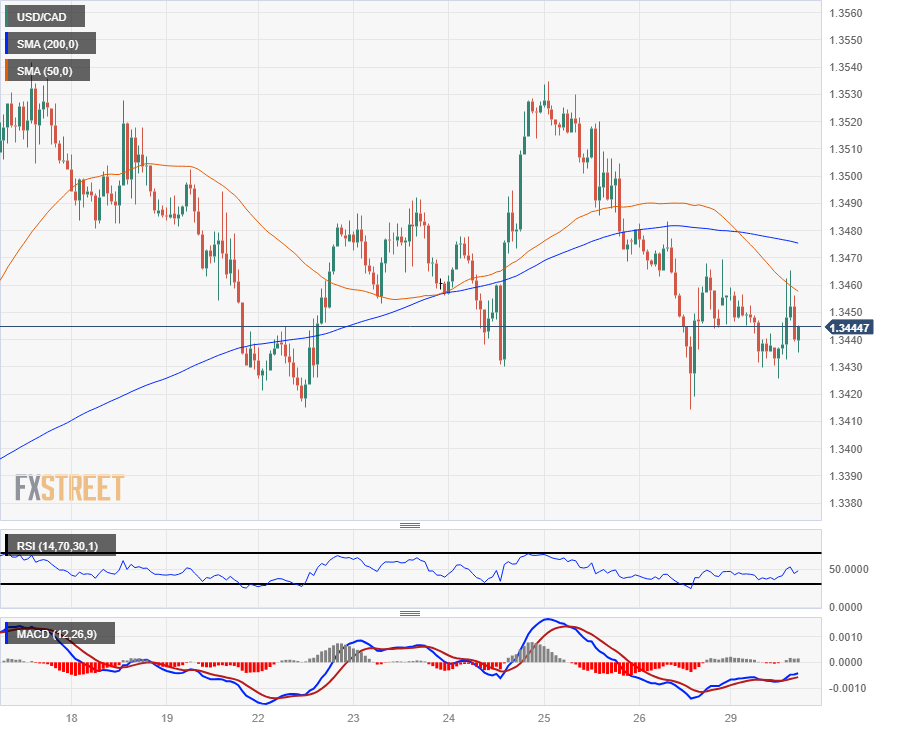
USD/CAD Daily Chart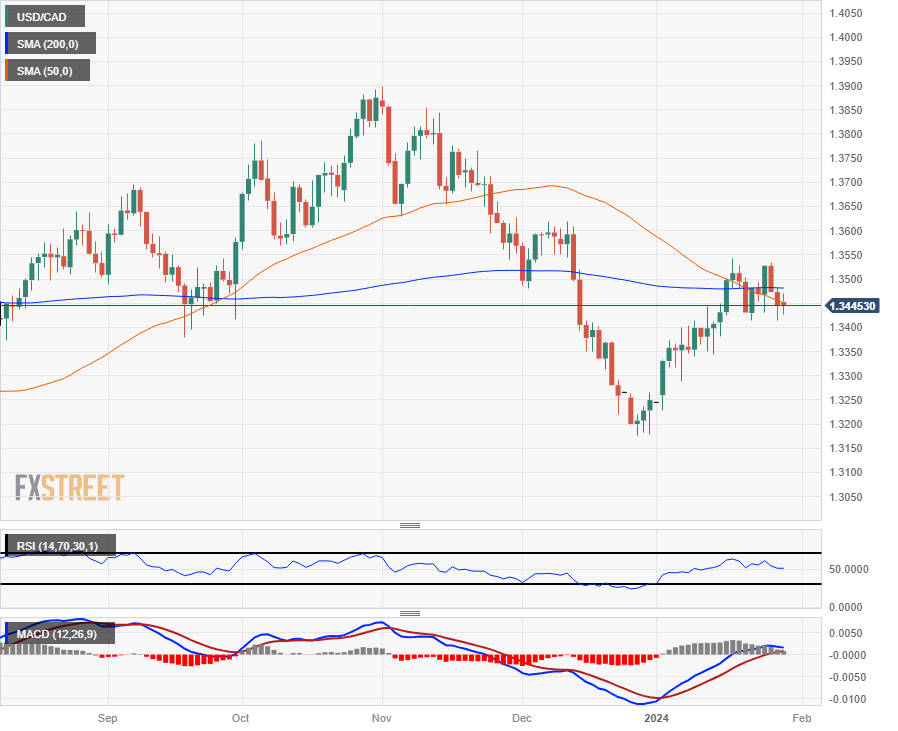
GDP FAQs
What is GDP and how is it recorded?
A country’s Gross Domestic Product (GDP) measures the rate of growth of its economy over a given period of time, usually a quarter. The most reliable figures are those that compare GDP to the previous quarter e.g Q2 of 2023 vs Q1 of 2023, or to the same period in the previous year, e.g Q2 of 2023 vs Q2 of 2022.
Annualized quarterly GDP figures extrapolate the growth rate of the quarter as if it were constant for the rest of the year. These can be misleading, however, if temporary shocks impact growth in one quarter but are unlikely to last all year – such as happened in the first quarter of 2020 at the outbreak of the covid pandemic, when growth plummeted.
How does GDP influence currencies?
A higher GDP result is generally positive for a nation’s currency as it reflects a growing economy, which is more likely to produce goods and services that can be exported, as well as attracting higher foreign investment. By the same token, when GDP falls it is usually negative for the currency.
When an economy grows people tend to spend more, which leads to inflation. The country’s central bank then has to put up interest rates to combat the inflation with the side effect of attracting more capital inflows from global investors, thus helping the local currency appreciate.
How does higher GDP impact the price of Gold?
When an economy grows and GDP is rising, people tend to spend more which leads to inflation. The country’s central bank then has to put up interest rates to combat the inflation. Higher interest rates are negative for Gold because they increase the opportunity-cost of holding Gold versus placing the money in a cash deposit account. Therefore, a higher GDP growth rate is usually a bearish factor for Gold price.
Author

Joshua Gibson
FXStreet
Joshua joins the FXStreet team as an Economics and Finance double major from Vancouver Island University with twelve years' experience as an independent trader focusing on technical analysis.















