Canadian Dollar drops to new twelve-month low as markets pivot ahead of Fed rate call
- Canadian Dollar falls back as broader markets turn into the US Dollar.
- Canada GDP flattens as economy lags, odds of future rate cuts beginning to rise.
- Fed’s Wednesday rate call has markets twisting, USD is Tuesday’s best performer.

The Canadian Dollar (CAD) has seen a quick end to its almost-rally on Monday, getting pushed back down and tipping into a fresh twelve-and-a-half-month low against the US Dollar (USD).
August’s Canada Gross Domestic Product (GDP) printed flat on Tuesday, missing the forecast of 0.1% and holding flat against July as Canadian economic growth stalls out.
Markets are turning broadly risk-off as investors jump back into the USD ahead of Wednesday’s Federal Reserve (Fed) rate call. While no rate moves are expected from the Fed this week, odds are increasing of one last rate hike in December before 2023 closes out.
Daily Digest Market Movers: Canadian Dollar sees an early failure in recovery rally after market sentiment rug pull
- CAD bulls couldn’t extend Monday’s rebound into a second day as broad market risk appetite evaporates.
- USD is the largest market gainer for Tuesday, Dollar Index (DXY) climbs almost a full percent into 106.80 from Tuesday’s bottom of 105.90.
- Canadian GDP came in flat, missing expectations as Canadian manufacturing sectors chalk in a fifth straight month of growth declines, with notable losses in agriculture due to dry conditions in Western Canada.
- Odds of a rate cut in Q2 next year are rising as the Canadian economy shows deeper cracks.
- Fed’s rate call on Wednesday to be the major market focus mid-week, investors beginning to price in one more 25-basis-point rate hike from the FOMC in December.
- Bank of Canada (BoC) Governor Tiff Macklem will be squeaking in under the radar tomorrow, due to finish out day two of testifying before the Canadian government’s banking and finance oversight committee.
- BoC Governor Macklem day one highlights here.
USD/CAD Technical Analysis: Canadian Dollar can’t find strength to fight off US Dollar
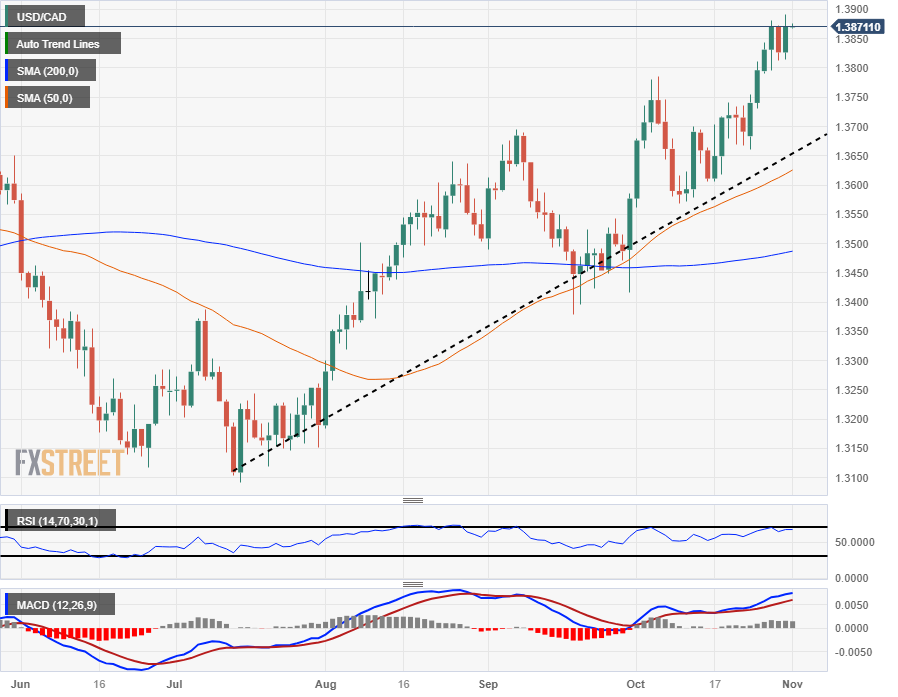
The USD/CAD is heading back toward 1.3900 in Tuesday trading as the US Dollar sees a broad-market resurgence.
The USD/CAD kicked into an intraday low of 1.3813 Tuesday morning before the Greenback came roaring back, sending the USD/CAD into a fresh twelve-and-a-half month high above 1.3880.
The pair is vaulting off the 50-day Simple Moving Average (SMA) lifting into 1.3850, with the 200-day SMA building out a price floor from 1.3770.
Technical resistance to the topside is looking increasingly thin, with the only notable sticking point sitting at 1.3977, 2022’s annual high set back in October of last year.
USD/CAD Daily Chart
Canadian Dollar FAQs
What key factors drive the Canadian Dollar?
The key factors driving the Canadian Dollar (CAD) are the level of interest rates set by the Bank of Canada (BoC), the price of Oil, Canada’s largest export, the health of its economy, inflation and the Trade Balance, which is the difference between the value of Canada’s exports versus its imports. Other factors include market sentiment – whether investors are taking on more risky assets (risk-on) or seeking safe-havens (risk-off) – with risk-on being CAD-positive. As its largest trading partner, the health of the US economy is also a key factor influencing the Canadian Dollar.
How do the decisions of the Bank of Canada impact the Canadian Dollar?
The Bank of Canada (BoC) has a significant influence on the Canadian Dollar by setting the level of interest rates that banks can lend to one another. This influences the level of interest rates for everyone. The main goal of the BoC is to maintain inflation at 1-3% by adjusting interest rates up or down. Relatively higher interest rates tend to be positive for the CAD. The Bank of Canada can also use quantitative easing and tightening to influence credit conditions, with the former CAD-negative and the latter CAD-positive.
How does the price of Oil impact the Canadian Dollar?
The price of Oil is a key factor impacting the value of the Canadian Dollar. Petroleum is Canada’s biggest export, so Oil price tends to have an immediate impact on the CAD value. Generally, if Oil price rises CAD also goes up, as aggregate demand for the currency increases. The opposite is the case if the price of Oil falls. Higher Oil prices also tend to result in a greater likelihood of a positive Trade Balance, which is also supportive of the CAD.
How does inflation data impact the value of the Canadian Dollar?
While inflation had always traditionally been thought of as a negative factor for a currency since it lowers the value of money, the opposite has actually been the case in modern times with the relaxation of cross-border capital controls. Higher inflation tends to lead central banks to put up interest rates which attracts more capital inflows from global investors seeking a lucrative place to keep their money. This increases demand for the local currency, which in Canada’s case is the Canadian Dollar.
How does economic data influence the value of the Canadian Dollar?
Macroeconomic data releases gauge the health of the economy and can have an impact on the Canadian Dollar. Indicators such as GDP, Manufacturing and Services PMIs, employment, and consumer sentiment surveys can all influence the direction of the CAD. A strong economy is good for the Canadian Dollar. Not only does it attract more foreign investment but it may encourage the Bank of Canada to put up interest rates, leading to a stronger currency. If economic data is weak, however, the CAD is likely to fall.
Author

Joshua Gibson
FXStreet
Joshua joins the FXStreet team as an Economics and Finance double major from Vancouver Island University with twelve years' experience as an independent trader focusing on technical analysis.














