Canadian Dollar stumbles further versus Greenback despite above-forecast Retail Sales on Friday
- The Canadian Dollar gives up further ground to the Greenback.
- Canada Retail Sales ease from previous figures but less than expected.
- Next week: Canada & US GDP figures to drive USD/CAD.

The Canadian Dollar (CAD) shed further weight against the US Dollar (USD) on Friday as market participants readjust their Greenback exposure in quiet Friday trading. Investors have pared back nearly all of the gains made during the midweek splurge sparked by rate cut bet hopes after the Federal Reserve (Fed) nodded toward higher odds of rate cuts to come.
Canada revealed a slight slide in Retail Sales figures in January. Fed Chairman Jerome Powell made few waves during his first public appearance since Wednesday’s Federal Open Market Committee (FOMC) press conference. Next week, Gross Domestic Product (GDP) figures from Canada and the US are expected but not until Thursday.
Canadian economic calendar events remain thin on the data docket until then, and next week will close out with another print of the Fed’s preferred inflation gauge, the Personal Consumption Expenditure (PCE) Price Index on Friday.
Daily digest market movers: CAD slips further as Greenback extends
- The Canadian Dollar is down around half of a percent against the US Dollar on Friday.
- Canadian MoM Retail Sales in January declined, but less than expected, printing at -0.3% versus the forecast of -0.4%. Canadian Retail Sales in December grew 0.9%.
- MoM Core Retail Sales, or Retail Sales excluding Automobiles, grew 0.5%, keeping well above the forecast of -0.4% but cooling slightly from the previous month’s 0.6%.
- Fed Chair Powell spoke at a Fed Listens event in Washington, DC. Markets monitored the speech for any qualifications or adjustments to the Fed head’s stance compared to Wednesday’s rate call, but Powell avoided discussing monetary policy.
- Next week:
- Canadian GDP is expected to tick upwards to 0.4% from 0.0%.
- US GDP is expected to stand pat at 3.2% in Q4.
- US (PCE) Price Index is expected to tick down to 0.3% from 0.4% MoM.
US Dollar price today
The table below shows the percentage change of US Dollar (USD) against listed major currencies today. US Dollar was the weakest against the Japanese Yen.
| USD | EUR | GBP | CAD | AUD | JPY | NZD | CHF | |
| USD | 0.50% | 0.48% | 0.54% | 0.82% | -0.17% | 0.85% | 0.12% | |
| EUR | -0.50% | -0.02% | 0.06% | 0.32% | -0.67% | 0.35% | -0.37% | |
| GBP | -0.48% | 0.02% | 0.08% | 0.34% | -0.65% | 0.38% | -0.36% | |
| CAD | -0.56% | -0.06% | -0.07% | 0.28% | -0.73% | 0.29% | -0.43% | |
| AUD | -0.81% | -0.32% | -0.35% | -0.28% | -0.99% | 0.03% | -0.70% | |
| JPY | 0.17% | 0.66% | 0.65% | 0.72% | 0.98% | 1.03% | 0.29% | |
| NZD | -0.86% | -0.36% | -0.39% | -0.29% | -0.02% | -1.02% | -0.73% | |
| CHF | -0.10% | 0.39% | 0.38% | 0.45% | 0.71% | -0.27% | 0.74% |
The heat map shows percentage changes of major currencies against each other. The base currency is picked from the left column, while the quote currency is picked from the top row. For example, if you pick the Euro from the left column and move along the horizontal line to the Japanese Yen, the percentage change displayed in the box will represent EUR (base)/JPY (quote).
Technical analysis: Canadian Dollar gives up against Greenback, slumps back to familiar lows
The Canadian Dollar (CAD) fell into recent lows against the US Dollar on Friday, extending Thursday’s decline as the broader market scooped the safe-haven Greenback up once more after Wednesday’s overly enthusiastic plunge. The USD/CAD pair is back into the 1.3600 region and challenging the week’s technical highs.
USD/CAD is running up against a supply zone between 1.3600 and 1.3620, and the pair has completely pared away the Greenback’s midweek plunge, climbing nearly 1.2% bottom-to-top from Thursday’s early bottom bids of 1.3451. Despite consolidation, USD/CAD is on pace to set fresh highs for 2024 north of 1.3613, the fresh high set early this week.
USD/CAD continues to churn close to the 200-day Simple Moving Average (SMA) near 1.3488, and bidders will be looking to price in a technical floor from the 1.3500 handle. On the downside, the last swing low into 1.3450 will be the level to beat for short sellers looking to force the Greenback lower once more.
USD/CAD hourly chart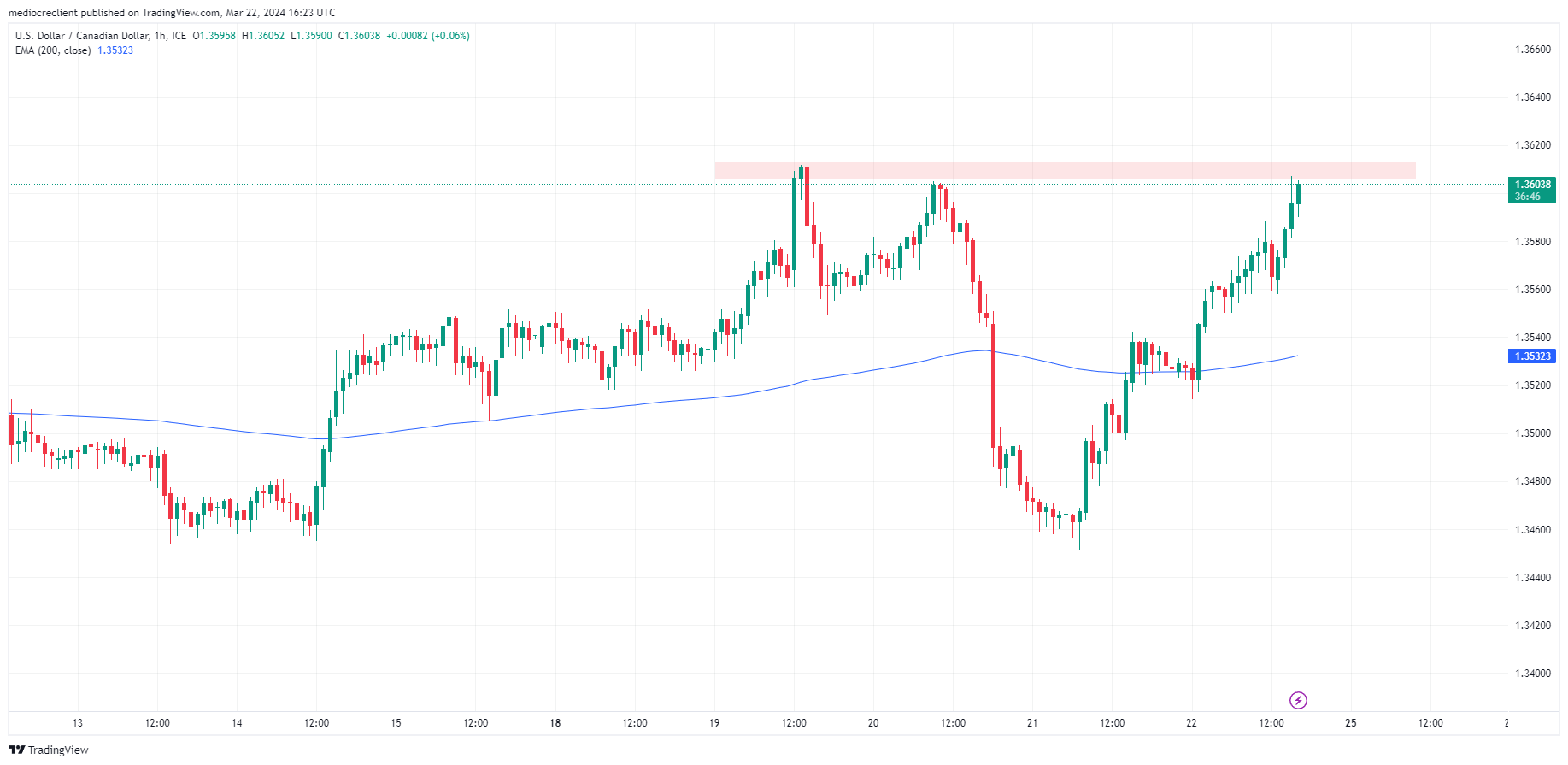
USD/CAD daily chart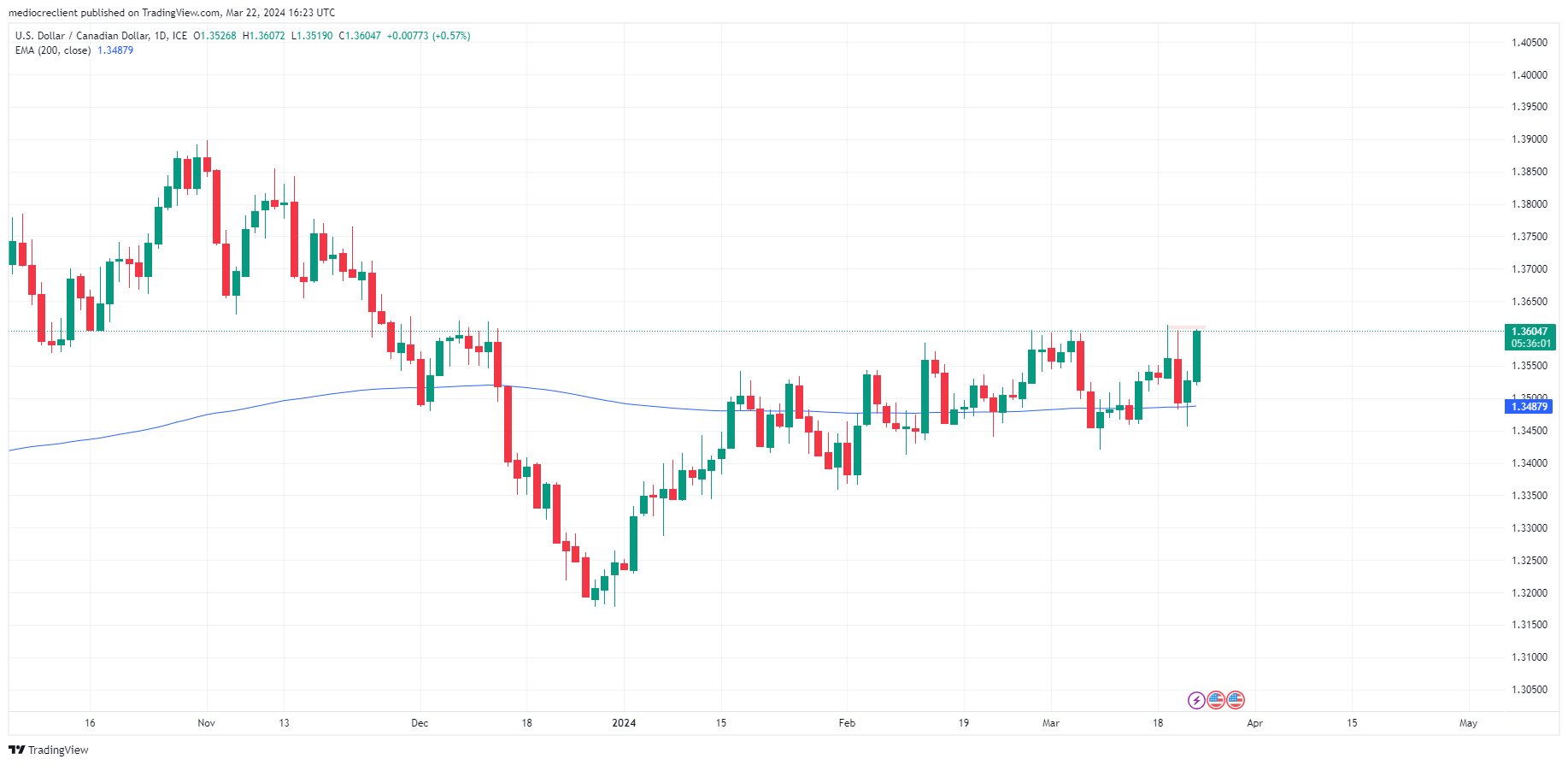
Risk sentiment FAQs
In the world of financial jargon the two widely used terms “risk-on” and “risk off'' refer to the level of risk that investors are willing to stomach during the period referenced. In a “risk-on” market, investors are optimistic about the future and more willing to buy risky assets. In a “risk-off” market investors start to ‘play it safe’ because they are worried about the future, and therefore buy less risky assets that are more certain of bringing a return, even if it is relatively modest.
Typically, during periods of “risk-on”, stock markets will rise, most commodities – except Gold – will also gain in value, since they benefit from a positive growth outlook. The currencies of nations that are heavy commodity exporters strengthen because of increased demand, and Cryptocurrencies rise. In a “risk-off” market, Bonds go up – especially major government Bonds – Gold shines, and safe-haven currencies such as the Japanese Yen, Swiss Franc and US Dollar all benefit.
The Australian Dollar (AUD), the Canadian Dollar (CAD), the New Zealand Dollar (NZD) and minor FX like the Ruble (RUB) and the South African Rand (ZAR), all tend to rise in markets that are “risk-on”. This is because the economies of these currencies are heavily reliant on commodity exports for growth, and commodities tend to rise in price during risk-on periods. This is because investors foresee greater demand for raw materials in the future due to heightened economic activity.
The major currencies that tend to rise during periods of “risk-off” are the US Dollar (USD), the Japanese Yen (JPY) and the Swiss Franc (CHF). The US Dollar, because it is the world’s reserve currency, and because in times of crisis investors buy US government debt, which is seen as safe because the largest economy in the world is unlikely to default. The Yen, from increased demand for Japanese government bonds, because a high proportion are held by domestic investors who are unlikely to dump them – even in a crisis. The Swiss Franc, because strict Swiss banking laws offer investors enhanced capital protection.
Author

Joshua Gibson
FXStreet
Joshua joins the FXStreet team as an Economics and Finance double major from Vancouver Island University with twelve years' experience as an independent trader focusing on technical analysis.