|

Brent Price Analysis: Oil hits two-month high

  • Brent hits over a two-month high price of $44 per barrel. 
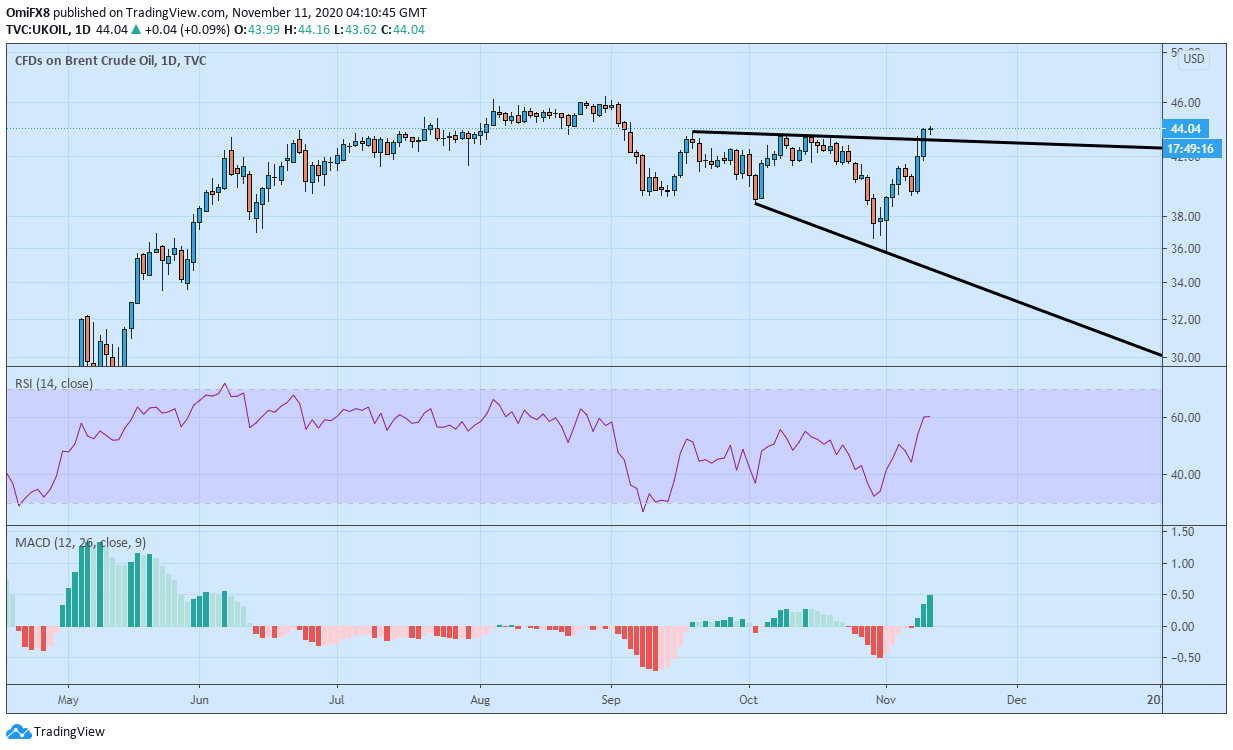
  • The daily chart shows a bullish channel breakout. 

Oil prices reached two-month highs a few minutes before the press time, extending the weekly gain on optimism generated by the US drugmaker Pfizer's disclosure of positive results of its coronavirus vaccine. 

Brent crude rose to $44.16, the highest level since Sept. 4. 

The move comes a day after the black gold advanced 4.76%, confirming an upside break of the channel pattern represented by trendlines Sept. 18 and Oct. 9 highs and Oct. 2 and Nov. 2 low and opening the doors for a re-test of the Aug. 31 high of $46.50. 

The breakout is backed by an above-50 or bullish reading on the 14-day relative strength index. Further, the MACD histogram is printing higher bars above the zero line, indicating a strengthening of the upward momentum. 

The bullish bias would be invalidated if oil ends Wednesday below $41.72 (Tuesday's low). 

Daily chart
Trend: Bullish

Technical levels

Brent Oil

Overview
Today last price44.16
Today Daily Change0.50
Today Daily Change %1.14
Today daily open43.72
 
Trends
Daily SMA2041.37
Daily SMA5041.75
Daily SMA10042.89
Daily SMA20040.54
 
Levels
Previous Daily High43.82
Previous Daily Low41.96
Previous Weekly High41.64
Previous Weekly Low35.85
Previous Monthly High43.76
Previous Monthly Low37.31
Daily Fibonacci 38.2%43.11
Daily Fibonacci 61.8%42.67
Daily Pivot Point S142.51
Daily Pivot Point S241.3
Daily Pivot Point S340.64
Daily Pivot Point R144.37
Daily Pivot Point R245.03
Daily Pivot Point R346.24

Author

Omkar Godbole

Omkar Godbole

FXStreet Contributor

Omkar Godbole, editor and analyst, joined FXStreet after four years as a research analyst at several Indian brokerage companies.


More from Omkar Godbole
Share:

Editor's Picks

GBP/USD flirts with weekly highs in the Fed's aftermath

GBP/USD reversed early losses following the Federal Reserve decision to keep rates on hold and neared the 1.3360 level before shedding some ground. Focus shifts to Governor Kevin Warsh's speech, while the Bank of England will announce its monetary policy decision on Thursday.

EUR/USD extends rally pass 1.1450 on Fed's Warsh

EUR/USD trades at fresh weekly highs above 1.1450, following the Federal Reserve monetary policy decision to keep interest rates on hold. The statement showed policymakers remain confident in economic progress while blaming inflation on energy prices. The divided vote among officials put in doubt a September hike, leading to sharp US Dollar losses.

Gold  hovers around $4,100 as Fed decision hits the USD

Gold surged following the Federal Reserve's decision to keep the benchmark interest rate unchanged at 3.50%-3.75%. Policymakers noted that inflation remains elevated and that economic activity is expanding at a solid pace despite elevated uncertainty, spurring doubts about a rate hike in September. XAU/USD peaked above $4,100, now battling to retain the level.

No soft target: Warsh vows to return inflation to 2%
The Fed left interest rates unchanged at 3.50%-3.75%, but the decision carried a distinctly hawkish edge as three officials voted for an immediate 25-basis-point increase. Chair Kevin Warsh reinforced that message, insisting there was no tolerance for a softer inflation target and warning that the Fed would not hesitate to act.
How the CLARITY Act unlocks Wall Street’s tokenization pipeline
The United States (US) Digital Asset Market Clarity Act (CLARITY Act), awaiting a full Senate floor vote, promises to unlock Wall Street’s potential to tokenize financial assets, including equities, US Treasuries, private credit, real estate and commodities at a scale that could supercharge the real-world asset (RWA) market from the current $17 billion level to $5.5 trillion by 2030, according to
US Dollar mid-year outlook: Exceptional currency, exceptional risks?
The US Dollar enters the second half of 2026 in a markedly different position from a year ago. The King currency has recovered, reflecting persistent US inflation, changing expectations for Fed policy, geopolitical tensions and renewed demand for defensive assets.















