|

BABA Stock Price: Alibaba edges higher as investors move on from cloud software bug

  • NYSE:BABA gained 0.72% during Thursday’s trading session.
  • AliBaba admitted it was slow to react to cloud services bugs.
  • JD.Com tumbled as Tencent slashed its stake in the eCommerce site.

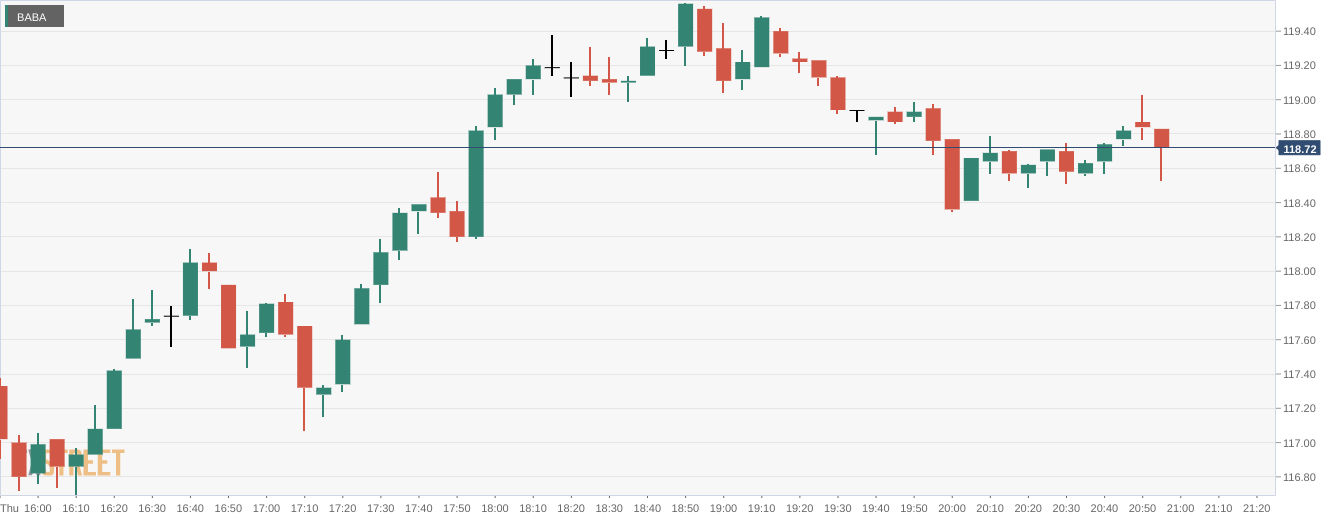
NYSE:BABA managed to close out the week in the green as Santa paid a visit to the struggling Chinese tech giant a couple days early. Shares of BABA gained 0.72% on Thursday and closed the trading day at $118.66. The stock has been under heavy pressure as it sinks back down towards its 52-week low price of $108.70. US markets entered the Christmas break on a bullish note as all three major indices climbed higher for the third straight session. In particular, the tech-heavy NASDAQ led the major indices with a gain of 0.85%, while the S&P 500 closed at a record high as investors shrugged off the recent fears of the Omicron variant.


Stay up to speed with hot stocks' news!


AliBaba made some headlines earlier this week when the Ministry of Industry and Information Technology suspended its use of AliBaba’s cloud services platform. The resulting software bug was found by a third party user and not by AliBaba itself. On Thursday, AliBaba admitted it was slow to act on the software glitch that has cost them a government partnership. The bug is just another in a series of issues between the Chinese government and AliBaba in 2021 that has severely fractured the relationship between the two sides.

BABA forecast
Baba Stock

One of AliBaba’s closest domestic rivals, JD.Com (NASDAQ:JD) received some disappointing news on Thursday. The company is losing one of its earliest investors: the Chinese tech conglomerate Tencent. It was reported that Tencent will be distributing 86% of its shares of JD.Com to Tencent shareholders as a special dividend. Tencent will also unlikely be providing further capital to JD.Com in the future, as Tencent stated it is more interested in helping startup companies. Shares of JD.Com fell by 6.92% on Thursday.


Like this article? Help us with some feedback by answering this survey:

Author

More from Stocks Reporter
Share:

Editor's Picks

GBP/USD defends 1.3300 after strong UK PMI data

Following Thursday's sharp decline, GBP/USD clings to small gains above 1.3300 in the American session on Friday, supported by the upbeat UK Retail Sales and July PMI data. Nevertheless, the pair's upside remains capped as investors cling to a cautious stance amid a further escalation of tensions in the Middle East. The US July PMI data failed to trigger relevant price action.

EUR/USD remains below 1.1400 after mixed US PMIs

EUR/USD pressures daily lows below the 1.1400 mark in the American session on Friday. Mixed S&P Global PMIs, as manufacturing output contracted while services activity expanded in July, triggered no relevant market reaction. The focus remains in Middle East developments and inflation-related concerns.

Gold holds above $4,050 but momentum still missing

Gold builds on its modest intraday bounce and climbs above the $4,050 level on Friday, hitting a fresh daily high amid a modest US Dollar pullback. The fundamental backdrop, however, warrants some caution before confirming that the pullback from an over two-week high, touched on Wednesday, has run its course and positioning for any meaningful upside.

Ethereum: Derivatives interest in ETH improves, but signs of caution remain

Ethereum is hovering slightly below the $1,900 level, down 3% on Thursday following a slight expansion in derivatives interest. The top altcoin's open interest has increased to 14.60 million ETH, marking a 600K ETH increase over the past two days and its highest level since June 7.

XRP retreats as ETF interest cools
Ripple (XRP) slides toward the short-term $1.10 support on Friday, as broader crypto market sentiment weighs on crypto assets. The sell-off mainly stems from fears of inflation in the United States (US) amid the ongoing war in the Middle East and rising Oil prices.
US Dollar mid-year outlook: Exceptional currency, exceptional risks?
The US Dollar enters the second half of 2026 in a markedly different position from a year ago. The King currency has recovered, reflecting persistent US inflation, changing expectations for Fed policy, geopolitical tensions and renewed demand for defensive assets.