Australian Dollar maintains position above the major level ahead of US PMI data
- Australian Dollar extends gains as the US Dollar declines.
- Australia’s Manufacturing PMI eased to 48.0, while the Services PMI dropped to 47.6.
- China may approve over 1 trillion yuan in additional sovereign debt issuance.
- US Treasury Department confirmed the meeting with China to discuss bilateral economic policy matters.
- RBA Governor Bullock said that the board can raise interest rates if inflation revises upward.

The Australian Dollar (AUD) trades in the positive territory on Tuesday, extending its gains for the second successive day. The AUD/USD pair receives upward support due to the correction in the US Dollar (USD), which could be attributed to the downbeat US Treasury yields.
Australia’s preliminary S&P Global Manufacturing and Services PMI for October eased, suggesting a contraction in both the manufacturing and services sectors. Market participants await the Aussie Consumer Price Index (CPI) data to be released on Wednesday, seeking further cues on the inflationary outlook.
RBA Governor Michele Bullock, speaking at the Commonwealth Bank of Australia Global Markets Conference in Sydney on Tuesday, emphasized the commitment to bringing inflation to the target within a reasonable timeframe. While suggesting that the current cash rate might be sufficient for this purpose, Bullock acknowledged the potential risks of inflation returning to the target more gradually than anticipated. The board maintains a low tolerance for such deviations and stands ready to raise rates if there's a significant upward revision to the inflation outlook.
US Treasury Department officially confirmed on Tuesday that the first meeting of the economic working group between the United States and China took place. This working group serves as a platform for discussing bilateral economic policy matters. According to the Treasury Department's statement, the US and Chinese delegations convened virtually, engaging in a productive and substantive discussion on both domestic and global macroeconomic developments.
China is reportedly planning to approve slightly over 1 trillion yuan in additional sovereign debt issuance, as per a Reuters report citing three unnamed sources. The move is part of the Chinese Communist Party's efforts to increase infrastructure spending and stimulate economic growth. The standing committee of the National People's Congress (NPC) is expected to give the green light for the extra debt issuance on the final day of a meeting.
The US Dollar Index (DXY) seems set to extend its four-day losing streak, possibly influenced by downbeat US Treasury yields. After reaching its highest point since 2007, the 10-year Treasury yield took a U-turn, leading to a bit of selling pressure on the US Dollar (USD).
As per the CME FedWatch Tool, the likelihood of a November rate hike isn't perceived by the markets. However, the odds for January 2024 still hover above 30%.
Daily Digest Market Movers: Australian Dollar extends its gains despite downbeat PMI data
- Australian S&P Global Composite PMI for October declined to 47.3 from the previous reading of 51.5. Manufacturing PMI eased to 48.0 compared to the prior figure of 48.7, while the Services PMI fell back into contraction, dropping to 47.6 from the previous month's reading of 51.8.
- Westpac's Chief Economist, Luci Ellis stated in a note that the core view presented that the Consumer Price Index (CPI) is expected to continue tracking lower and return to the RBA’s 2-3 percent target band in 2025, aligning with the central bank’s own expectations.
- Ellis highlighted several broader risks to the economy and inflation outlook that are being closely monitored. These include the resurgence of housing prices to levels close to pre-pandemic peaks, a global rise in bond yields, and China's slower-than-expected recovery from a prolonged period of COVID-related lockdowns.
- Australia's Unemployment Rate for September surprised on the positive side, coming in at 3.6% compared to the expectations of 3.7%, which was expected to remain consistent.
- Australian Employment Change for the same month was 6.7K, falling short of the consensus forecast of 20K. This is a notable decline from the 64.9K jobs added in August.
- Australia's central bank expresses heightened concern about the inflation impact stemming from supply shocks. Governor of the Reserve Bank of Australia, Michele Bullock stated that if inflation persists above projections, the RBA will take responsive policy measures. There is an observable deceleration in demand, and per capita consumption is on the decline.
- China is set to host a significant financial policy meeting early next week, occurring once every five years. The primary objectives of this gathering are to proactively address and mitigate risks and to establish medium-term priorities for the expansive $61 trillion financial industry.
- Atlanta Fed President Raphael Bostic said on Friday that he believes the US central bank is unlikely to lower interest rates before the middle of next year. Fed Philadelphia President Patrick Harker reiterated his inclination to maintain interest rates.
- Fed Cleveland President Loretta Mester indicated that the US central bank is "at or near the peak of the rate hike cycle." However, Mester acknowledged that the data released during the previous week could influence the central bank's decision regarding the future of monetary policy.
- The 10-year Treasury yield surged to 5.02%, marking its first time at such levels since 2007. However, it promptly reversed direction, declining to 4.81% by the press time.
- Market participants will closely monitor the US S&P Global PMI on Tuesday, the Q3 Gross Domestic Product (GDP) on Thursday, and the Core Personal Consumption Expenditures (PCE) on Friday.
Technical Analysis: Australian Dollar hovers above 14-day EMA lined up with 0.6350 major level
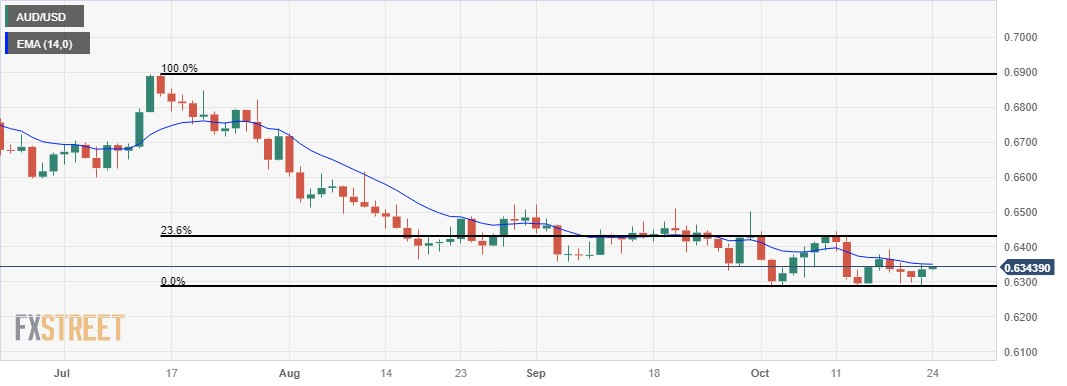
The Australian Dollar hovers around the 14-day Exponential Moving Average (EMA) at 0.6349, following a major resistance at the 0.6400 level. A breakthrough above this resistance holds the potential to reach around the 23.6% Fibonacci retracement level at 0.6429. On the downside, the notable support emerges at the 0.6300 level followed by the monthly low at 0.6285.
AUD/USD: Daily Chart
Australian Dollar price today
The table below shows the percentage change of Australian Dollar (AUD) against listed major currencies today. Australian Dollar was the strongest against the Euro.
| USD | EUR | GBP | CAD | AUD | JPY | NZD | CHF | |
| USD | 0.15% | 0.03% | 0.00% | -0.51% | -0.23% | -0.20% | 0.10% | |
| EUR | -0.15% | -0.12% | -0.15% | -0.67% | -0.38% | -0.36% | -0.06% | |
| GBP | 0.03% | 0.18% | 0.03% | -0.49% | -0.21% | -0.18% | 0.12% | |
| CAD | 0.00% | 0.15% | -0.03% | -0.54% | -0.24% | -0.20% | 0.08% | |
| AUD | 0.54% | 0.69% | 0.57% | 0.54% | 0.30% | 0.33% | 0.63% | |
| JPY | 0.23% | 0.38% | 0.20% | 0.23% | -0.34% | 0.03% | 0.31% | |
| NZD | 0.18% | 0.36% | 0.17% | 0.20% | -0.34% | -0.03% | 0.28% | |
| CHF | -0.08% | 0.07% | -0.05% | -0.07% | -0.60% | -0.31% | -0.28% |
The heat map shows percentage changes of major currencies against each other. The base currency is picked from the left column, while the quote currency is picked from the top row. For example, if you pick the Euro from the left column and move along the horizontal line to the Japanese Yen, the percentage change displayed in the box will represent EUR (base)/JPY (quote).
Economic Indicator
Australia Consumer Price Index (YoY)
The Consumer Price Index released by the RBA and republished by the Australian Bureau of Statistics is a measure of price movements by the comparison between the retail prices of a representative shopping basket of goods and services . The purchase power of AUD is dragged down by inflation. The CPI is a key indicator to measure inflation and changes in purchasing trends. A high reading is seen as positive (or bullish) for the AUD, while a low reading is seen as negative (or Bearish).
Read more.Why it matters to traders
The quarterly Consumer Price Index (CPI) published by the Australian Bureau of Statistics (ABS) has a significant impact on the market and the AUD valuation. The gauge is closely watched by the Reserve Bank of Australia (RBA), in order to achieve its inflation mandate, which has major monetary policy implications. Rising consumer prices tend to be AUD bullish, as the RBA could hike interest rates to maintain its inflation target. The data is released nearly 25 days after the quarter ends.
Author

Akhtar Faruqui
FXStreet
Akhtar Faruqui is a Forex Analyst based in New Delhi, India. With a keen eye for market trends and a passion for dissecting complex financial dynamics, he is dedicated to delivering accurate and insightful Forex news and analysis.