Australian Dollar rises as US Dollar depreciates ahead of ISM Manufacturing PMI
- The Australian Dollar advances as the US Dollar may struggle due to rising economic concerns in the US.
- ANZ Job Advertisements fell by 1.2% in May, deepening from a revised 0.3% fall in April.
- Trump plans to increase import tariffs on steel and aluminum to 50% from 25%.

The Australian Dollar (AUD) appreciated against the US Dollar (USD) by over 0.50% on Monday. The AUD/USD pair rises as the Greenback faces challenges amid growing concerns regarding slow growth and renewed inflation in the United States (US). US President Donald Trump threatened to double import tariffs on steel and aluminum, increasing them to 50% from 25%.
ANZ Job Advertisements declined by 1.2% in May, following a revised 0.3% fall in the previous month. The Australian job ads drop for the second consecutive month. Moreover, S&P Global Manufacturing Purchasing Managers’ Index (PMI) declined to 51.0 in May from 51.7 prior, dropping for the second straight month to the lowest level since February.
In responding to US accusations of China not reducing tariffs as agreed, a spokesperson from China’s Ministry of Commerce said on Monday that China had complied with the agreement by cancelling or suspending relevant tariff and non-tariff measures aimed at US "reciprocal tariffs."
The AUD holds ground following the mixed Chinese Manufacturing Purchasing Managers’ Index (PMI) data released on Saturday. The National Bureau of Statistics (NBS) showed that China’s Manufacturing PMI rose to 49.5 in May, from April’s 49.0 reading. Meanwhile, the Non-Manufacturing PMI declined to 50.3 from the previous 50.4 figure, falling short of the expected reading of 50.6. The Aussie Dollar could be impacted by Chinese economic data as both countries are close trading partners.
Australian Dollar advances amid rising concerns over US growth, inflation
- The US Dollar Index (DXY), which measures the value of the Greenback against six major currencies, is trading lower near 98.80 at the time of writing. Traders seek fresh cues from the release of the US ISM Manufacturing Purchasing Managers' Index (PMI) for May, which is due later in the North American session.
- US President Donald Trump said at a rally in Pennsylvania on Friday that he planned to double import tariffs on steel and aluminum to build up pressure on global steel producers and intensify the trade war. "We are going to be imposing a 25% increase. We're going to bring it from 25% to 50% - the tariffs on steel into the United States of America, which will even further secure the steel industry in the United States," he said, per Reuters.
- A three-judge panel at the Court of International Trade in Manhattan halted US President Donald Trump from imposing "Liberation Day" tariffs from taking effect. The federal court found that Trump exceeded his authority in imposing broad import tariffs and declared the executive orders issued on April 2 unlawful. However, the US Court of Appeals for the Federal Circuit in Washington, on Thursday, temporarily allowed Trump's tariffs to take effect.
- On Friday, Trump accused China of breaching a truce on tariffs reached earlier this month. Washington and Beijing agreed to temporarily lower reciprocal tariffs in a meeting in Geneva. Trump said that China had "totally violated its agreement with us". US Trade Representative Jamieson Greer also said that China had failed to remove non-tariff barriers as agreed.
- Securities Times in China reports that analysts believe that the People’s Bank of China (PBoC) may boost Pledged Supplementary Lending (PSL). This move would provide low-cost, long-term funding to policy banks, which in turn support government-prioritized sectors, such as housing, urban redevelopment, and major infrastructure projects.
- Australia’s seasonally adjusted Retail Sales declined by 0.1% month-over-month in April, against the expectations of remaining consistent at 0.3% growth. Meanwhile, the monthly Building Permits fell by 5.7%, against the expected increase of 3.1%.
- The Reserve Bank of Australia (RBA) is expected to deliver more rate cuts in the upcoming policy meetings. The central bank acknowledged progress in curbing inflation and warned that US-China trade barriers pose downside risks to economic growth. Governor Michele Bullock stated that the RBA is prepared to take additional action if the economic outlook deteriorates sharply, raising the prospect of future rate cuts.
Australian Dollar rebounds from 0.6450 support near nine-day EMA
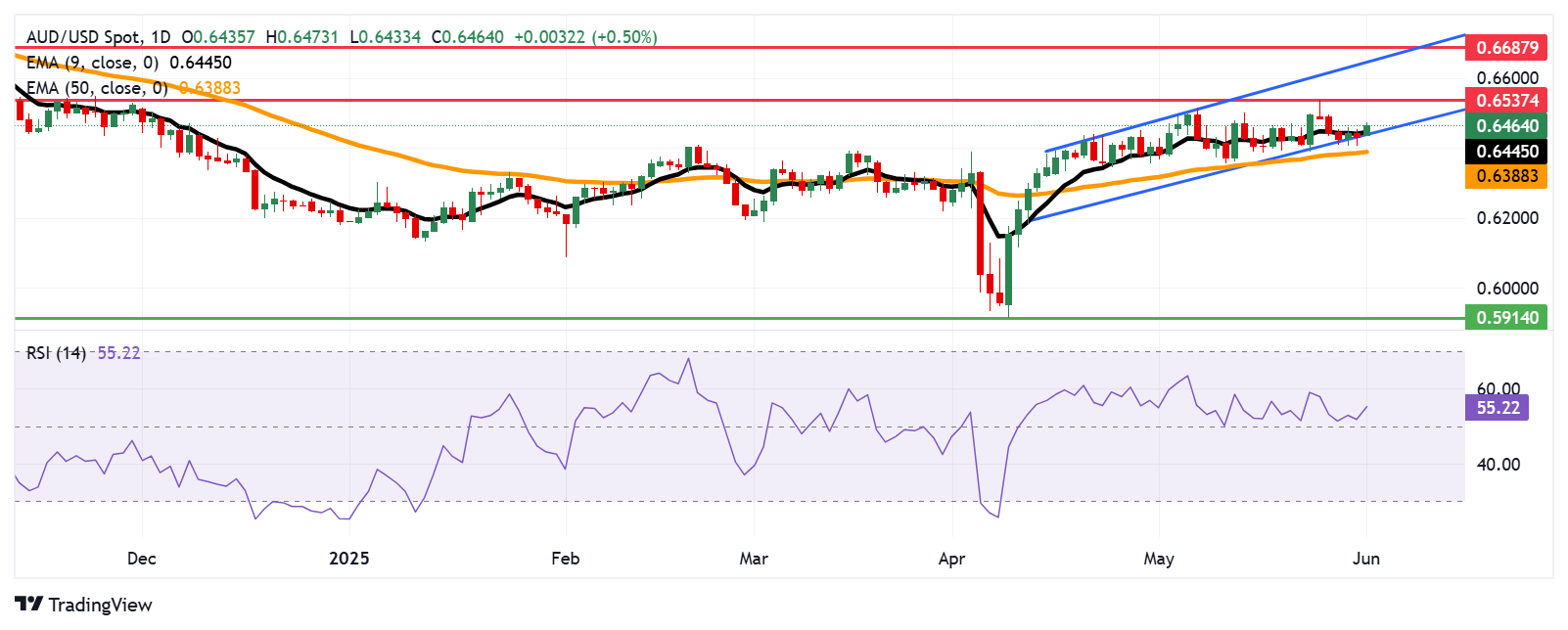
AUD/USD is trading around 0.6460 on Monday, indicating a strengthening bullish bias. The technical analysis of the daily chart suggests that the pair is stepping up within the ascending channel pattern. The short-term price momentum strengthens as the pair moves above the nine-day Exponential Moving Average (EMA). Additionally, the 14-day Relative Strength Index (RSI) is rising above the 50 mark, suggesting a persistent bullish bias.
The AUD/USD pair could target the initial barrier at 0.6537, a seven-month high recorded on May 26. A break above this crucial resistance zone could reinforce the bullish bias and support the pair to explore the region around the upper boundary of the ascending channel around 0.6650.
On the downside, the immediate support appears at the nine-day EMA of 0.6445, aligned with the ascending channel’s lower boundary around 0.6440. A break below this crucial support zone could weaken the bullish bias and lead the AUD/USD pair to test the 50-day EMA at 0.6388.
AUD/USD: Daily Chart
Australian Dollar PRICE Today
The table below shows the percentage change of Australian Dollar (AUD) against listed major currencies today. Australian Dollar was the strongest against the US Dollar.
| USD | EUR | GBP | JPY | CAD | AUD | NZD | CHF | |
|---|---|---|---|---|---|---|---|---|
| USD | -0.60% | -0.59% | -0.59% | -0.39% | -0.68% | -0.90% | -0.52% | |
| EUR | 0.60% | -0.00% | 0.02% | 0.19% | -0.07% | -0.34% | 0.07% | |
| GBP | 0.59% | 0.00% | 0.02% | 0.20% | -0.07% | -0.33% | 0.07% | |
| JPY | 0.59% | -0.02% | -0.02% | 0.20% | -0.10% | -0.34% | -0.03% | |
| CAD | 0.39% | -0.19% | -0.20% | -0.20% | -0.28% | -0.53% | -0.13% | |
| AUD | 0.68% | 0.07% | 0.07% | 0.10% | 0.28% | -0.20% | 0.22% | |
| NZD | 0.90% | 0.34% | 0.33% | 0.34% | 0.53% | 0.20% | 0.40% | |
| CHF | 0.52% | -0.07% | -0.07% | 0.03% | 0.13% | -0.22% | -0.40% |
The heat map shows percentage changes of major currencies against each other. The base currency is picked from the left column, while the quote currency is picked from the top row. For example, if you pick the Australian Dollar from the left column and move along the horizontal line to the US Dollar, the percentage change displayed in the box will represent AUD (base)/USD (quote).
Australian Dollar FAQs
One of the most significant factors for the Australian Dollar (AUD) is the level of interest rates set by the Reserve Bank of Australia (RBA). Because Australia is a resource-rich country another key driver is the price of its biggest export, Iron Ore. The health of the Chinese economy, its largest trading partner, is a factor, as well as inflation in Australia, its growth rate and Trade Balance. Market sentiment – whether investors are taking on more risky assets (risk-on) or seeking safe-havens (risk-off) – is also a factor, with risk-on positive for AUD.
The Reserve Bank of Australia (RBA) influences the Australian Dollar (AUD) by setting the level of interest rates that Australian banks can lend to each other. This influences the level of interest rates in the economy as a whole. The main goal of the RBA is to maintain a stable inflation rate of 2-3% by adjusting interest rates up or down. Relatively high interest rates compared to other major central banks support the AUD, and the opposite for relatively low. The RBA can also use quantitative easing and tightening to influence credit conditions, with the former AUD-negative and the latter AUD-positive.
China is Australia’s largest trading partner so the health of the Chinese economy is a major influence on the value of the Australian Dollar (AUD). When the Chinese economy is doing well it purchases more raw materials, goods and services from Australia, lifting demand for the AUD, and pushing up its value. The opposite is the case when the Chinese economy is not growing as fast as expected. Positive or negative surprises in Chinese growth data, therefore, often have a direct impact on the Australian Dollar and its pairs.
Iron Ore is Australia’s largest export, accounting for $118 billion a year according to data from 2021, with China as its primary destination. The price of Iron Ore, therefore, can be a driver of the Australian Dollar. Generally, if the price of Iron Ore rises, AUD also goes up, as aggregate demand for the currency increases. The opposite is the case if the price of Iron Ore falls. Higher Iron Ore prices also tend to result in a greater likelihood of a positive Trade Balance for Australia, which is also positive of the AUD.
The Trade Balance, which is the difference between what a country earns from its exports versus what it pays for its imports, is another factor that can influence the value of the Australian Dollar. If Australia produces highly sought after exports, then its currency will gain in value purely from the surplus demand created from foreign buyers seeking to purchase its exports versus what it spends to purchase imports. Therefore, a positive net Trade Balance strengthens the AUD, with the opposite effect if the Trade Balance is negative.
Author

Akhtar Faruqui
FXStreet
Akhtar Faruqui is a Forex Analyst based in New Delhi, India. With a keen eye for market trends and a passion for dissecting complex financial dynamics, he is dedicated to delivering accurate and insightful Forex news and analysis.

















