Australian Dollar struggles due to dovish RBA, US Dollar remains firmer
- The Australian Dollar lost ground after the RBA’s policy decision to keep its interest rate unchanged.
- The Australian Central Bank maintained its forward guidance of "not ruling anything in or out."
- The US Dollar appreciated due to sentiment of the Fed prolonging higher interest rates.

The Australian Dollar (AUD) has plunged following the Reserve Bank of Australia (RBA)'s decision to maintain its interest rate at 4.35% on Tuesday. Investor sentiment leaned toward a potentially more hawkish stance from the RBA, particularly after last week's inflation data surpassed expectations. However, the RBA acknowledged that recent advancements in curbing inflation have halted, maintaining its forward guidance of "not ruling anything in or out."
The Australian monthly inflation surged in March, contrary to market expectations of stagnation. Additionally, the RBA Governor Michele Bullock emphasized the importance of remaining vigilant regarding inflation risks. Bullock believes that current interest rates are appropriately set to steer inflation back towards its target range of 2-3% in the second half of 2025 and to the midpoint in 2026.
The US Dollar Index (DXY), which gauges the performance of the US Dollar (USD) against six major currencies, gains ground due to the sentiment of the Federal Reserve’s (Fed) maintaining higher interest rates for longer. Additionally, the hawkish comments from Minneapolis Fed President Neel Kashkari have bolstered the US Dollar, consequently weakening the AUD/USD pair.
President Kashkari indicated that the prevailing expectation is for rates to stay steady for a considerable duration. Although the likelihood of rate hikes is minimal, it's not entirely dismissible, as per a Reuters report.
Daily Digest Market Movers: Australian Dollar depreciates due to dovish RBA
- Australia's 10-year government bond yield dipped toward 4.3%, marking its lowest point in a fortnight. This decline occurred as the RBA opted to keep the cash rate unchanged. The absence of any overtly hawkish signals, which many market participants were expecting, contributed to the subdued reaction.
- The ASX 200 Index extended its upward trend for the fifth consecutive session following the Reserve Bank of Australia's less hawkish stance after the Tuesday policy decision. Significant increases were observed among key players in the index, including Commonwealth Bank, Wesfarmers, and Woodside Energy.
- Societe Generale has released a note regarding the Reserve Bank of Australia, emphasizing their view that the RBA's optimism regarding economic growth is misplaced. The institution anticipates a downturn in economic growth in Australia, with the potential for surprises on the downside. They attribute this forecast partly to the prevalent effects of RBA rate hikes filtering into the economy.
- The latest US Nonfarm Payrolls report highlights a notable deceleration from the robust pace seen in the first quarter, falling short of the average monthly increase observed over the past year.
- The Judo Bank Australia Composite Purchasing Managers Index (PMI) declined in April, indicating a slightly slower growth in Australian private sector output. The growth in business activity was mainly confined to the service sector while manufacturing output continued to decrease.
- According to forecasts by analysts at Commonwealth Bank and Westpac, the RBA’s interest rate is expected to peak at its highest point at 4.35% in November 2023, then decrease to 3.10% by December 2025.
Technical Analysis: Australian Dollar moves below 0.6600
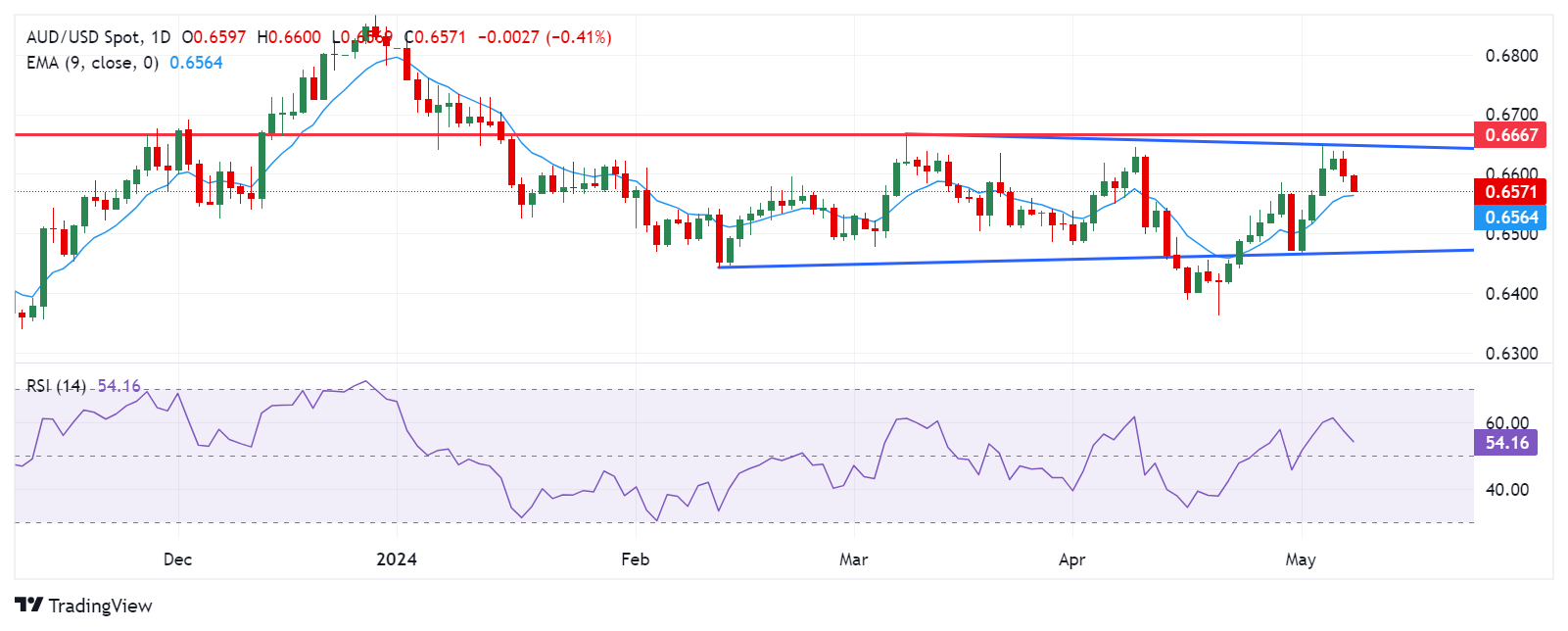
The Australian Dollar trades around 0.6570 on Wednesday. The pair consolidates within a symmetrical triangle pattern, with the 14-day Relative Strength Index (RSI) above the 50-level, suggesting a bullish bias.
The AUD/USD pair could potentially find the barrier at the psychological level of 0.6600, followed by the upper boundary near the major support level of 0.6650. A breakthrough above this level might prompt the pair to revisit March’s high of 0.6667, followed by the psychological level of 0.6700.
On the downside, the AUD/USD pair may encounter immediate support at the nine-day Exponential Moving Average (EMA) at 0.6564. If the pair breaks below the EMA, it could face further pressure to navigate the region around the lower boundary of the symmetrical triangle around the level of 0.6465.
AUD/USD: Daily Chart
Australian Dollar price this week
The table below shows the percentage change of the Australian Dollar (AUD) against listed major currencies this week. The Australian Dollar was the weakest against the US Dollar.
| USD | EUR | GBP | CAD | AUD | JPY | NZD | CHF | |
| USD | 0.16% | 0.43% | 0.45% | 0.47% | 1.06% | 0.26% | 0.35% | |
| EUR | -0.17% | 0.26% | 0.28% | 0.31% | 0.88% | 0.09% | 0.19% | |
| GBP | -0.44% | -0.26% | 0.02% | 0.05% | 0.62% | -0.18% | -0.08% | |
| CAD | -0.45% | -0.28% | -0.02% | 0.03% | 0.63% | -0.20% | -0.10% | |
| AUD | -0.48% | -0.31% | -0.05% | -0.02% | 0.58% | -0.22% | -0.13% | |
| JPY | -1.08% | -0.88% | -0.60% | -0.61% | -0.57% | -0.77% | -0.72% | |
| NZD | -0.25% | -0.09% | 0.17% | 0.21% | 0.22% | 0.81% | 0.10% | |
| CHF | -0.35% | -0.19% | 0.08% | 0.10% | 0.13% | 0.72% | -0.10% |
The heat map shows percentage changes of major currencies against each other. The base currency is picked from the left column, while the quote currency is picked from the top row. For example, if you pick the Euro from the left column and move along the horizontal line to the Japanese Yen, the percentage change displayed in the box will represent EUR (base)/JPY (quote).
Australian Dollar FAQs
One of the most significant factors for the Australian Dollar (AUD) is the level of interest rates set by the Reserve Bank of Australia (RBA). Because Australia is a resource-rich country another key driver is the price of its biggest export, Iron Ore. The health of the Chinese economy, its largest trading partner, is a factor, as well as inflation in Australia, its growth rate and Trade Balance. Market sentiment – whether investors are taking on more risky assets (risk-on) or seeking safe-havens (risk-off) – is also a factor, with risk-on positive for AUD.
The Reserve Bank of Australia (RBA) influences the Australian Dollar (AUD) by setting the level of interest rates that Australian banks can lend to each other. This influences the level of interest rates in the economy as a whole. The main goal of the RBA is to maintain a stable inflation rate of 2-3% by adjusting interest rates up or down. Relatively high interest rates compared to other major central banks support the AUD, and the opposite for relatively low. The RBA can also use quantitative easing and tightening to influence credit conditions, with the former AUD-negative and the latter AUD-positive.
China is Australia’s largest trading partner so the health of the Chinese economy is a major influence on the value of the Australian Dollar (AUD). When the Chinese economy is doing well it purchases more raw materials, goods and services from Australia, lifting demand for the AUD, and pushing up its value. The opposite is the case when the Chinese economy is not growing as fast as expected. Positive or negative surprises in Chinese growth data, therefore, often have a direct impact on the Australian Dollar and its pairs.
Iron Ore is Australia’s largest export, accounting for $118 billion a year according to data from 2021, with China as its primary destination. The price of Iron Ore, therefore, can be a driver of the Australian Dollar. Generally, if the price of Iron Ore rises, AUD also goes up, as aggregate demand for the currency increases. The opposite is the case if the price of Iron Ore falls. Higher Iron Ore prices also tend to result in a greater likelihood of a positive Trade Balance for Australia, which is also positive of the AUD.
The Trade Balance, which is the difference between what a country earns from its exports versus what it pays for its imports, is another factor that can influence the value of the Australian Dollar. If Australia produces highly sought after exports, then its currency will gain in value purely from the surplus demand created from foreign buyers seeking to purchase its exports versus what it spends to purchase imports. Therefore, a positive net Trade Balance strengthens the AUD, with the opposite effect if the Trade Balance is negative.
Author

Akhtar Faruqui
FXStreet
Akhtar Faruqui is a Forex Analyst based in New Delhi, India. With a keen eye for market trends and a passion for dissecting complex financial dynamics, he is dedicated to delivering accurate and insightful Forex news and analysis.