|

AUD/USD weakens further as US Treasury yields boost US Dollar

  • AUD/USD drops 0.26%, pressured by higher US Treasury yields and risk aversion, contributing to a 0.70% two-day decline.
  • RBA keeps rates steady; nuanced inflation comments lead to negative market reaction for AUD/USD.
  • US Fed caution echoed by Boston Fed President Susan Collins, warning against premature rate cuts amid September cut expectations.

The Australian Dollar extended its losses against the US Dollar for the second straight day, as higher US Treasury bond yields underpinned the Greenback. On Wednesday, the AUD/USD lost 0.26% as market participants turned risk-averse ahead of the release of further US data during the rest of the week, followed by next week’s inflation report. As the Asian session begins, the pair trades at 0.6577, virtually unchanged.

AUD/USD dips amid rising US yields and cautious market sentiment ahead of key economic data releases.

The financial markets remain strictly focused on when the major central banks would ease policy. on Tuesday, the Reserve Bank of Australia (RBA) decided to keep rates unchanged, though slightly tweaked their statement, mentioning that inflation is indeed cooling. Despite adding that “the Board is not ruling anything in or out,” AUD/USD traders punished the Aussie Dollar, as it has lost close to 0.70% in the last two days.

RBA’s Governor Michele Bullock maintained a balanced tone at the press conference. Regarding rates, she mentioned that "we might have to raise, we might not," indicating the board's contemplation of rate hikes at this meeting.

On the US front, Federal Reserve officials continued to cross the newswires. Boston Fed President Susan Collins stated that she expects demand to slow down to bring inflation to the Fed’s 2% goal. She added that there are risks of cutting rates “too soon” and mentioned that the current policy is well-positioned and that it is “moderately restrictive.”

Regarding interest rate expectations, the swaps market has largely discounted any further RBA rate hikes over the next six months, with a decrease priced in for the subsequent six months.

On the US front. the CME FedWatch Tool shows that odds for a quarter-percentage-point cut in September by the Fed increased from 55% last week to 85% as of writing.

AUD/USD Price Analysis: Technical outlook

From a daily chart perspective, the pair is neutral to upward biased, though buyers need to surpass the latest cycle high seen at 0.6667 the March 8 high, which could exacerbate a rally toward 0.6700. Once cleared, the next resistance level would be the December 28 high at 0.6871. On the other hand, if sellers push prices below the 100-day moving average (DMA) at 0.6577, subsequent losses are awaited. The next demand level would be the 50-DMA at 0.6535, followed by the 200-DMA at 0.6515.
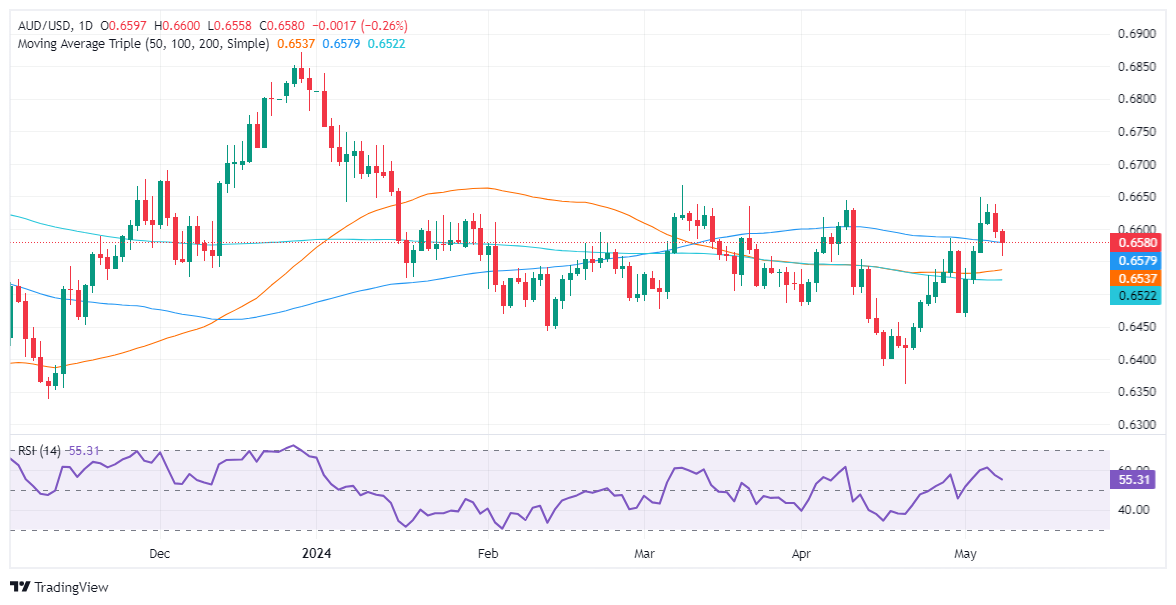
AUD/USD

Overview
Today last price0.658
Today Daily Change-0.0017
Today Daily Change %-0.26
Today daily open0.6597
 
Trends
Daily SMA200.6504
Daily SMA500.6536
Daily SMA1000.658
Daily SMA2000.6522
 
Levels
Previous Daily High0.6638
Previous Daily Low0.6587
Previous Weekly High0.6649
Previous Weekly Low0.6465
Previous Monthly High0.6644
Previous Monthly Low0.6362
Daily Fibonacci 38.2%0.6606
Daily Fibonacci 61.8%0.6618
Daily Pivot Point S10.6577
Daily Pivot Point S20.6556
Daily Pivot Point S30.6526
Daily Pivot Point R10.6628
Daily Pivot Point R20.6659
Daily Pivot Point R30.6679

Author

Christian Borjon Valencia

Christian Borjon began his career as a retail trader in 2010, mainly focused on technical analysis and strategies around it. He started as a swing trader, as he used to work in another industry unrelated to the financial markets.

More from Christian Borjon Valencia
Share:

Markets move fast. We move first.

Orange Juice Newsletter brings you expert driven insights - not headlines. Every day on your inbox.

By subscribing you agree to our Terms and conditions.

Editor's Picks

EUR/USD: Sellers attack 1.1700 as USD stages a solid comeback

EUR/USD attacks 1.1700 amid heavy selling interest in the European trading hours on Wednesday. A solid comeback staged by the US Dollar weighs heavily on the pair, as traders look to USD short covering ahead of US CPI on Thursday. However, the downside could be capped by hawkish ECB expectations. 

GBP/USD slides toward 1.3300 after softer-than-expected UK inflation data

GBP/USD has come under intense selling pressure, eyeing 1.3300 in the European session on Wednesday. The UK annual headline and core CPI rose by 3.2% each, missing estimates of 3.5% and 3.4%, respectively, reaffirming dovish BoE expectations and smashing the Pound Sterling across the board. 

Gold: Bulls await breakout through multi-day-old range amid Fed rate cut bets

Gold attracts fresh buyers during the Asian session on Wednesday, though it remains confined in a multi-day-old trading range amid mixed fundamental cues. The global risk sentiment remains on the defensive amid economic woes and fears of the AI bubble burst. Moreover, dovish US Federal Reserve expectations lend support to the non-yielding yellow metal, though a modest US Dollar uptick might cap any further appreciating move.

Bitcoin, Ethereum and Ripple extend correction as bearish momentum builds

Bitcoin, Ethereum, and Ripple remain under pressure as the broader market continues its corrective phase into midweek. The weak price action of these top three cryptocurrencies by market capitalization suggests a deeper correction, as momentum indicators are beginning to tilt bearish.

Ukraine-Russia in the spotlight once again

Since the start of the week, gold’s price has moved lower, but has yet to erase the gains made last week. In today’s report we intend to focus on the newest round of peace talks between Russia and Ukraine, whilst noting the release of the US Employment data later on day and end our report with an update in regards to the tensions brewing in Venezuela.

AAVE slips below $186 as bearish signals outweigh the SEC investigation closure

Aave (AAVE) price continues its decline, trading below $186 at the time of writing on Wednesday after a rejection at the key resistance zone. Derivatives positioning and momentum indicators suggest that bearish forces still dominate in the near term.