|

AUD/USD stuck on the low end of near-term losses as Friday markets flatline

  • AUD/USD cycles just north of 0.6550.
  • Little Aussie data to chew on leaves AUD/USD in the lurch.
  • Next week: double-header showings from RBA and Fed.

The AUD/USD is churning just above 0.6550 as markets prepare for next week’s double feature from the Reserve Bank of Australia (RBA) and the US Federal Reserve (Fed). Both central banks are broadly expected to hold interest rates steady as investors focus on when rate cuts will come. According to the CME’s FedWatch Tool, money markets were recently thrown a curve ball, and bets of a June rate cut from the Fed have eased to 60%, down from 70% at the start of the week.

Next week also brings Australia’s latest labor and employment figures on Thursday, and median market forecasts expect Australia’s Employment Change in February to add 30K new jobs, while the Unemployment Rate is forecast to tick down to 4.0% from 4.1%. Preliminary Judo Bank Australian Purchasing Managers Index (PMI) figures for February are also scheduled for early Thursday.

Broader markets will be focusing full-bore on next Wednesday’s Fed rate statement, where the US central bank is also expected to update the Fed Dot Plot summary of interest rate expectations. The near-term end of the Dot Plot curve is expected to tick up to 5.5% from the current 4.6%. With markets pinning hopes on at least three 25 basis point rate cuts from the Fed in 2024, investor sentiment has been at odds with the Fed’s own rate outlook for the entire year. The Fed projected three rate cuts through 2024, while money markets priced in an eye-watering six or seven rate cuts through the year totaling nearly 200 basis points in rate trims for the year.

As the US economy continues to churn at a healthy clip and inflation remains stubbornly sticky, markets have had little choice but to slash rate cut expectations, and rate futures traders are half-heartedly hoping for a June rate cut.

AUD/USD technical outlook

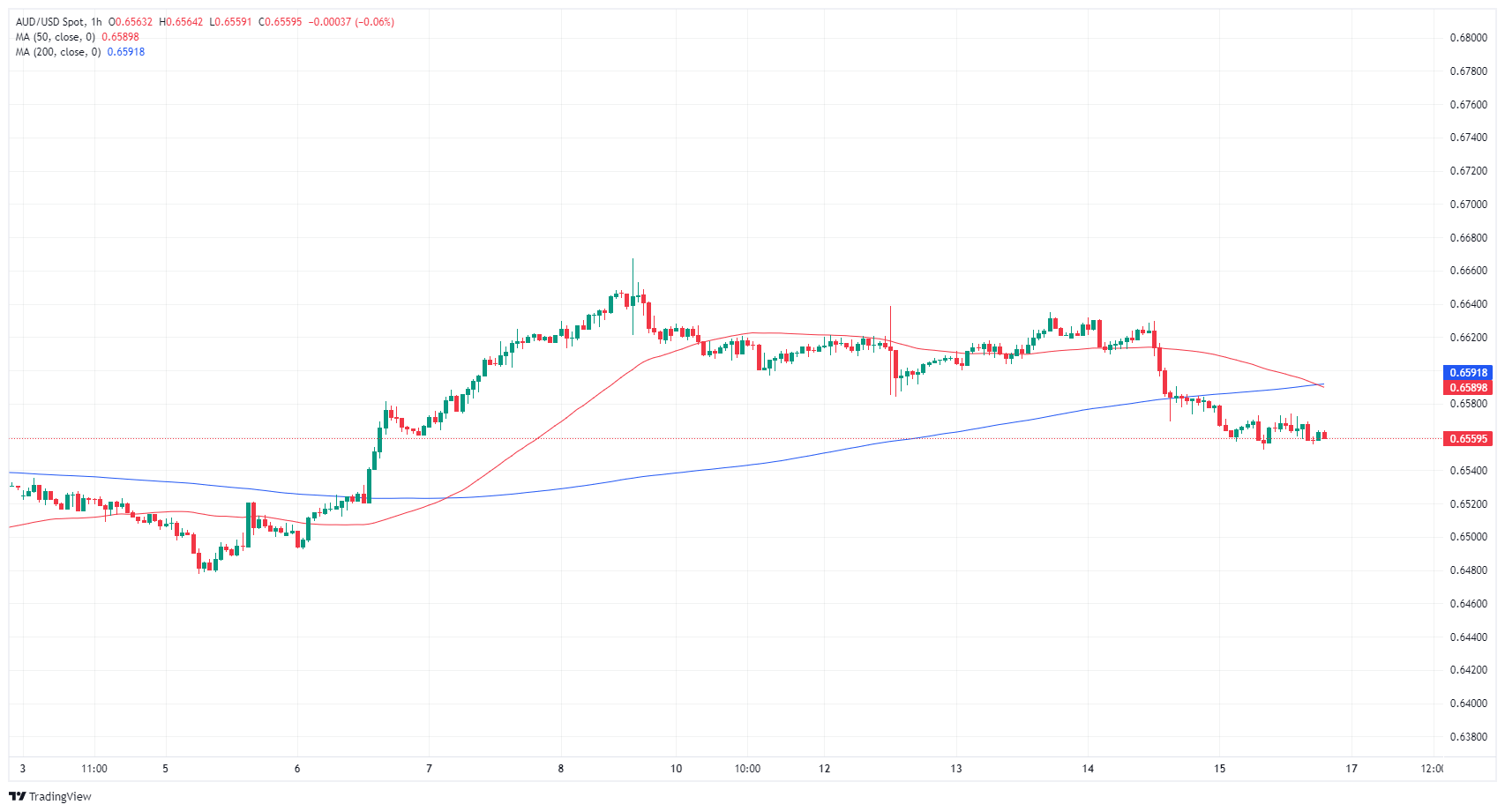
AUD/USD spent most of the trading week on the low side, backsliding into the 200-hour Simple Moving Average (SMA) near 0.6580 on Thursday. The 50-hour and 200-hour SMAs have begun a bearish crossover near 0.6585 as intraday price action tilts into the bearish side. The Aussie-Dollar pair flubbed a brief bullish push into the 0.6640 early in the week.

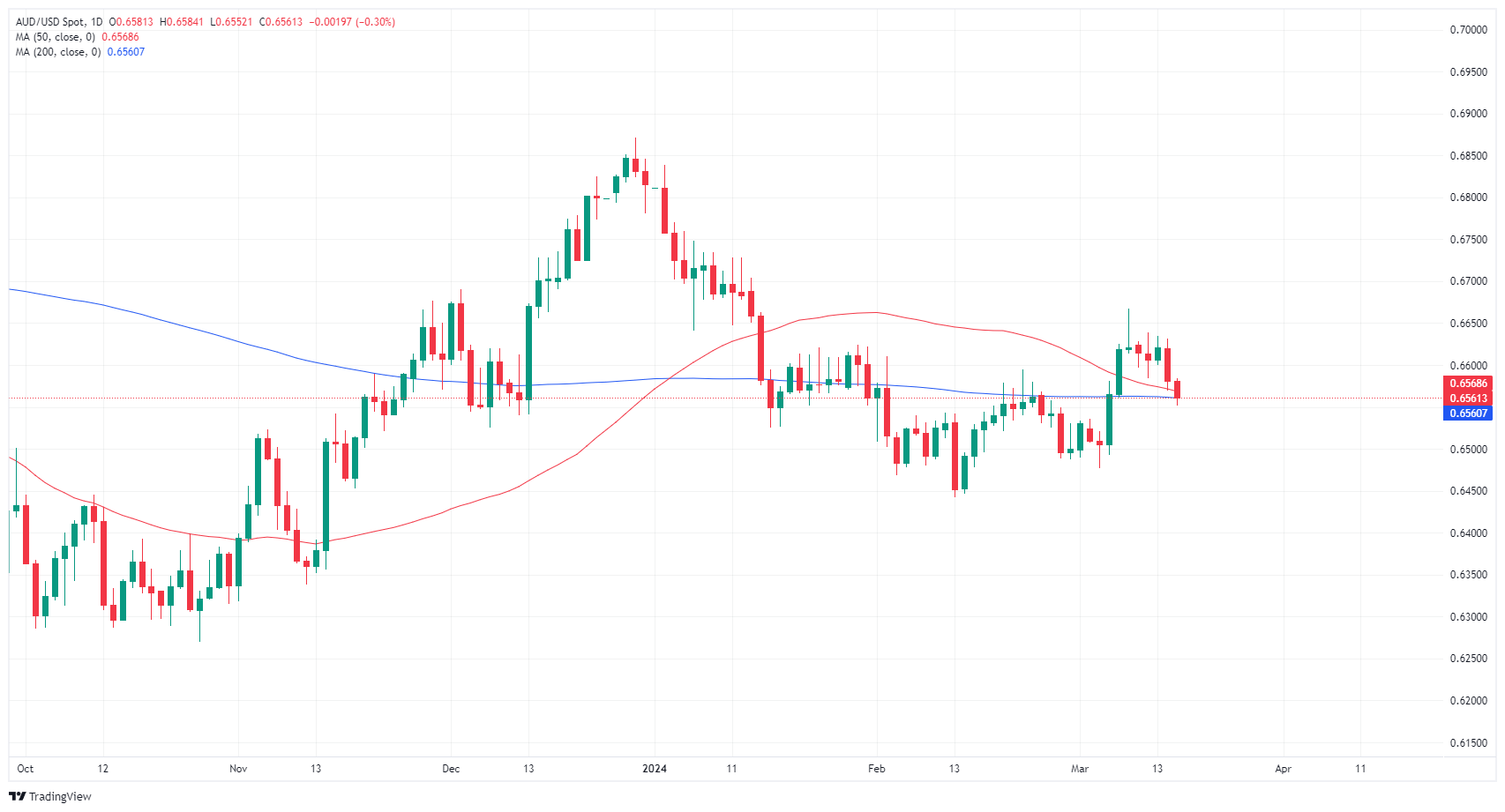
Friday’s third of a percent decline has the Aussie clattering into the 200-day SMA against the US Dollar near 0.6560, and momentum is tilted into bear country as the pair fails to find bullish momentum after a rebound from the last swing low into the 0.6450 handle.

AUD/USD hourly chart
AUD/USD daily chart
AUD/USD

Overview
Today last price0.6561
Today Daily Change-0.0020
Today Daily Change %-0.30
Today daily open0.6581
 
Trends
Daily SMA200.6557
Daily SMA500.6572
Daily SMA1000.6584
Daily SMA2000.6562
 
Levels
Previous Daily High0.6632
Previous Daily Low0.657
Previous Weekly High0.6667
Previous Weekly Low0.6478
Previous Monthly High0.661
Previous Monthly Low0.6443
Daily Fibonacci 38.2%0.6593
Daily Fibonacci 61.8%0.6608
Daily Pivot Point S10.6556
Daily Pivot Point S20.6532
Daily Pivot Point S30.6494
Daily Pivot Point R10.6619
Daily Pivot Point R20.6656
Daily Pivot Point R30.6681

Author

Joshua Gibson

Joshua joins the FXStreet team as an Economics and Finance double major from Vancouver Island University with twelve years' experience as an independent trader focusing on technical analysis.


More from Joshua Gibson
Share:

Editor's Picks

AUD/USD consolidates above 0.7000; remains close to monthly top

AUD/USD holds steady above 0.7000 during the Asian session on Friday, trading just below the previous day's monthly low amid diverging forces. A hawkish RBA continues to support the Aussie, while the recent decline in US bond yields keeps the US Dollar depressed near a three-week low. However, oil-driven inflation fears reinforce Fed hike bets, which, along with geopolitical risks, could benefit the safe-haven buck and cap the currency pair.

USD/JPY bounces off one-month low; climbs to 157.00 amid reviving USD demand

USD/JPY rebounds from the 156.00 neighborhood, or a one-month low touched during Friday’s Asian session, with bulls looking to extend momentum beyond 157.00 amid the emergence of some US Dollar buying. Meanwhile, Japan's National CPI rose to a nine-month peak and reaffirmed BoJ rate-hike bets, which could support the Japanese Yen and cap gains for the currency pair.

Gold stalls recovery from three-month low as Fed hike bets and USD uptick cap gains

Gold struggles to capitalize on a modest intraday bounce from levels below the $4,000 psychological mark, or a three-month low set during the Asian session, and sticks to a negative tone for the second straight day. The Federal Reserve recently signaled that there is no urgency to raise interest rates. Traders, however, are still pricing in around an 80% chance that the US central bank will raise borrowing costs again at its December policy meeting.

Bitcoin, Ethereum, and Ripple rebound as major support levels cap recent sell-off

Bitcoin, Ethereum and Ripple rebound modestly on Friday after correcting and testing their key support zone the previous day. BTC holds the 50-day EMA, ETH finds support around the 100-day EMA, while XRP holds the horizontal floor near $1.300. The price action of these top three cryptocurrencies suggests a recovery if this critical support zone holds; a decisive close below these levels suggests a deeper correction.

The week ahead – UK budget, Shell, BP and HSBC and NatWest results
Financial markets have undergone another turbulent week with concerns about public sector debt levels, the impact of energy policy and higher oil and gas prices, and what events in France might mean for the UK economy going forward.
What November 3 means for the Fed's rate path and the US Dollar

The USD faces a decisive period ahead of the November 3 midterm elections. While markets anticipate another interest rate increase from the Fed in December, the battle for control of Congress could reshape fiscal policy expectations and, indirectly, the path of US monetary policy in 2027.