AUD/USD struggles at 0.7200 ahead of the RBA’s monetary policy meeting
- The AUD/USD begins the week losing 0.10%, ahead of RBA’s decision and US inflation figures.
- An upbeat market mood was no excuse for the greenback to rise, propelled by the US 10-year yield above 3%.
- Reserve Bank of Australia Preview: Rate hikes are here to stay
- AUD/USD Price Forecast: Trendless ahead of the RBA’s meeting.

The Australian dollar slides below 0.7200, erasing earlier gains after reaching a daily high at 0.7231, despite an upbeat market mood ahead of the Reserve Bank of Australia (RBA) rate decision. At the time of writing, the AUD/USD is trading at 0.7197
A risk-on mood surrounds the financial markets. Global equities are registering gains, a consequence of China’s easing Covid-19 restrictions, and Caixin PMIs Services and Composite, which showed the world’s second-largest economy, appears to be founding a bottom despite slowing down.
Meanwhile, the US Dollar Index, a measurement of the greenback’s value, erases some earlier losses and remains to gain some 0.19%, sitting at 102.360, underpinned by elevated US Treasury yields. The 10-year benchmark note rate is at 3.025%, gains eight and a half bps, as investors assess the Federal Reserve’s pace of tightening.
The latter factor is the main reason for the AUD/USD fall. Despite the Reserve Bank of Australia (RBA) 25 bps hike, widely expected on Tuesday, June 7, market players had already priced in the increase. However, don’t discount the chance of a 40 bps rate hike.
TD Securities analysts wrote that “the risks to inflation lean towards the upside and we expect the RBA to hike by 40bps to address this. Average hourly earnings from the national accounts showed further gains in Q1 and points to an acceleration in wages growth which will pressure inflation higher.”
“With the economy on a stronger footing, we think the RBA can afford to take larger policy steps to tame inflation,” analysts noted.
Also read: Reserve Bank of Australia Preview: Rate hikes are here to stay
Additionally to the RBA monetary policy decision, the Australian economic calendar would feature the Building Permits and the AI Group Services Index.
In the case of the US, ISM PMIs were mixed but stayed above the 50-midline, displaying that the economy is cooling but not in recessionary territory. Additionally, May’s Nonfarm Payrolls report was better than foreseen, further cementing the case for the Federal Reserve hike in the June meeting.
AUD/USD Price Forecast: Technical outlook
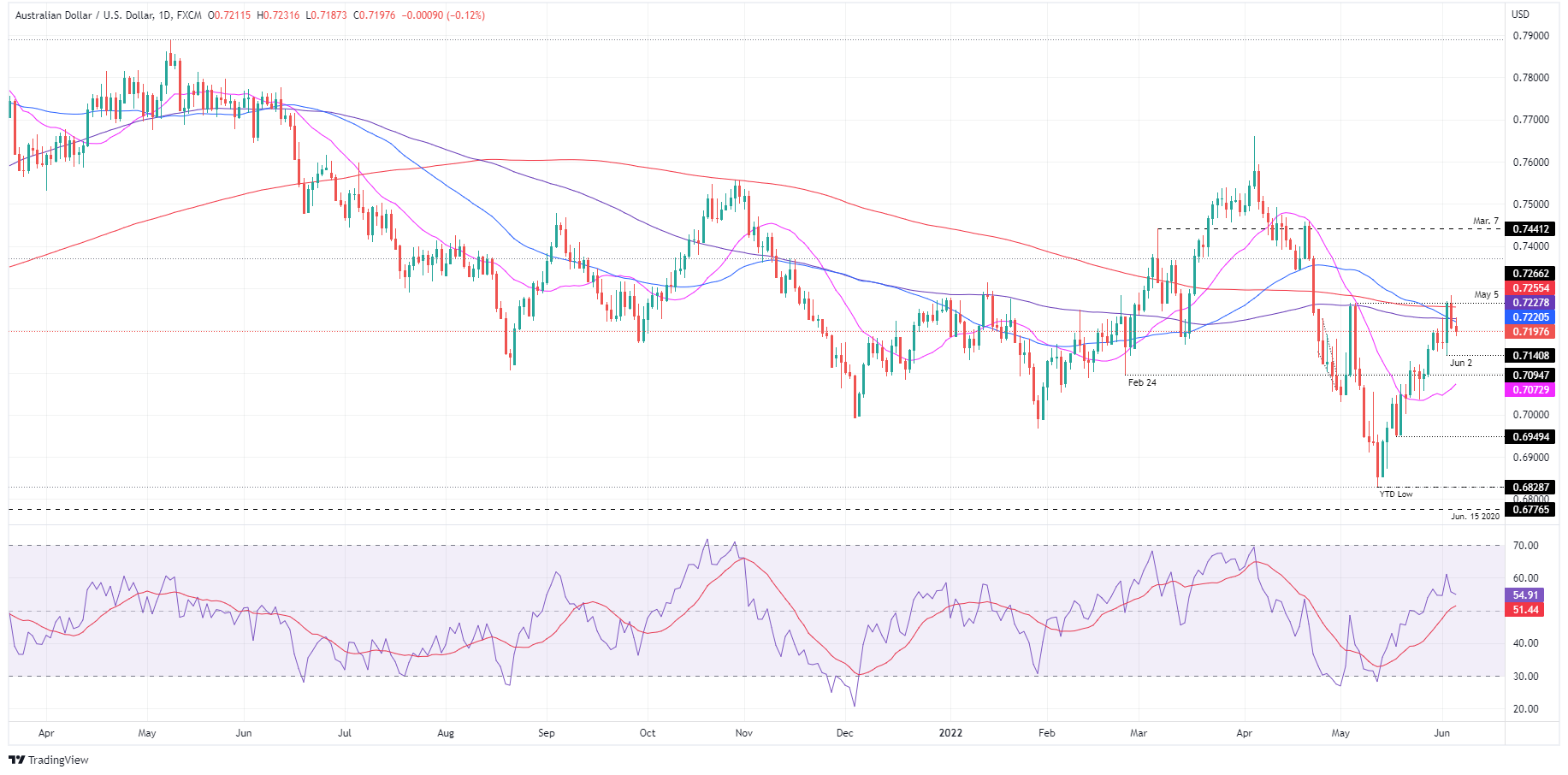
The AUD/USD tumbled below the 200-DMA at 0.7255 after trading above it for just one trading session in the last week. It is worth noting that during the day, AUD/USD buyers lifted the pair towards the 100-DMA at 0.7227, though they did not have the force to break resistance, and the AUD/USD dipped towards the session lows at 0.7187. Since then, the major remains seesawing with no clear direction ahead of the RBA’s monetary policy meeting.
Upwards, the AUD/USD’s first resistance would be the 50-DMA at 0.7220. Once cleared, the next resistance would be the 100-DMA at 0.7227, followed by the trend-setter 200-DMA at 0.7255. On the other hand, the major’s first support would be June’s 2 low at 0.7140. Break below would expose February’s 24 daily low at 0.7094, closely followed by the 20-DMA at 0.7073.
Key Technical Levels
Author

Christian Borjon Valencia
FXStreet
Markets analyst, news editor, and trading instructor with over 14 years of experience across FX, commodities, US equity indices, and global macro markets.

















