AUD/USD stays firm awaiting RBA speech; US PCE ahead in the week
- AUD/USD stabilizes after gains, with traders eyeing the 200-DMA and upcoming Australian consumer sentiment indicators.
- Mixed messages from Fed officials on rate cuts contrast with potential optimism from RBA’s upcoming commentary.
- Geopolitical tensions and global economic indicators may sway risk appetite, influencing AUD/USD direction.

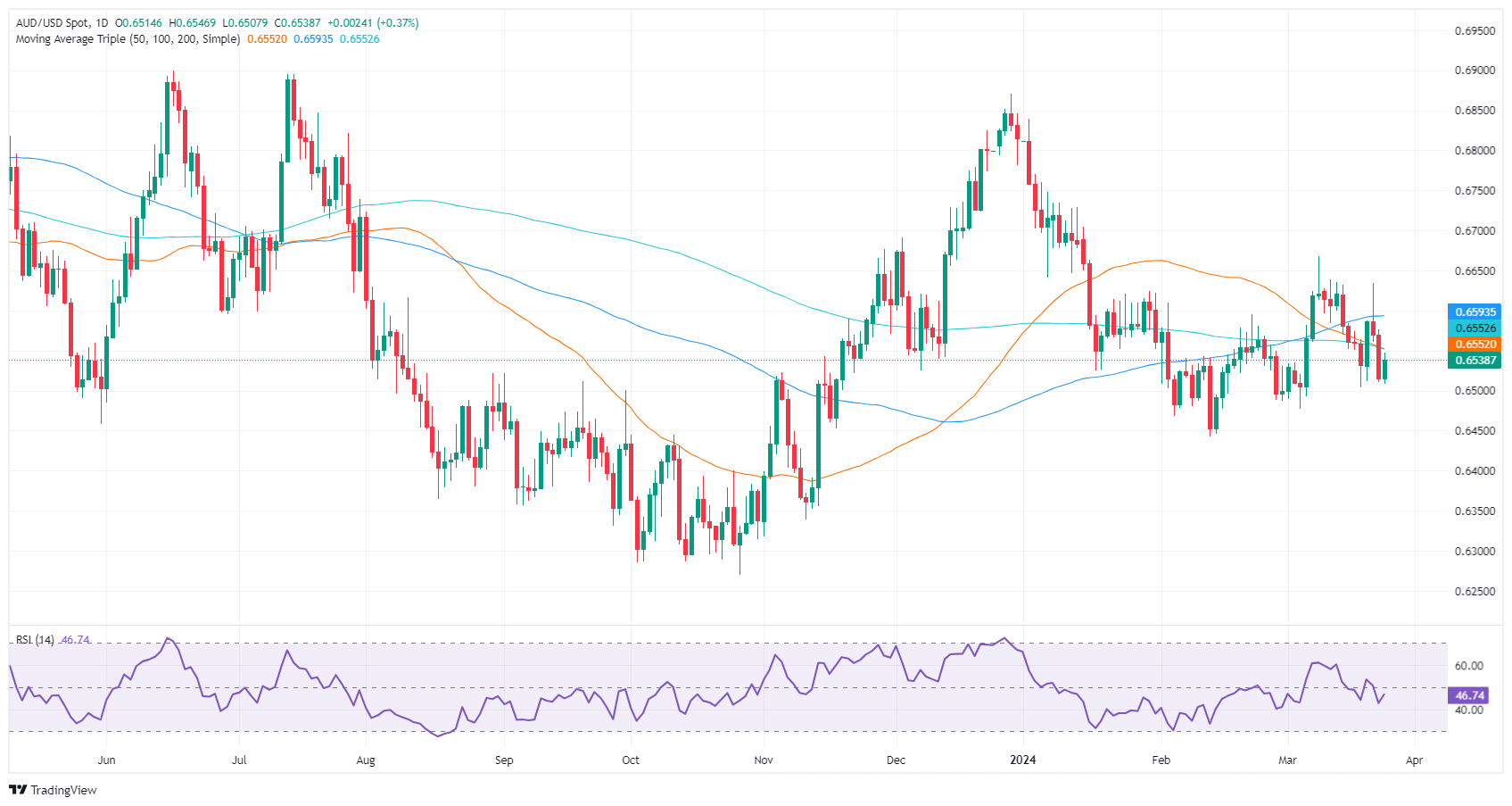
The Aussie Dollar (AUD) begins the Asian session virtually unchanged vs. the US Dollar after clocking solid gains of 0.41% on Monday. At the time of writing, the AUD/USD trades at 0.6539, beneath the 200-day moving average (DMA).
AUD/USD traders await Aussie’s Consumer Confidence
Wall Street ended Monday’s session with losses as traders braced for the release of a US inflation report. US New Home Sales in February contracted to pre-pandemic levels, decreasing -0.3% MoM from a 1.7% rise in January, from 0.664 million to 0.662 million. Other data showed that the Chicago Fed National Activity Index improved from -0.54 to 0.05.
Elsewhere, the Dallas Fed Manufacturing survey fell from -11.3 in February to -14.4 in March and below expectations for a minimal rise.
On the Aussie’s front, the schedule will feature the Consumer Confidence and the speech of Ellis Connolly, a Reserve Bank of Australia (RBA) member. In the US, traders are waiting for the release of the Fed’s preferred gauge for inflation, the Core Personal Consumption Expenditure (PCE), expected to dip from 0.4% to 0.3% MoM, which headline inflation is foreseen to tick up from 0.3% to 0.4% MoM.
Fed speakers remained split about rate cuts
Atlanta Fed President Raphael Bostic said he expects just one rate cut this year, adding that cutting rates too soon could be more disruptive. At the same time, his colleague, Chicago Fed President Austan Goolsbee, adheres to the majority of the board and expects three cuts, though he said he needs more evidence of inflation “coming down.”
Fed Governor Lisa Cook echoed Bostic's comments, saying that cutting too soon increases the risks of inflation becoming entrenched. She added that the Fed’s dual mandate goals are moving toward better balance.
Given the fundamental backdrop and a positive market mood, the AUD/USD can extend its gains and test key resistance levels. Nevertheless, the sudden escalation of the Russia-Ukraine conflict, alongside the Red Sea crisis, could dent investors' appetite for riskier assets, and seeking safety could underpin the Greenback.
AUD/USD Price Analysis: Technical outlook
The AUD/USD pair bounced off last Friday’s lows and is climbing but faces a key resistance level at 0.6551, the confluence of the 50 and 200-day moving averages (DMA). Once breached, further upside is seen. The next supply zone would be the 100-DMA at 0.6589, ahead of 0.6600. On the other hand, sellers' failure at 0.6550 would sponsor a leg-down, and the pair could re-test the 0.6500 figure.
Australian Dollar FAQs
One of the most significant factors for the Australian Dollar (AUD) is the level of interest rates set by the Reserve Bank of Australia (RBA). Because Australia is a resource-rich country another key driver is the price of its biggest export, Iron Ore. The health of the Chinese economy, its largest trading partner, is a factor, as well as inflation in Australia, its growth rate and Trade Balance. Market sentiment – whether investors are taking on more risky assets (risk-on) or seeking safe-havens (risk-off) – is also a factor, with risk-on positive for AUD.
The Reserve Bank of Australia (RBA) influences the Australian Dollar (AUD) by setting the level of interest rates that Australian banks can lend to each other. This influences the level of interest rates in the economy as a whole. The main goal of the RBA is to maintain a stable inflation rate of 2-3% by adjusting interest rates up or down. Relatively high interest rates compared to other major central banks support the AUD, and the opposite for relatively low. The RBA can also use quantitative easing and tightening to influence credit conditions, with the former AUD-negative and the latter AUD-positive.
China is Australia’s largest trading partner so the health of the Chinese economy is a major influence on the value of the Australian Dollar (AUD). When the Chinese economy is doing well it purchases more raw materials, goods and services from Australia, lifting demand for the AUD, and pushing up its value. The opposite is the case when the Chinese economy is not growing as fast as expected. Positive or negative surprises in Chinese growth data, therefore, often have a direct impact on the Australian Dollar and its pairs.
Iron Ore is Australia’s largest export, accounting for $118 billion a year according to data from 2021, with China as its primary destination. The price of Iron Ore, therefore, can be a driver of the Australian Dollar. Generally, if the price of Iron Ore rises, AUD also goes up, as aggregate demand for the currency increases. The opposite is the case if the price of Iron Ore falls. Higher Iron Ore prices also tend to result in a greater likelihood of a positive Trade Balance for Australia, which is also positive of the AUD.
The Trade Balance, which is the difference between what a country earns from its exports versus what it pays for its imports, is another factor that can influence the value of the Australian Dollar. If Australia produces highly sought after exports, then its currency will gain in value purely from the surplus demand created from foreign buyers seeking to purchase its exports versus what it spends to purchase imports. Therefore, a positive net Trade Balance strengthens the AUD, with the opposite effect if the Trade Balance is negative.
Author

Christian Borjon Valencia
FXStreet
Markets analyst, news editor, and trading instructor with over 14 years of experience across FX, commodities, US equity indices, and global macro markets.