AUD/USD post moderate gains on solid US data, weak Aussie PMI
- Australian Dollar appreciates against USD, driven by positive sentiment and strong US economic data.
- US Dollar Index falls 0.27% after Fed keeps rates steady and signals slower Quantitative Tightening.
- Chair Powell stresses data-dependent policy amid slow inflation progress.
- Australia's Judo Bank Services PMI disappoints investors, coming at 53.6, down from 54.2, missing estimates.
- AUD/USD traders await US labor data, including Nonfarm Payrolls and Unemployment Rates.

The Australian Dollar registered solid gains of 0.65% against the US Dollar on Thursday, courtesy of an upbeat market mood amid solid economic data from the United States (US). However, the Federal Reserve’s (Fed) latest monetary policy decision is still weighing on the Greenback, which finished the session losing 0.27%, as depicted by the US Dollar Index (DXY). The AUD/USD trades at 0.6567, up by a minuscule 0.03%.
AUD/USD slightly up as traders digest Federal Reserve decision and Powell comments
On Wednesday, the Fed decided to hold rates unchanged and opened the door to reducing the Quantitative Tightening (QT) pace. Additionally, the Fed Chair said that it’s not appropriate to reduce interest rates as inflation progresses stalled. He emphasized the data-dependent stance, saying they would decide monetary policy “meeting by meeting.”
Data-wise, the US Balance of Trade reported the deficit narrowed -0.1% from $-69.5 billion to $-69.4 billion, falling shy of the expected $-69.1 billion. Other data showed that Factory orders improved from 1.2% to 1.6% MoM in March as projected, while Americans filling for unemployment benefits for the last week rose by 208K, less than the 21K expected, unchanged from the previous reading.
In the meantime, AUD/USD traders are looking for the release of the Judo Bank Services PMI Final reading for April, which is expected to drop from 54.4 to 54.2. On the US front, April’s US Nonfarm Payrolls are expected to rise 240K vs. 303K in March. The Unemployment Rate is estimated to stay at 3.8%, while Average Hourly Earnings would likely remain unchanged at 0.3% MoM.
AUD/USD Price Analysis: Technical outlook
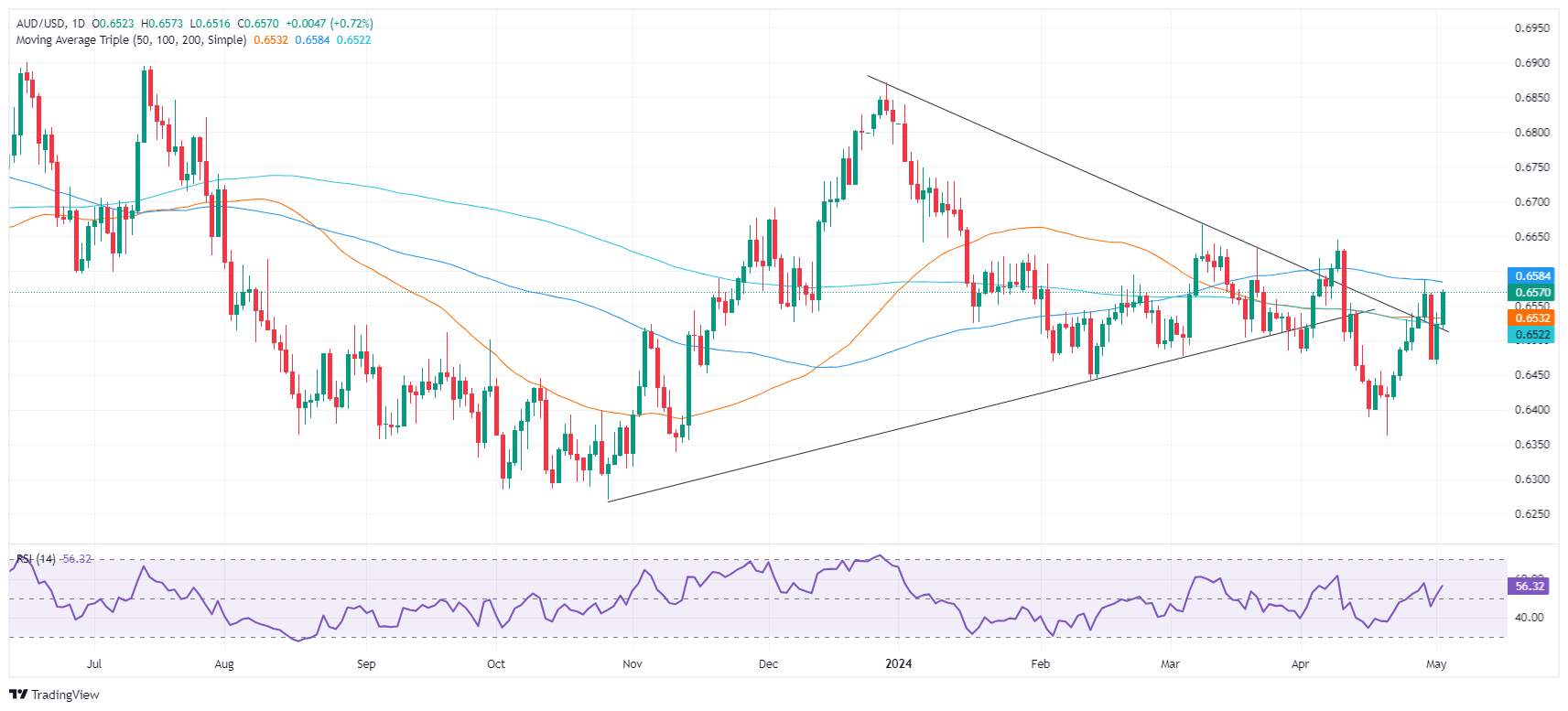
The AUD/USD daily chart suggests the pair is neutrally biased, as price action meanders around flat 50, 200, and 100-day moving averages (DMAs). However, if buyers lift the pair above the 100-DMA at 0.6580, it will clear the path toward 0.6600. Further upside is seen once broken, with the next supply zone seen at March 8 high at 0.6667. Conversely, a drop below the confluence of the 200 and 50-DMAs at around 0.6520 could pave the way to challenge the current week's low of 0.6465.
Australian Dollar FAQs
One of the most significant factors for the Australian Dollar (AUD) is the level of interest rates set by the Reserve Bank of Australia (RBA). Because Australia is a resource-rich country another key driver is the price of its biggest export, Iron Ore. The health of the Chinese economy, its largest trading partner, is a factor, as well as inflation in Australia, its growth rate and Trade Balance. Market sentiment – whether investors are taking on more risky assets (risk-on) or seeking safe-havens (risk-off) – is also a factor, with risk-on positive for AUD.
The Reserve Bank of Australia (RBA) influences the Australian Dollar (AUD) by setting the level of interest rates that Australian banks can lend to each other. This influences the level of interest rates in the economy as a whole. The main goal of the RBA is to maintain a stable inflation rate of 2-3% by adjusting interest rates up or down. Relatively high interest rates compared to other major central banks support the AUD, and the opposite for relatively low. The RBA can also use quantitative easing and tightening to influence credit conditions, with the former AUD-negative and the latter AUD-positive.
China is Australia’s largest trading partner so the health of the Chinese economy is a major influence on the value of the Australian Dollar (AUD). When the Chinese economy is doing well it purchases more raw materials, goods and services from Australia, lifting demand for the AUD, and pushing up its value. The opposite is the case when the Chinese economy is not growing as fast as expected. Positive or negative surprises in Chinese growth data, therefore, often have a direct impact on the Australian Dollar and its pairs.
Iron Ore is Australia’s largest export, accounting for $118 billion a year according to data from 2021, with China as its primary destination. The price of Iron Ore, therefore, can be a driver of the Australian Dollar. Generally, if the price of Iron Ore rises, AUD also goes up, as aggregate demand for the currency increases. The opposite is the case if the price of Iron Ore falls. Higher Iron Ore prices also tend to result in a greater likelihood of a positive Trade Balance for Australia, which is also positive of the AUD.
The Trade Balance, which is the difference between what a country earns from its exports versus what it pays for its imports, is another factor that can influence the value of the Australian Dollar. If Australia produces highly sought after exports, then its currency will gain in value purely from the surplus demand created from foreign buyers seeking to purchase its exports versus what it spends to purchase imports. Therefore, a positive net Trade Balance strengthens the AUD, with the opposite effect if the Trade Balance is negative.
Author

Christian Borjon Valencia
FXStreet
Markets analyst, news editor, and trading instructor with over 14 years of experience across FX, commodities, US equity indices, and global macro markets.