AUD/USD plummets against US Dollar amid strong US yields ahead of Fed’s Waller comments
- AUD/USD dips pressured by rising US Treasury yields and a robust 0.60% gain in the US Dollar Index (DXY).
- Deteriorating risk appetite and expectations of less aggressive Fed rate cuts contribute to the AUD's weakness; Fed Governor Waller's speech highly anticipated.
- Australian consumer sentiment wanes amid higher mortgage rates and living costs, despite potential RBA restraint in further rate hikes due to slowing inflation.

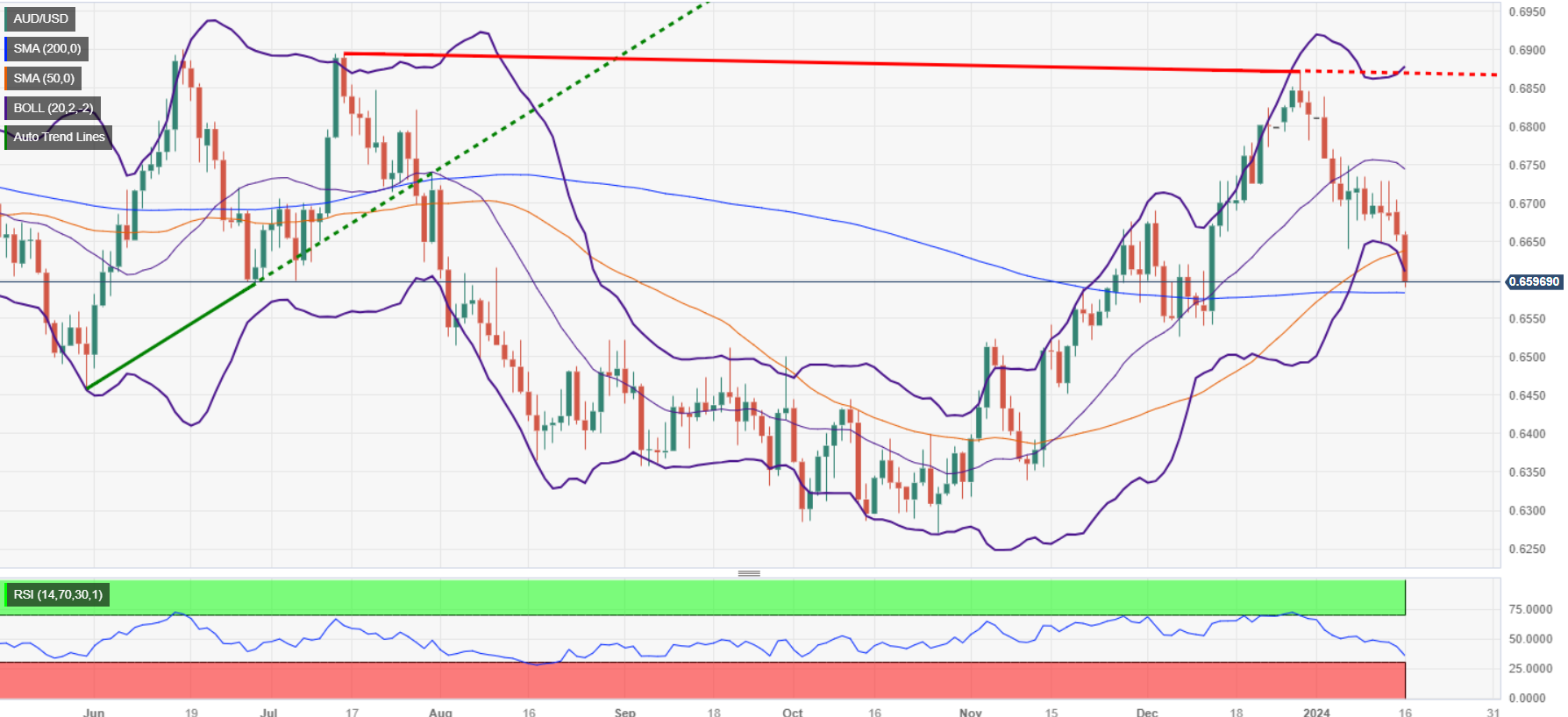
The Australian Dollar (AUD) tumbles sharply against the US Dollar (USD) as US Treasury yields climb and the Greenback (USD) posts solid gains of more than 0.50% via the US Dollar Index (DXY). Expectations that the US Federal Reserve (Fed) would cut rates in the year had been tempered, a headwind for the AUD/USD pair, which trades at 0.6596, down 0.93%.
Aussie Dollar’s dropped sharply weighed by deterioration in Australia’s consumer sentiment
Risk appetite had deteriorated while US Treasury bond yields had risen as investors trimmed overaggressive bets that the Fed would ease monetary policy as soon as March. The lack of economic data in the docket, except for the New York Fed Empire State Manufacturing Index for January plummeting sharply at -43.7 vs. estimates of -5, and December’s -14.5, casting doubts of a recovery in the manufacturing sector. For the latest month, the ISM Manufacturing PMI remained in contractionary territory for 14 consecutive months.
Aside from this, traders are awaiting a speech of Fed Governor Christopher Waller, which shifted from one of the strongest hawks to a dove in his latest speech in December, which opened the door for the Santa Claus rally in US equities in December.
In the meantime, the AUD/USD is driven by a strong US Dollar. The DXY, which measures the buck's performance against six currencies, posted solid gains of 0.60%, at 103.28, underpinned by the 10-year benchmark note rate at 4.01%, gaining six basis points.
On the Australian front, January’s consumer sentiment deteriorated, which was blamed on higher mortgage rates and the cost of living, according to the report. It should be said the Reserve Bank of Australia (RBA) hiked rates up to 4.35%, a 12-year high, and kept the door open for further tightening if inflationary figures remain high. Nevertheless, a downtick in the latest monthly inflation report could deter the RBA from increasing rates.
AUD/USD Price Analysis: Technical outlook
Given the fundamental backdrop, the AUD/USD shifted neutral to slightly downwards, extending its losses and breaking support at the 50-day moving average (DMA) at 0.6629, putting into play a challenge of the 200-DMA at 0.6581. If sellers could decisively break the latter, expect additional selling pressure, which could cause prices to tumble towards December’s 7 low of 0.6525. On the other hand, if buyers defend the 200-DMA and reclaim 0.6600, that could pave the way to re-test the January 5 swing low seen at 0.6640.
Author

Christian Borjon Valencia
FXStreet
Markets analyst, news editor, and trading instructor with over 14 years of experience across FX, commodities, US equity indices, and global macro markets.