AUD/USD marks a lower low below neckline support, buyers looking for entry point
- AUD/USD bears pile in below H&S neckline as risk aversion takes hold.
- Data leading up to the RBA meeting will be critical.

AUD/USD bears are chipping away on the downside as markets get set for the Aussie jobs data later in the week. The fundamentals for the Aussie are heavily weighted to the downside with the Reserve bank of Australia meeting on the horizon, 4th Feb, following a series of downbeat data releases (besides strong retail sales report for November) and the bushfires.
The RBA’s three rate cuts in 2019 were a heavy weight for the Aussie which extended the 2018 decline, testing the 200-day moving average on three occasions, failing miserably to penetrate it and subsequently falling from a 2019 high of 0.7295 to a 2019 low of 0.6670. Despite the notion of QE2020, the currency has managed to recover in a bullish channel from there to a December 2019 high of 0.7031, forming a H&S and a lower-low today below the neckline to 0.6842 with plenty at stake in the lead up to the highly anticipated RBA.
RBA meeting on the radar, with the RBA meeting on 4th Feb
In its Statement on Monetary Policy, the RBA clarified that “the Board is prepared to ease monetary policy further if needed to support sustainable growth in the economy, full employment and the achievement of the medium-term inflation target over time”.
The minutes of the December monetary policy meeting made it clear that the Board will be reassessing the economic outlook next February, noting that “economic growth and the unemployment rate remain broadly consistent with the forecasts." However, members agreed that it will be concerning if there were a deterioration in the outlook.
While the US and Chinse trade deal goes some way to buoy economic growth prospects in the near term, the bushfires and prospects of a disappointment in this week's jobs data (the unemployment rate is a very important source of attention for the Board) could serve for a downside bias for the Aussie, a currency already submerged below series if heavily bearish days of trade for the month so far:
AUD/USD daily price action YTD
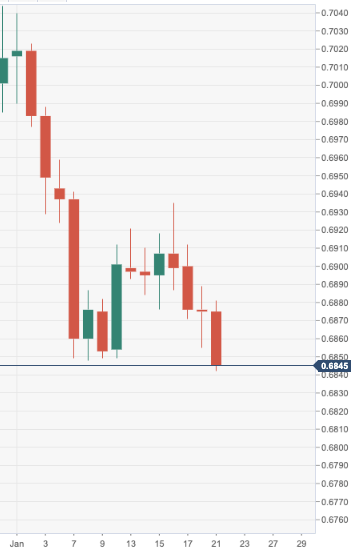
Westpac expects that the unemployment rate will drift higher to around 5.6% in the June quarter from the current 5.3%, but any deterioration there sooner will be a massive blow for the Aussie.
There will be a keen eye on wages this week as well, as the concerns about weak wages growth remain central to the Board: “it was noted that the current rate of wages growth was not consistent with inflation being sustainably within the target range… nor was it consistent with consumption growth returning to trend”.
Then, markets will be waiting for the Consumer Price Index later in the month as the ultimate round of key domestic data ahead for the RBA to mull. “The Q4 2019 CPI report due at the end of January will, as always, provide key information for the RBA ahead of its February meeting; but only a major surprise would upset the RBA’s outlook. We expect headline inflation for the quarter to jump to 0.7% q/q and 1.9% y/y. Trimmed mean inflation is expected to be more restrained at 0.4%and 1.6% in quarterly and annual terms, respectively,” analysts at ANZ bank explained.
QE on the horizon? We will have to wait and see
Last year, RBA Governor Lowe outlined some parameters with respect to the use of unconventional policies in Australia. Although he made clear that conditions were currently not ripe for QE, he indicated that if the Cash rate was cut by an additional 50 bps to 0.25%, then the RBA could embark on an asset purchases programme.
It is possible that this could if economic headwinds were to persist and considering that here are some expectations that tensions between the US and China will rise again in the months ahead, this would accelerate the economic headwinds blowing across Australia. With the view that both the Cash rate and the AUD will trend lower into 2020, AUD/USD could be forecasted to head towards the 0.6600 handle on a 3-month view.
Markets catching the flu, weighing on AUS and risk sentiment
Meanwhile, we have been in risk-off mode in recent trade. Global markets have reacted negatively to news of virus spreading in China while US markets also took into account the gloomy IMF report after being closed the previous day – more on that here.
COT more bullish, but still bearish
While there is a clear technical bias to the downside, at this stage, and plenty of fundamental reasons to be concerned for, going forward, data-dependent, when we look at the positioning data, the net exposure has actually been decreasing from a -46579 position to -20540 position in the latest readings, ( net shorts being trimmed (from -30% of o.i. in mid-December to -17% as of 07 January – (bullish).
However, analysts at ING bank argued that "this is not enough to avoid the label of biggest G10 short and that the bushfire emergency ongoing in Australia (in tandem with the prospect of RBA easing) is likely going to keep appetite for the currency subdued and AUD shorts solidly in place for a bit longer."
Always the optimist, but ...
While the analysts at ING make a valid point, it should still be noted that the longs are increasing and the shorts are decreasing. On a positive outcome in the trio of Aussie jobs, CPI and most importantly the RBA, AUD/USD has the legs to take-off higher and continue within a bullish channel while it sets its sights on a reversal of the 2018 downtrend.
If the positive trends of higher commodity prices, risk-on and global trade negotiations are here to stay, then the bulls will be riding higher in the 0.70s. The patient bulls can look to buy into such a trade once either the RBA is out of the way or when the technical environment is ripe for a long. Such a condition would be on failures at the base of the rising channel support, for instance, and a subsequent break back above the H&S neckline. Another would be a test of the golden ratio, 61.8%, a less dovish RBA and a subsequent rally. Then, when you throw in how far the CNY has to rally back towards its pre-tariff war levels ... blue skies for AUD. However, the trade deal offers only limited tariff relief for China in exchange for a huge increase in purchases of US exports, which doesn’t seem overly bullish for the yuan, as analysts at Westpac noted, calling for a lower AUD/CNY regardless, in anticipation of a 0.5% rate cut from the RBA as soon as Feb and more to come down the line, including QE, due to sub-trend growth and muted inflation.
Daily chart, 3 events risks, 3 technical scenarios
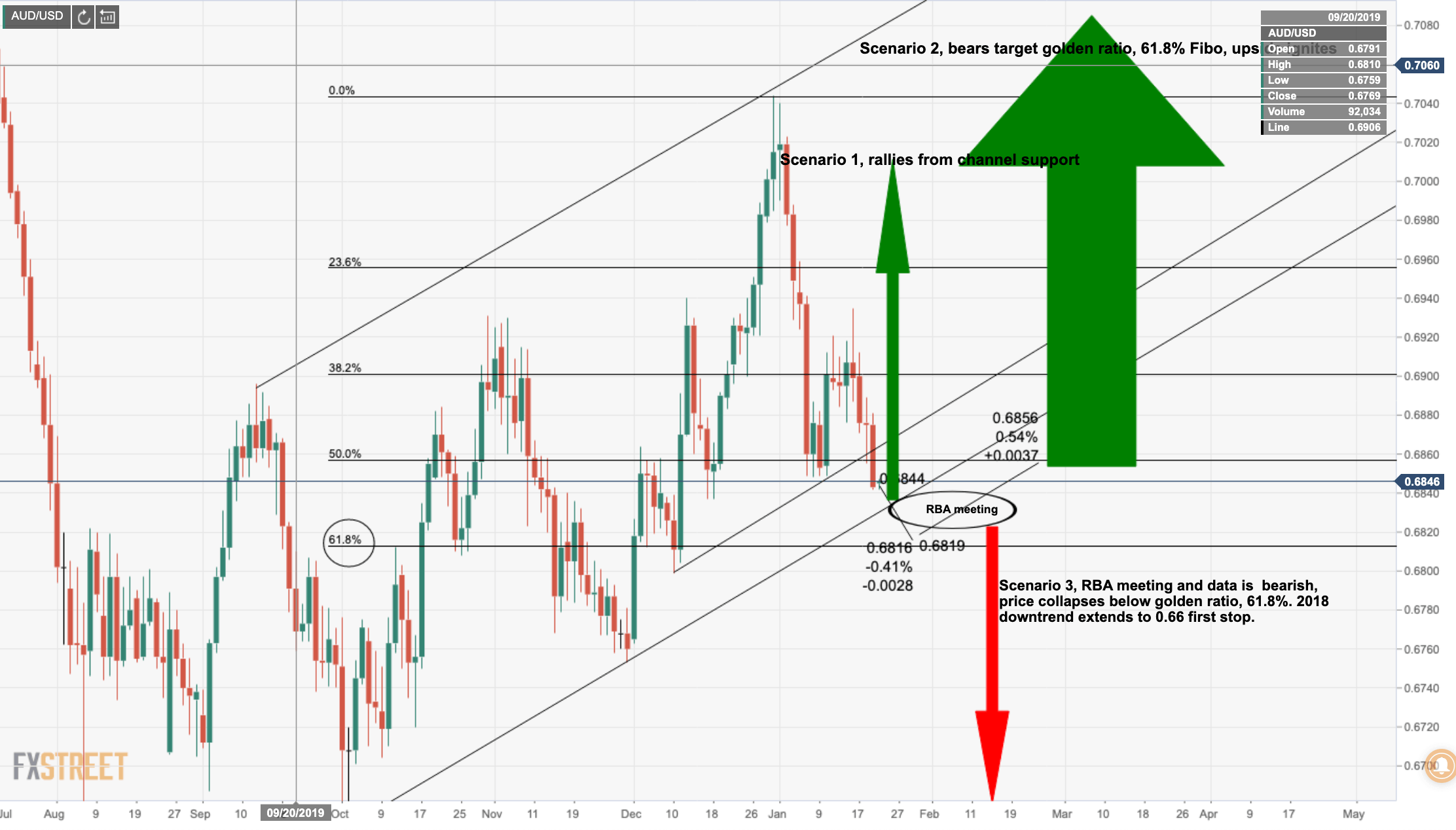
AUD/USD levels
Author

Ross J Burland
FXStreet
Ross J Burland, born in England, UK, is a sportsman at heart. He played Rugby and Judo for his county, Kent and the South East of England Rugby team.

















