AUD/USD dips below 0.6600 following RBA’s decision
- AUD/USD drops 0.42% after RBA holds cash rate at 4.35%, adopting a dovish tone in its statement.
- Markets react quickly, adjusting to RBA's shift from a neutral to a slightly dovish stance due to slow cooling inflation.
- US Dollar gains strength after Minneapolis Fed President Kashkari suggests possible rate hikes if inflation persists.

The Australian Dollar registered losses of around 0.42% against the US Dollar on Tuesday, following the Reserve Bank of Australia’s (RBA) monetary policy decision to keep rates unchanged. However, it was perceived as a dovish decision. Therefore, the AUD/USD finished the session near the day's lows, and as Wednesday's Asian session began, it traded at 0.6591, down 0.09%.
AUD/USD falls beneath 0.6600 amid Reserve Bank of Australia's cautious stance on inflation
Wall Street finished the session mixed, while the Greenback ended on a higher note despite the fall of US Treasury yields.
The main driver for AUD/USD traders was the RBA’s decision to keep the Cash Rate at 4.35%. Their monetary policy statement was tweaked from March, acknowledging that inflation is easing at a slower pace than expected, while March’s statement mentioned that inflation was cooling but remained high. That was perceived as dovish by the markets, who quickly priced in the RBA’s tilting neutral to slightly dovish.
On the US front, the narrative revolves around when the Federal Reserve will cut interest rates. Following the Federal Open Market Committee's (FOMC) decision to hold rates, the US Central Bank mentioned that risks to achieving its dual mandate on employment and inflation “moved toward better balance over the past year,” indicating that sudden weakness in the labor market could open the door to lowering rates.
The lack of data releases keeps traders leaning on speeches by Fed officials. Minneapolis Fed President Neel Kashkari bolstered the Greenback after saying that the Fed might stand put on interest rates and opened the door to raising the federal funds rate if inflation doesn’t resume its downtrend.
In the meantime, the CME FedWatch Tool shows that odds for a quarter-percentage-point cut in September by the Fed increased from 55% last week to 85% as of writing.
AUD/USD Price Analysis: Technical outlook
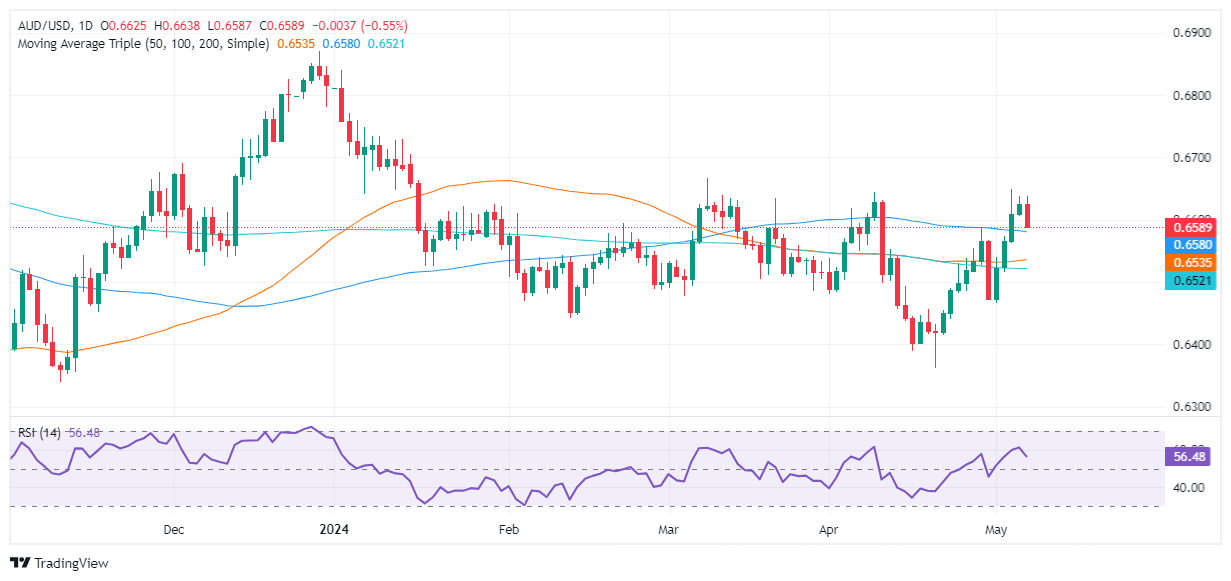
From a daily chart perspective, the pair is neutral to upward biased, though buyers need to surpass the latest cycle high seen at 0.6667 the March 8 high, which could exacerbate a rally toward 0.6700. Once cleared, the next resistance level would be the December 28 high at 0.6871. On the other hand, if sellers push prices below the 100-day moving average (DMA) at 0.6577, subsequent losses are awaited. The next demand level would be the 50-DMA at 0.6535, followed by the 200-DMA at 0.6515.
Author

Christian Borjon Valencia
FXStreet
Markets analyst, news editor, and trading instructor with over 14 years of experience across FX, commodities, US equity indices, and global macro markets.