|

AUD/NZD slips into new lows, aiming for 1.0800, Aussie manufacturing PMI slides

  • AUD/NZD is seeing extended declines, continuing Wednesday's backslide.
  • Aussie is reaching lower against the Kiwi, down 0.95% for the week.
  • Australian PMI figures came in mixed with manufacturing seeing further declines.

The AUD/NZD has broken out of recent consolidation on the weak side, and the pair shrugged off a mixed trade balance printing from New Zealand (NZ) as markets focus on weakened manufacturing figures from the Australian Purchasing Manager Index (PMI) printing.

Read more:

Australia: S&P Global Manufacturing PMI drops to 48.2, Services PMI improves to 50.5 in September

New Zealand Trade Balance came in mixed for August, NZD/USD remains flat above 0.5900

Australian PMI figures came in mixed, with the services component seeing a minor bump into 50.5 from 47.8, but weak spots in the manufacturing component are keeping the Aussie (AUD) on the weak side, with the Manufacturing PMI declining further to 48.2 from 49.6.

AUD/NZD technical outlook

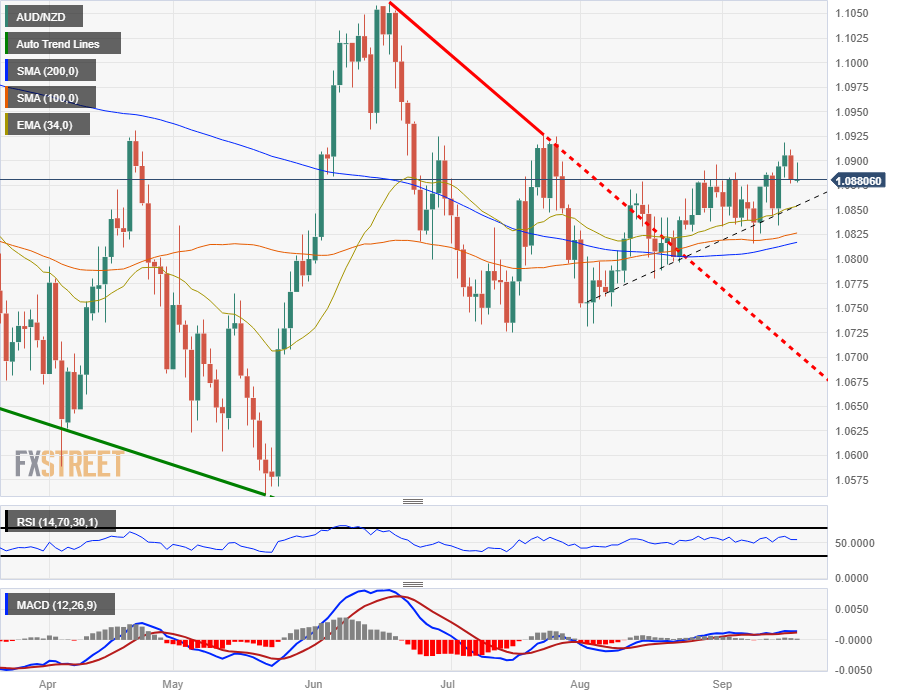
The Aussie-Kiwi pair has tumbled into the 200-day Simple Moving Average currently capping off prices near 1.0820.

Continued declines will see the pair testing August's early lows near 1.0720, while a bullish recovery will see the AUD/NZD challenging the recent swing high into 1.0920.

AUD/NZD daily chart
AUD/NZD technical outlook

AUD/NZD

Overview
Today last price1.0808
Today Daily Change-0.0068
Today Daily Change %-0.63
Today daily open1.0876
 
Trends
Daily SMA201.0866
Daily SMA501.0838
Daily SMA1001.0828
Daily SMA2001.0818
 
Levels
Previous Daily High1.0892
Previous Daily Low1.0855
Previous Weekly High1.0919
Previous Weekly Low1.0825
Previous Monthly High1.0897
Previous Monthly Low1.0732
Daily Fibonacci 38.2%1.0878
Daily Fibonacci 61.8%1.0869
Daily Pivot Point S11.0857
Daily Pivot Point S21.0837
Daily Pivot Point S31.082
Daily Pivot Point R11.0894
Daily Pivot Point R21.0911
Daily Pivot Point R31.0931

Author

Joshua Gibson

Joshua joins the FXStreet team as an Economics and Finance double major from Vancouver Island University with twelve years' experience as an independent trader focusing on technical analysis.


More from Joshua Gibson
Share:

Editor's Picks

AUD/USD remains below 0.7000 amid light trading

AUD/USD fills a modest bearish gap on Monday, but remains below 0.7000 in the Asian session amid holiday-thinned liquidity. The US Dollar attempts a bounce even as US bond yields pull back from multi-year highs, limiting the pair. Moreover, diminishing odds of another RBA rate hike in November cap the Aussie.

USD/JPY hovers above 158.00 amid Japan/ US holiday

USD/JPY extends its range-bound price action into a new week, trading above 158.00 as bulls remain on high alert amid speculation that authorities will step in to prop up the Japanese Yen. Meanwhile, softer US bond yields keep US Dollar bulls on the back foot and cap the pair's upside. However, geopolitical uncertainties could limit losses for the safe-haven buck amid thin liquidity due to a holiday in Japan and the US.

Gold buyers retain control as the US CPI week begins

Gold is extending its recovery from a two-month low of $4,067 into a new week on Monday, trying to remain above the $4,200 level amid a pause in the US Dollar retreat from an 18-month peak.

Cardano holds above EMAs as recovery builds

Cardano (ADA) reclaims trading above the key support zone on Monday after a 2.85% correction last week. Improving derivatives positioning and constructive technical outlook support a recovery for ADA. Derivatives data shows an improving sentiment among Cardano traders. CoinGlass’ long-to-short ratio for ADA reads 1.01 on Monday, flipping into green territory.

USD/INR drops 1% at open as RBI steps up measures to support Indian Rupee

The Indian Rupee (INR) opens significantly higher against the US Dollar (USD) on Monday. The USD/INR pair falls 1% to near 95.80 as Reserve Bank of India’s (RBI) fresh measures to curb US Dollar demand has brought relief for the Indian currency.

Has Bitcoin really escaped the macro forces it was built to fight?
Over 17 years ago, Satoshi Nakamoto designed Bitcoin (BTC) on the back of a global financial crisis as an alternative to the global monetary system outside the control of central banks, governments and traditional intermediaries. This raises a key question: has Bitcoin really become independent of the macroeconomic forces it was built to challenge?















