AUD/NZD drifting into 1.0865 as positive China comments pull Aussie higher
- The Aussie is shifting higher after China bullies markets on CNY speculation.
- Upside capped by recent downswings, but there's room to run if sentiment holds.
- Australian unemployment data in the mid-week could help or hurt depending on market sentiment.

The AUD/NZD caught a bump on Monday, trading into the 1.0870 region after kicking the trading week off near 1.0840. The Aussie (AUD) has caught a minor lift back into familiar territory after drifting to a medium-term low near 1.0820 late last week, getting bolstered by improving risk sentiment from China.
Chinese authorities are hitting markets with strong talking points early in the week, essentially warning market participants that they should “voluntarily maintain a stable market” and avoid excessive speculation trading.
Aussie getting dragged higher by up-step from China
The Renminbi (CNY) saw a much stronger fix than usual, and the upside momentum for the Chinese currency is dragging the Aussie higher, with Australia taking pride of place as China’s largest trading partner.
Things are light on the Kiwi (NZD) side, and changes in market dynamics will rest firmly in the hands of AUD traders for the week. The data point of note for the Aussie this week will be unemployment figures due on Wednesday, which markets are broadly expecting to hold steady at 3.7%.
AUD/NZD technical outlook
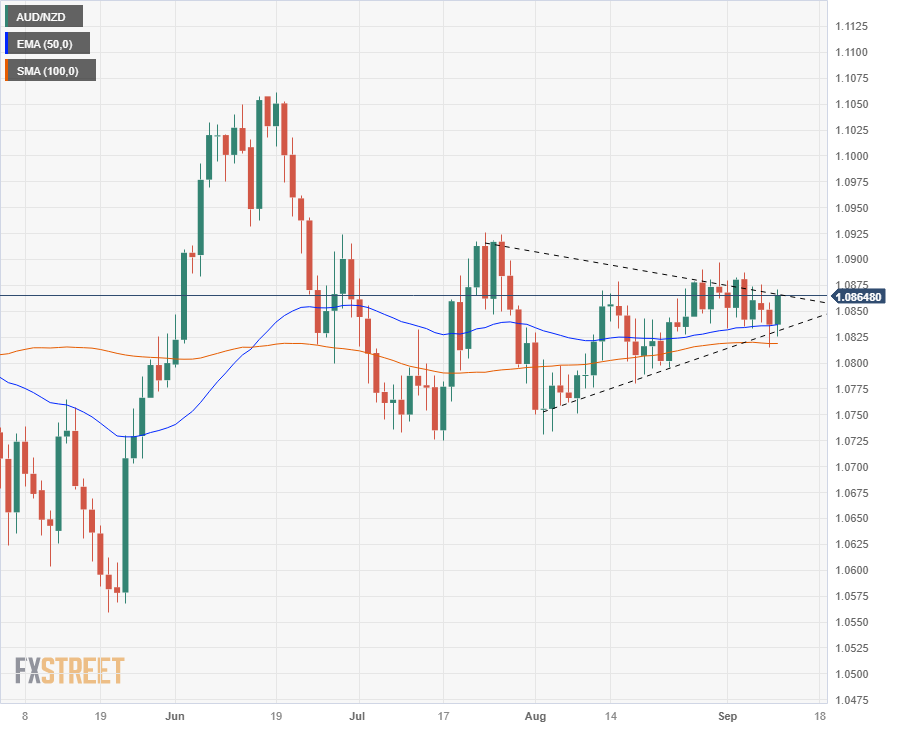
The Aussie-Kiwi pairing is holding steady in consolidation territory just below the 1.0880 level, but the floor has been sagging in recent days, and each downturn for the AUD sees fresh lows. Chart action is now tapping into a declining trendline baked into the 4-hour candles, and a turnaround from this region will see new bearish challenges of the 1.0820 handle.
On the bullish side, a fresh break to the high side will see significant action around the 1.1000 major psychological level, a region from which the Aussie faced rejection seven weeks ago. Meanwhile, a rough wedge on the daily candles is running aground of consolidating support from the constrained 50-day Exponential Moving Average and 100-day Simple Moving Average.
AUD/NZD 4-hour chart
Author

Joshua Gibson
FXStreet
Joshua joins the FXStreet team as an Economics and Finance double major from Vancouver Island University with twelve years' experience as an independent trader focusing on technical analysis.


![How Wall Street rigs the game [Video]](https://editorial.fxsstatic.com/images/i/market-chaos-01.jpg)