|

AUD/JPY Price Analysis: dropping from 94.80 with further downside on the books

  • The AUD/JPY wobbled on Thursday, dipping from the open before staging a relief rally into 95.15.
  • The Aussie is falling back once more, settling Thursday's trading session close to where it started.
  • A bearish lean is baked into the candles heading into Asia's early market window.

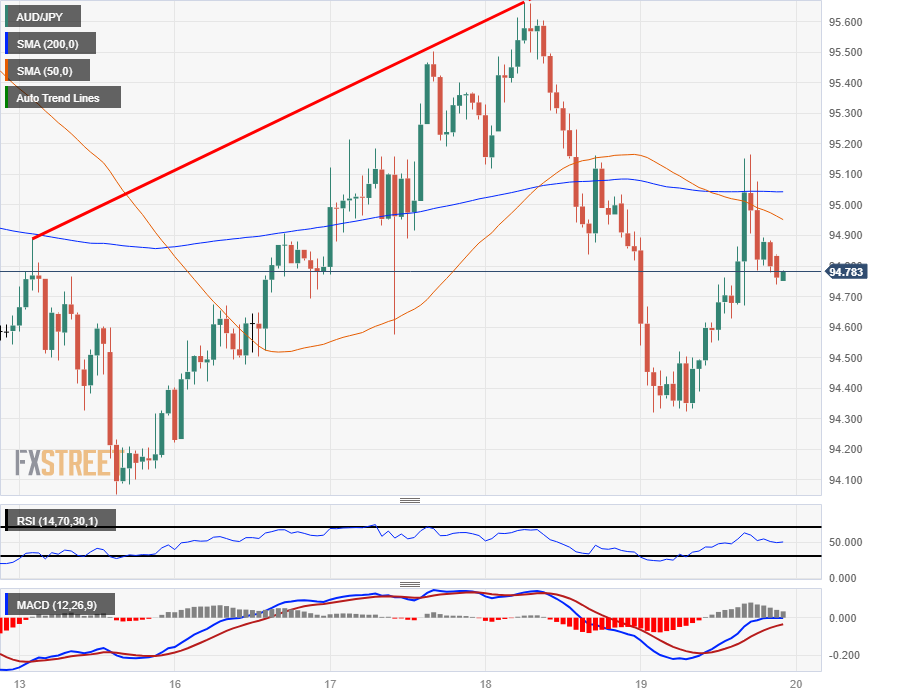
The AUD/JPY kicked off Thursday trading at 94.85 before dropping into an early low of 94.31. The Aussie (AUD) then rallied against the Japanese Yen (JPY), ticking into 95.16 before seeing an intraday rejection of the 200-hour Simple Moving Average (SMA) near 95.05.

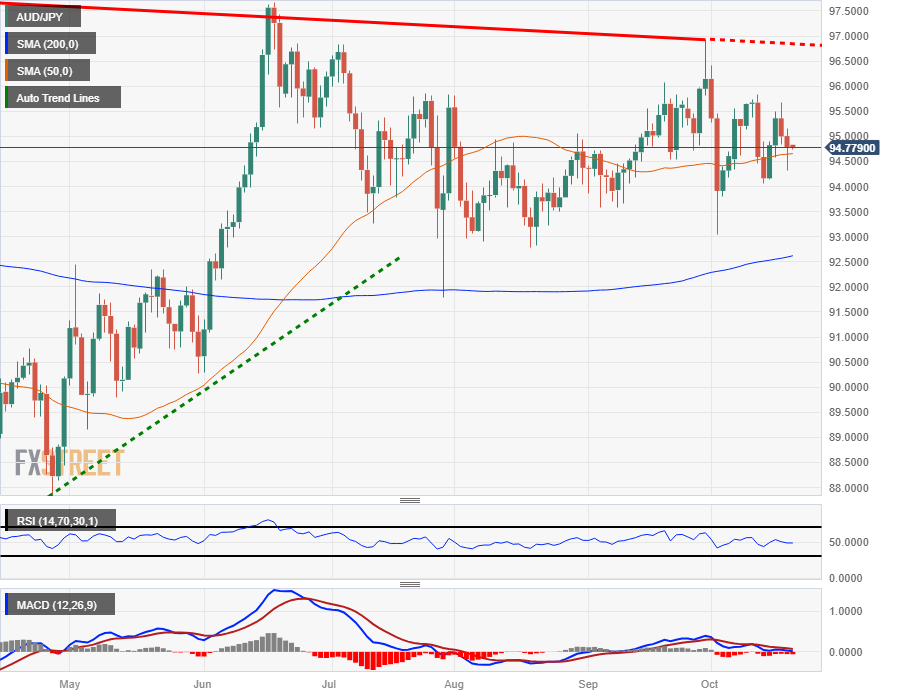
Daily candlesticks have the AUD/JPY stuck firmly in familiar congestion, with the pair trading in a constrained channel from 93.00 to 96.00 since running up the charts into 97.67 in June.

The medium-term trend is firmly planted in the midrange, with prices continuing to cycle around the 50-day SMA, with the 200-day SMA buoying bids from 92.62, providing technical support for any shifts to the downside.

AUD/JPY Hourly Chart
AUD/JPY Daily Chart
AUD/JPY Technical Levels

AUD/JPY

Overview
Today last price94.76
Today Daily Change-0.24
Today Daily Change %-0.25
Today daily open95
 
Trends
Daily SMA2095.12
Daily SMA5094.64
Daily SMA10094.73
Daily SMA20092.57
 
Levels
Previous Daily High95.66
Previous Daily Low94.84
Previous Weekly High95.83
Previous Weekly Low94.05
Previous Monthly High96.92
Previous Monthly Low93.59
Daily Fibonacci 38.2%95.15
Daily Fibonacci 61.8%95.35
Daily Pivot Point S194.67
Daily Pivot Point S294.34
Daily Pivot Point S393.84
Daily Pivot Point R195.5
Daily Pivot Point R295.99
Daily Pivot Point R396.32

Author

Joshua Gibson

Joshua joins the FXStreet team as an Economics and Finance double major from Vancouver Island University with twelve years' experience as an independent trader focusing on technical analysis.


More from Joshua Gibson
Share:

Editor's Picks

GBP/USD: Daily gains remain capped by 1.3650

GBP/USD leaves behind Monday’s pessimism and advances marginally on Tuesday. Cable’s humble gains, however, appear to have met quite a decent resistance in the 1.3650 zone for now, in a context of a slight selling pressure hovering around the Greenback.

EUR/USD struggles to regain pace; gyrates around 1.1670

EUR/USD clinches humble gains around 1.1670 following Tuesday’s close on Wall Street. Indeed, marginal losses in the US Dollar encourages spot to set aside two dauly pullbacks in a row and maintain the 1.1700 barrier on the cross-hairs for now. Moving forward, US inflation tracked by the PCE and another revision of Q2 GDP data should keep investors entertained on Wednesday.

Gold: Buyers still hold the grip

Gold navigates the middle of its daily range near $4,650 per troy ounce on Tuesday. The lack of clear direction in the yellow metal comes on the back of the widespread cautious tone among market participants, a mildly offered stance in the US Dollar and a marked decline in US Treasury yields across the curve.

BNB Price Forecast: BNB rally stalls as Pasteur hardfork launches on BSC mainnet
BNB (BNB) shows subtle weakness, sliding below $700 on Tuesday. Last week's broader crypto rally propelled BNB to $725 from support around $600. The token native to Binance, the largest crypto exchange by trading volume, flaunts a bullish picture. However, momentum indicators signal that the uptrend may be overstretched, raising the odds of an extended correction.
Nvidia earnings: A quick look at expectations

The 2026 Q2 earnings season is nearly over for S&P 500 members, with the reporting cycle notably positive. But looming large this week is none other than AI-favorite NVIDIA (NVDA) , whose results will wrap up the reporting cycle for the Magnificent Seven group as well.

$20 billion offered, $2 billion taken: Why Treasury doubled its buyback cap

The US Treasury moved off its own calendar on Wednesday, and that is the part worth sitting with. At 12:32 GMT, the department said it would at least double the size of liquidity support buyback operations in the 10-year to 20-year and 20-year to 30-year sectors, lifting the maximum from $2 billion per operation to at least $4 billion, effective September 9 and running to November 4.















