AUD/JPY holds near 109.00 as RBA-BoJ policy gap widens
- Australian Dollar supported by hawkish RBA stance and tight labor market as BoJ normalizes gradually.
- Australia's January employment data showed unemployment steady at 4.1%, reinforcing the Reserve Bank of Australia's hawkish outlook and keeping a further rate hike on the table.
- The Bank of Japan held rates at 0.75% in January with markets pricing an 80% chance of an April hike, while US core Personal Consumption Expenditures (PCE) data on Friday could shift broader risk sentiment.
The Reserve Bank of Australia (RBA) raised its cash rate by 25 basis points to 3.85% earlier this month, the first hike in over two years, citing a material pickup in inflation through the second half of 2025. This week's RBA minutes reinforced a data-dependent but hawkish stance, and Thursday's January employment report kept the unemployment rate at 4.1%, below the expected 4.2%, even as headline job gains of 17.8K missed the 20K consensus. On the Japanese Yen side, the Bank of Japan (BoJ) held rates at 0.75% at its January meeting, though board members continue to signal that further normalization is needed. Markets are pricing in a roughly 80% probability of a BoJ hike by April, which could narrow the rate differential and weigh on the cross if realized. Friday's US Q4 Gross Domestic Product (GDP) and core PCE round out a heavy week.
Consolidation near 109.00 as Stochastic drifts to neutral
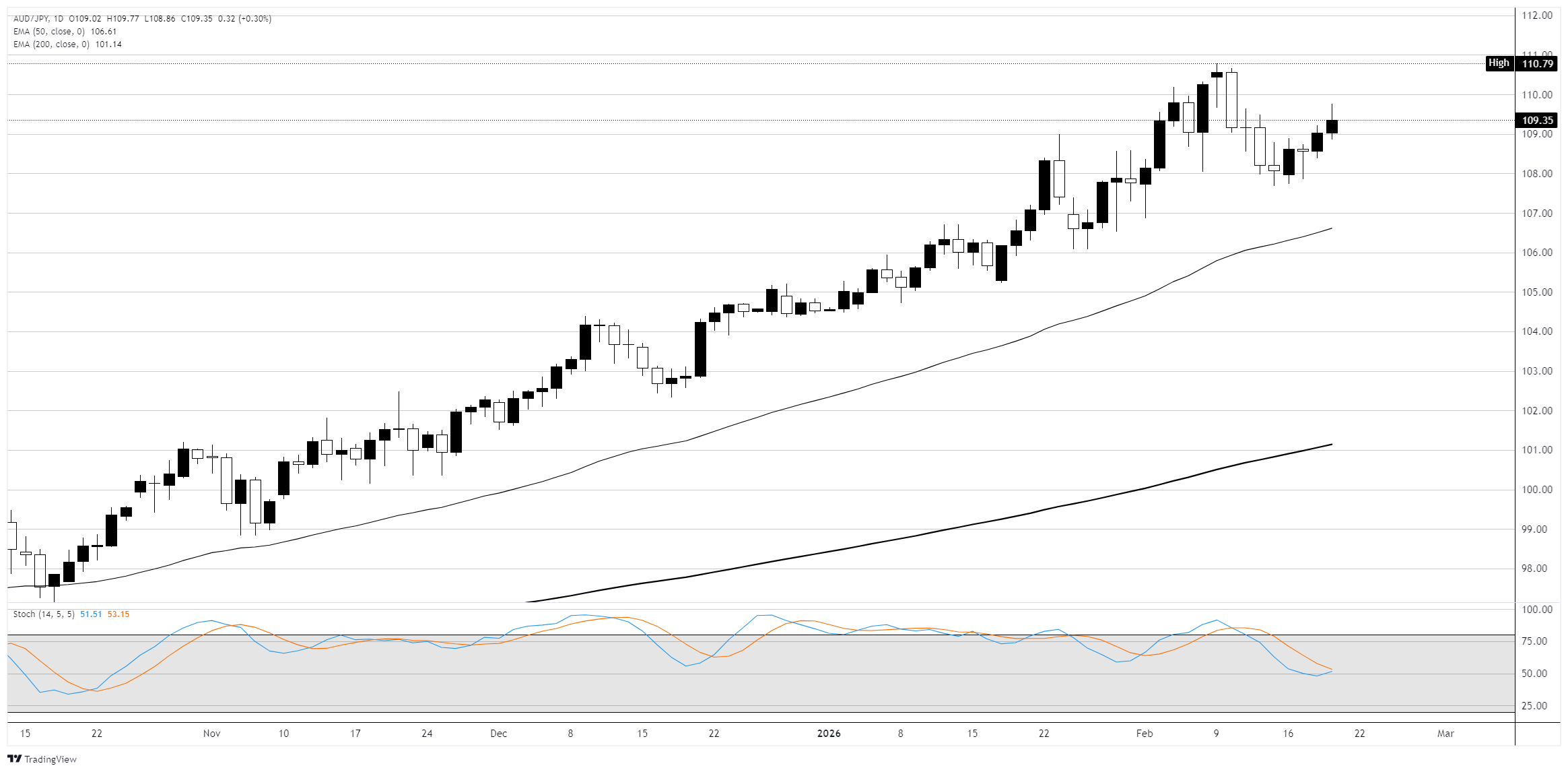
On the daily chart, AUD/JPY traded in a narrow range near 109.00 on Thursday. The pair is holding well above the rising 50-day Exponential Moving Average (EMA) at 106.60 and the 200-day EMA at 100.45, confirming the uptrend from the early January lows near 104.72 is continuing. The rally from those lows has stalled since printing a year-to-date high at 110.79 in early February, with price consolidating in a roughly 109.00 to 110.00 range over the past two weeks. The Stochastic Oscillator has rolled down from the overbought zone and is now drifting near the midline, suggesting momentum has cooled and the pair has room to move in either direction. A cluster of small-bodied candles near 109.00 points to indecision. Resistance sits at the 110.79 high; a break above would open the path toward 112.00. Support rests at 108.00, with the 50-day EMA at 106.60 below.
AUD/JPY daily chart
Australian Dollar FAQs
One of the most significant factors for the Australian Dollar (AUD) is the level of interest rates set by the Reserve Bank of Australia (RBA). Because Australia is a resource-rich country another key driver is the price of its biggest export, Iron Ore. The health of the Chinese economy, its largest trading partner, is a factor, as well as inflation in Australia, its growth rate and Trade Balance. Market sentiment – whether investors are taking on more risky assets (risk-on) or seeking safe-havens (risk-off) – is also a factor, with risk-on positive for AUD.
The Reserve Bank of Australia (RBA) influences the Australian Dollar (AUD) by setting the level of interest rates that Australian banks can lend to each other. This influences the level of interest rates in the economy as a whole. The main goal of the RBA is to maintain a stable inflation rate of 2-3% by adjusting interest rates up or down. Relatively high interest rates compared to other major central banks support the AUD, and the opposite for relatively low. The RBA can also use quantitative easing and tightening to influence credit conditions, with the former AUD-negative and the latter AUD-positive.
China is Australia’s largest trading partner so the health of the Chinese economy is a major influence on the value of the Australian Dollar (AUD). When the Chinese economy is doing well it purchases more raw materials, goods and services from Australia, lifting demand for the AUD, and pushing up its value. The opposite is the case when the Chinese economy is not growing as fast as expected. Positive or negative surprises in Chinese growth data, therefore, often have a direct impact on the Australian Dollar and its pairs.
Iron Ore is Australia’s largest export, accounting for $118 billion a year according to data from 2021, with China as its primary destination. The price of Iron Ore, therefore, can be a driver of the Australian Dollar. Generally, if the price of Iron Ore rises, AUD also goes up, as aggregate demand for the currency increases. The opposite is the case if the price of Iron Ore falls. Higher Iron Ore prices also tend to result in a greater likelihood of a positive Trade Balance for Australia, which is also positive of the AUD.
The Trade Balance, which is the difference between what a country earns from its exports versus what it pays for its imports, is another factor that can influence the value of the Australian Dollar. If Australia produces highly sought after exports, then its currency will gain in value purely from the surplus demand created from foreign buyers seeking to purchase its exports versus what it spends to purchase imports. Therefore, a positive net Trade Balance strengthens the AUD, with the opposite effect if the Trade Balance is negative.
Author

Joshua Gibson
FXStreet
Joshua joins the FXStreet team as an Economics and Finance double major from Vancouver Island University with twelve years' experience as an independent trader focusing on technical analysis.