AUD/JPY edges lower despite upbeat Aussie Composite PMI, Australian Monthly CPI eyed
- AUD/JPY depreciates a positive sentiment due to the easing geopolitical tensions in the Middle East.
- Australia's Judo Bank Composite PMI indicated a rapid expansion in the Australian private sector during Q2.
- The Japanese Yen encounters challenges as the yield gap widens between Japan and other major countries.


AUD/JPY loses ground on Tuesday following gains in the previous session. However, the prevailing optimistic mood may lend support to the Australian Dollar (AUD), underpinning the AUD/JPY cross, potentially influenced by a relaxed geopolitical climate in the Middle East.
Australia's Judo Bank Composite Purchasing Managers Index (PMI) surged to a 24-month high of 53.6 in April, marking an improvement from the previous month's 53.3. This signals an accelerated expansion in the Australian private sector during the second quarter, with notable growth driven by the services sector.
The Japanese Yen (JPY) faces challenges due to the expanding yield gap between Japan and many other major countries, prompting traders to borrow JPY and invest in higher-yielding assets elsewhere.
Additionally, Reuters reported that Bank of Japan (BoJ) Governor Kazuo Ueda reiterated on Tuesday that the central bank would raise interest rates again if trend inflation accelerates toward its 2% target, in line with its forecast. Ueda also said that it is hard to predict in advance the ideal timeframe for the Bank of Japan (BoJ) to gather sufficient data before considering a policy change.
Daily Digest Market Movers: AUD/JPY consolidates with an improved risk sentiment
- Australia's Judo Bank Manufacturing PMI rose to an eight-month high of 49.9 in April, compared to March's 47.3. Services PMI declined to a 2-month low of 54.2 compared to the previous reading of 54.4.
- The weekly ANZ-Roy Morgan Australian Consumer Confidence declined by 3.2 points to reach its lowest level this year at 80.3, down from the previous reading of 83.5. ANZ noted that both economic and financial subindices experienced decreases. Confidence dropped across various housing cohorts, with renters being particularly affected.
- Japan’s Jibun Bank Manufacturing PMI improved to 49.9 in April, compared to the expected reading of 48.0 and 48.2 prior. Meanwhile, Services PMI rose to 54.6 from the previous reading of 54.1.
- Japan's Finance Minister Shunichi Suzuki stated on Tuesday that last week's trilateral meeting with his counterparts from the U.S. and South Korea likely established a foundation for Tokyo to undertake necessary measures in the foreign exchange market.
- On Tuesday, the China Securities Journal reported that the People's Bank of China (PBoC) will decrease the Medium-term Lending Facility (MLF) rate, aiming to lower funding costs. The next MLF rate setting is scheduled for May 15. This decision could potentially influence the Australian market, given the close trade relationship between the two countries.
- The People's Bank of China maintained its Loan Prime Rates (LPR) at 3.45% on Monday. The LPR functions as a benchmark rate for Chinese banks in setting interest rates for loans extended to their clients.
- On Monday, the Chinese Ministry of Commerce announced a new tariff on US goods. Specifically, China has imposed a duty of 43.5% on imports of propionic acid from the United States. This chemical is extensively utilized in various sectors, including food, feed, pesticides, and medical applications, as per Reuters report.
- Traders are expected to closely monitor the upcoming Monthly Consumer Price Index and quarterly RBA Trimmed Mean CPI data from Australia on Wednesday.
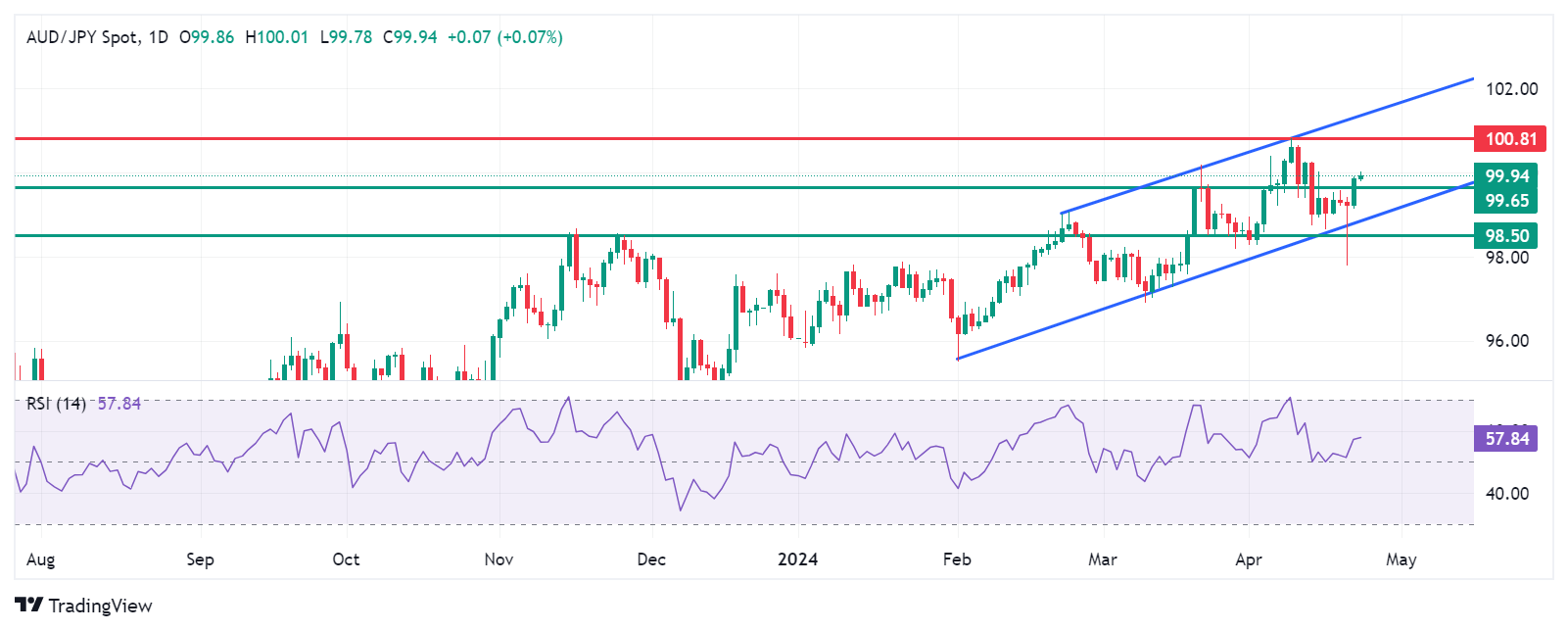
Technical Analysis: AUD/JPY holds position around the level of 100.00
The AUD/JPY trades around 99.90 on Tuesday. The currency cross remains above the significant support level of 99.65. The daily ascending channel, coupled with the 14-day Relative Strength Index (RSI) reacting above the 50 level, indicates an evolving bullish sentiment. The immediate barrier appears at the psychological level of 100.00, following the major level of 100.50 and April’s high of 100.81. A break above this region could lead the AUD/JPY cross to test the upper boundary of the ascending channel at 101.30.
On the downside, the AUD/JPY cross could find immediate support at the psychological level of 99.50. A break below this level could lead the pair to approach the psychological level of 99.00. A break below this level could push the pair to test the lower boundary of the ascending channel and a major level of 98.50.
AUD/JPY: Daily Chart
Australian Dollar price today
The table below shows the percentage change of the Australian Dollar (AUD) against listed major currencies today. The Australian Dollar was the weakest against the Japanese Yen.
| USD | EUR | GBP | CAD | AUD | JPY | NZD | CHF | |
| USD | 0.07% | 0.09% | 0.03% | 0.05% | -0.01% | 0.23% | 0.05% | |
| EUR | -0.08% | -0.01% | -0.05% | -0.01% | -0.10% | 0.15% | -0.05% | |
| GBP | -0.09% | -0.01% | -0.06% | -0.03% | -0.10% | 0.15% | -0.04% | |
| CAD | -0.04% | 0.04% | 0.05% | 0.04% | -0.05% | 0.20% | 0.01% | |
| AUD | -0.06% | 0.00% | 0.02% | -0.04% | -0.08% | 0.17% | -0.03% | |
| JPY | 0.02% | 0.10% | 0.10% | 0.05% | 0.09% | 0.26% | 0.07% | |
| NZD | -0.23% | -0.17% | -0.15% | -0.21% | -0.16% | -0.24% | -0.19% | |
| CHF | -0.04% | 0.04% | 0.04% | -0.01% | 0.03% | -0.07% | 0.20% |
The heat map shows percentage changes of major currencies against each other. The base currency is picked from the left column, while the quote currency is picked from the top row. For example, if you pick the Euro from the left column and move along the horizontal line to the Japanese Yen, the percentage change displayed in the box will represent EUR (base)/JPY (quote).
Australian Dollar FAQs
One of the most significant factors for the Australian Dollar (AUD) is the level of interest rates set by the Reserve Bank of Australia (RBA). Because Australia is a resource-rich country another key driver is the price of its biggest export, Iron Ore. The health of the Chinese economy, its largest trading partner, is a factor, as well as inflation in Australia, its growth rate and Trade Balance. Market sentiment – whether investors are taking on more risky assets (risk-on) or seeking safe-havens (risk-off) – is also a factor, with risk-on positive for AUD.
The Reserve Bank of Australia (RBA) influences the Australian Dollar (AUD) by setting the level of interest rates that Australian banks can lend to each other. This influences the level of interest rates in the economy as a whole. The main goal of the RBA is to maintain a stable inflation rate of 2-3% by adjusting interest rates up or down. Relatively high interest rates compared to other major central banks support the AUD, and the opposite for relatively low. The RBA can also use quantitative easing and tightening to influence credit conditions, with the former AUD-negative and the latter AUD-positive.
China is Australia’s largest trading partner so the health of the Chinese economy is a major influence on the value of the Australian Dollar (AUD). When the Chinese economy is doing well it purchases more raw materials, goods and services from Australia, lifting demand for the AUD, and pushing up its value. The opposite is the case when the Chinese economy is not growing as fast as expected. Positive or negative surprises in Chinese growth data, therefore, often have a direct impact on the Australian Dollar and its pairs.
Iron Ore is Australia’s largest export, accounting for $118 billion a year according to data from 2021, with China as its primary destination. The price of Iron Ore, therefore, can be a driver of the Australian Dollar. Generally, if the price of Iron Ore rises, AUD also goes up, as aggregate demand for the currency increases. The opposite is the case if the price of Iron Ore falls. Higher Iron Ore prices also tend to result in a greater likelihood of a positive Trade Balance for Australia, which is also positive of the AUD.
The Trade Balance, which is the difference between what a country earns from its exports versus what it pays for its imports, is another factor that can influence the value of the Australian Dollar. If Australia produces highly sought after exports, then its currency will gain in value purely from the surplus demand created from foreign buyers seeking to purchase its exports versus what it spends to purchase imports. Therefore, a positive net Trade Balance strengthens the AUD, with the opposite effect if the Trade Balance is negative.
Author
Akhtar Faruqui
FXStreet
Akhtar Faruqui is a Forex Analyst based in New Delhi, India. With a keen eye for market trends and a passion for dissecting complex financial dynamics, he is dedicated to delivering accurate and insightful Forex news and analysis.