|premium|

AMD news: Advanced micro devices stock falls during another roller coaster session

  • NASDAQ:AMD dips by 0.45% as the Fed interest rate announcement rocks tech sectors.
  • AMD unveils a new version of its Radeon GPU that features liquid cooling technology.
  • A report surfaces that 25% of GPUs in the first quarter of 2021 were used for Crypto mining.

NASDAQ:AMD has seen its recent downtrend continue with another lower low on Wednesday during a whipsaw session that sent the markets tumbling midday. Shares of AMD lost 0.45% to close the trading day at $80.11, after hitting as low as $78.96 during intraday trading. AMD has struggled to gain traction as of late, and Wednesday was the third straight day this week that the stock closed at a lower low, signalling a bit of bearishness starting to creep into its chart. 


Stay up to speed with hot stocks' news!


AMD did manage to unveil a new Radeon GPU model of processor on Wednesday that utilizes the company’s patented liquid cooling technology. The Radeon RX 6900 XT Liquid Edition has a higher board power and runs at higher speeds than its non-liquid cooling counterpart. The early rumor is that this version will only be available in pre-built gaming computers, which would definitely make them an exclusive feature that gamers would seek out. 

AMD stock forecast
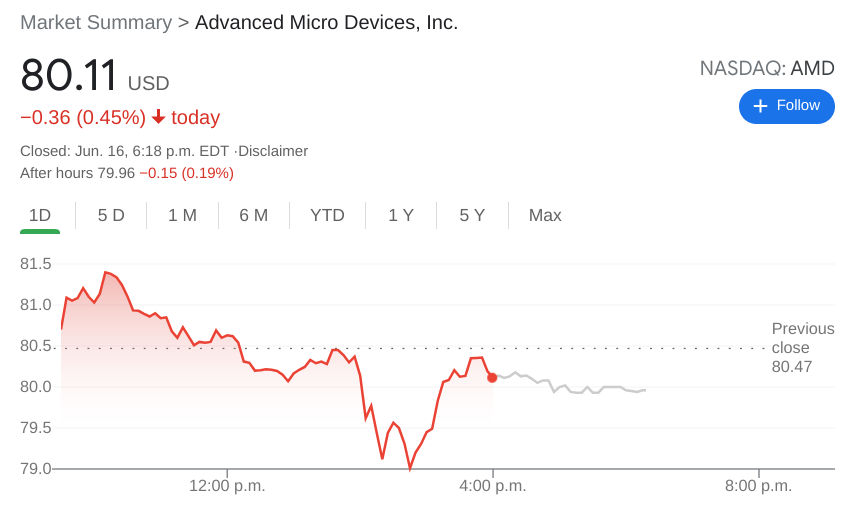
AMD wasn’t the only chip stock to fall on Wednesday, as the Fed announcement of interest rates arriving sooner than expected did not sit well with growth investors. Other industry stalwarts like Intel (NASDAQ:INTC) and Taiwan Semiconductor (NYSE:TSM) fell by 1.33% and 1.20% respectively, although industry leader NVIDIA (NASDAQ:NVDA) was up slightly by 0.12% on the day.


A new report from John Peddie Research showed that nearly 25% of high powered GPUs that were sold in the first quarter of 2021, were used for the purposes of cryptocurrency mining. While the company cites NVIDIA as the leading producer of the CMP crypto-mining cards, it revealed that AMD has not taken any steps towards creating specific crypto-mining cards to compete in the growing market.

Premium

You have reached your limit of 3 free articles for this month.

Start your subscription and get access to all our original articles.

Subscribe to PremiumSign In

Author

More from Stocks Reporter
Share:

Editor's Picks

GBP/USD pops to three-week highs above 1.3400

GBP/USD accelerates its advance and surpasses the key 1.3400 barrier on Wednesday. That said, Cable clinches new multi-week tops on the back of the resurgence of the selling interest in the Greenback despite persistent tensions in the Middle East.

EUR/USD reverses losses, targets 1.1450

EUR/USD trades with decent gains north of the 1.1400 hurdle in the latter part of Wednesday’s NA session. The fresh offered stance in the US Dollar allowed the pair to revert the initial drop and refocus on the upside despite the hawkish tone from the FOMC Minutes and persistent geopolitical tensions.

Gold trims losses, looks at $4,100

Gold manages to regain some composure and bounce off earlier lows on Wednesday. The precious metal now shifts its focus to the $4,100 mark per troy ounce amid decent losses in the US Dollar and steady geopolitical jitters.

Dogecoin Forecast: DOGE risks sliding below $0.07 despite returning retail interest
Dogecoin (DOGE) edges lower toward support at $0.07 at the time of writing on Wednesday. The meme coin reflects a broader sell-off in the crypto market, primarily attributed to uncertainty over tensions in the Middle East. Iran launched attacks on American military bases in the Middle East on Wednesday in retaliation for attacks by the United States (US) on several places in Iran.
2.50%: Why the Kiwi's first hike in three years is a wager on a number nobody can see
The Reserve Bank of New Zealand (RBNZ) raised the Official Cash Rate (OCR) by 25 basis points to 2.50% at 02:00 GMT on Wednesday, its first hike in three years and the moment the bank that cut deeper than any G10 peer last cycle turned to face the other way.
Bye, forward guidance: How to trade when central banks choose silence

Central banks have spent years telling markets what might come next. Now, traders face the possibility that they say a lot less. From the Federal Reserve to the European Central Bank and the Bank of England, policymakers are pushing back against forward guidance.
















