|

AMC Share Price: Support breaks as AMC officially is in free fall

  • NYSE:AMC tumbles 7.65% on Tuesday as meme stocks plunge further.
  • Retail investors are trying to initiate another squeeze with #AMCDay trending on social media.
  • If record ticket sales can’t save AMC’s stock, there may be little hope left. 

NYSE:AMC investors who were left holding the bag after the recent short squeeze in June are feeling those bags getting heavier by the day. On Tuesday, shares of the world’s largest movie theater chain dropped by 7.65% and closed the session at $39.35, as the stock breached the $40 price level for the first time in weeks. AMC continued to spiral downwards in after hours trading as well with shares losing a further 5% at the time of this writing. Why is AMC plummeting out of control? Lower trading volume and lost momentum from the social media movement seems to have been too much for diamond hands to handle. 


Stay up to speed with hot stocks' news!


Retail investors are trying their best to have history repeat itself, as #AMCDay was trending once again on social media on Tuesday. The last time this happened, Apes were able to coordinate a squeeze up to over $60 at the beginning of June, so time will tell if the latest effort will reap the same rewards. Judging by the stock’s performance on Tuesday, it doesn’t seem like the movement has formed much of a rally the second time around. 

AMC stock forecast
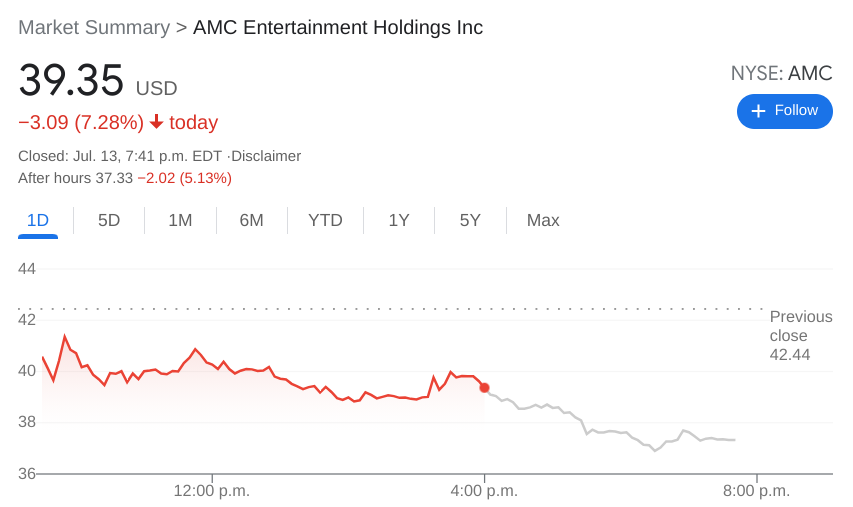
AMC reported record ticket sales last weekend after the global premiere of Disney’s (NYSE:DIS) latest Marvel Universe movie, the Black Widow. Despite this, shares of AMC fell on Monday and Tuesday, signalling that even the global reopening at the ticket booth may not be able to save AMC’s stock from remaining overvalued and uber inflated. Streaming services threaten to cut into AMC’s revenues, and even the release of further summer blockbusters may not have the same impact or success that Black Widow had. 

Author

More from Stocks Reporter
Share:

Editor's Picks

AUD/USD turns south toward 0.6900 as USD firms up

AUD/USD sees fresh selling and drops toward 0.6900 in late Asian trading on Monday, as renewed US Dollar strength weighs on the pair amid lingering Middle East and Russia-Ukraine geopolitical tensions. Focus remains on Oil prices, Treasury bond yields, and RBA expectations for fresh trading impetus in the major.

USD/JPY retakes 158.00 amid hawkish BoJ bets, firmer USD

USD/JPY erases losses and retakes 158.00 in the Asian session on Monday, trading within a one-week-old range. Geopolitical uncertainty continues to underpin the US Dollar, despite fading Fed rate hike hopes, supporting the pair's rebound. However, further upside could be capped by hawkish BoJ expectations and looming intervention risks that could support the Japanese Yen.

Gold languishes below $4,200 amid high US yields

Gold trims some losses on Monday, but remains trapped within previous ranges, with upside attempts limited below $4,200 and with two-month lows of $4,110 at a short distance. The recent pullback on the US Dollar Index has provided some support for precious metals although the high US Treasury yields are keeping a floor on US Dollar dips so far.

Pi Network risks a steeper decline as bearish momentum builds

Pi Network extends losses below $0.090 maintaining a steady decline for the fifth consecutive day. The retail demand remains firm, with the notional value of active perpeutals holding above $10 million. The technical outlook for PI remains bearish as bearish momentum mounts.

ISM Services PMI expected to show robust US economy in September

The US ISM Services PMI is expected to improve marginally in September. The US services sector is expected to remain well into expansionary territory. Bets of further Fed tightening appear to have lost traction in the last few days.

The Euro is near a one-year low: Inflation could trigger its rebound, not its fall

EUR/USD has fallen to its lowest level since May 2025. The pair hit 1.1312 on Wednesday and trades well below the January peak of 1.2082. The decline reflects a powerful combination of US Dollar strength, geopolitical uncertainty and renewed concerns about Europe's exposure to higher energy prices.