Advanced Micro Devices Stock News: AMD moving averages forecast further bearish price action
- AMD on Tuesday nearly produced a Downside Tasuki Gap pattern.
- Advanced Micro Devices plans to reach a 30x energy efficiency figure by 2025 for its AI processors.
- 9-day moving average moved below 21-day moving average on Tuesday.

Advanced Micro Devices (AMD) saw its 9-day moving average drop below its 21-day moving average on Tuesday in what is likely a sign that Monday's deep red candlestick will be continued by a downturn despite Tuesday and Wednesday's rebound. The semiconductor hot stock is flat at the time of writing but has traded as high as $147.03 and as low as $142.70 in Wednesday's session.
Advanced Micro Devices (AMD) Stock News: a new goal for energy efficiency
In a blog post last week, Advanced Micro Devices announced a new goal. It wants to produce 30x energy efficiency for its accelerated computing processors used by the artificial intelligence and high-performance computing sectors. This amounts to beating the industry's recent past progress on this metric by about 2.5x per year. It would mean reducing the power needed to run these elite processors by 97%.
In late November Bank of America analysts said that for the first time in its history AMD stock had a greater percentage of ownership by investment funds than rival Intel. Management at Intel may have read the note as on Monday they announced their intention to spin out their autonomous driving subsidiary Mobileye. The IPO is tentatively scheduled for some time in mid-2022.
AMD CEO Lisa Su announced at a conference last week that she expects the acquisition of Xilinx to be completed before 2022. The chip maker has received anti-trust approval in the US and Europe but is waiting on feedback and approval from third-party partners in China. Rival Nvidia has recently seen its proposed merger with Arm become the subject of a lawsuit by the Federal Trade Commission.
AMD key statistics
| Market Cap | $174 billion |
| Price/Earnings | 44 |
| Price/Sales | 12 |
| Price/Book | 24 |
| Enterprise Value | $171 billion |
| Operating Margin | 21% |
| Profit Margin |
27% |
| 52-week high | $164.46 |
| 52-week low | $72.50 |
| Short Interest | 6% |
| Average Wall Street Rating and Price Target | Buy, $141.50 |
Advanced Micro Devices (AMD) Stock Forecast: the downturn should continue
Following the Moving Average Convergence Divergence (MACD) crossing lower on December 1, now the 9-day moving average is crossing below its 21-day counterpart. The shorter average has been above its longer-dated cousin since October 13. Monday's crash, however, has made the current month pullback seem more longer term in nature.
Monday's low of $134.23 was below the low of November 5, another signal that all was not well. The past few sessions produced what nearly amounted to a Downside Tasuki Gap. This is a bearish continuation pattern. Friday and Monday's plunge produced the gap. Tuesday, however, saw AMD price action close above the gap, just barely, so maybe we should discard this signal.
FXStreet View: We think the bearish pullback will continue with the crossing of the short-term moving averages. Bulls should wait for $120 to enter.
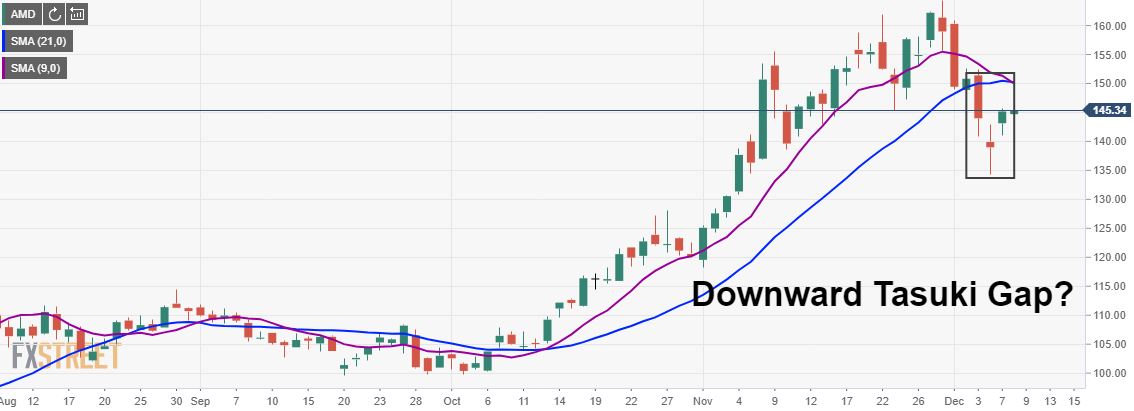
AMD 1-day chart
Like this article? Help us with some feedback by answering this survey:
Author

Clay Webster
FXStreet
Clay Webster grew up in the US outside Buffalo, New York and Lancaster, Pennsylvania. He began investing after college following the 2008 financial crisis.