The precious metals market has just passed a symbolic milestone. The price of Silver (XAG/USD) has surged above $40 an ounce, reaching its highest level since September 2011. This move is attracting the attention of investors around the world, both for its economic implications and for what it reveals about the current economic climate.
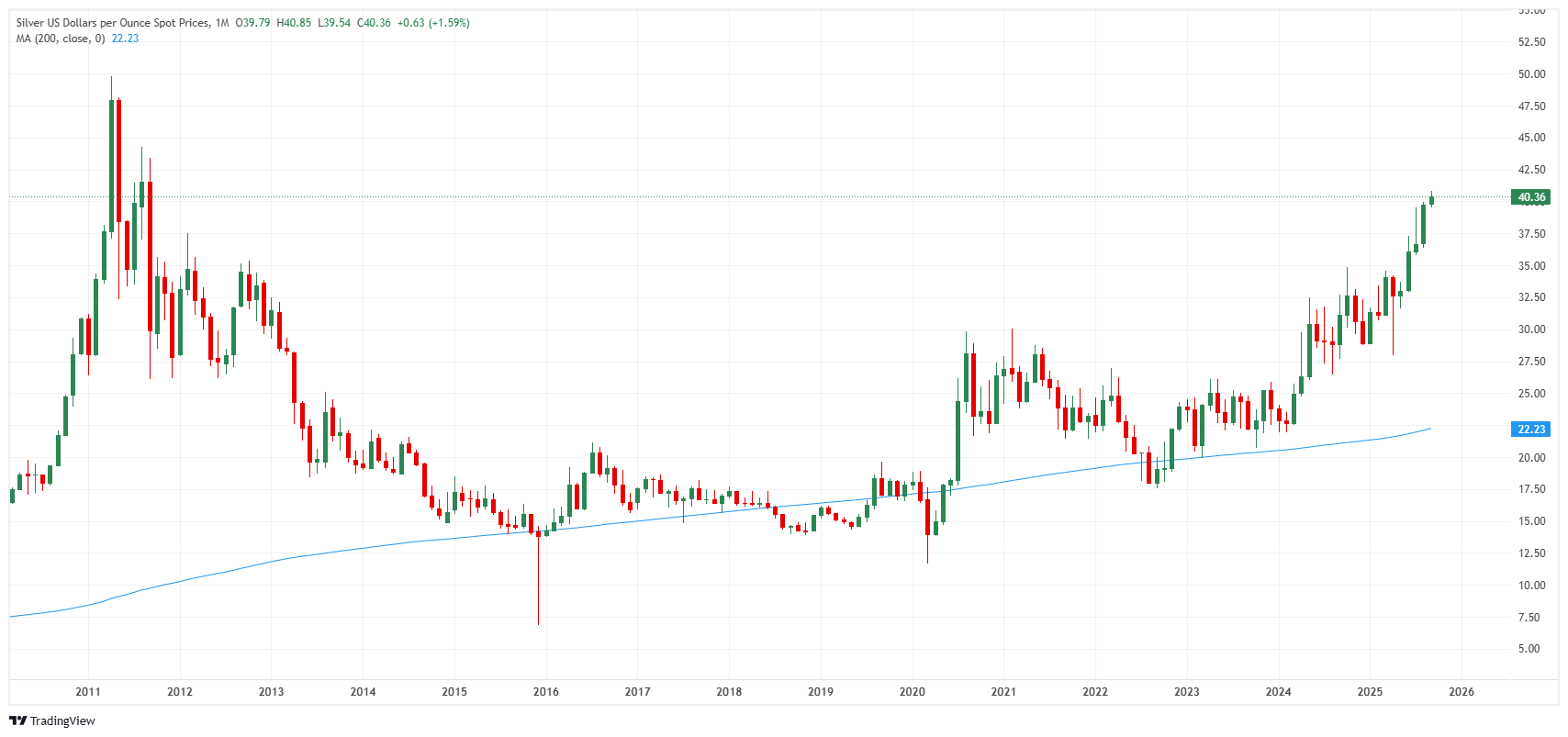
Silver monthly chart. Source: FXStreet
A movement fuelled by interest rates
This surge in Silver prices is primarily due to expectations of lower interest rates in the United States (US). The US Federal Reserve (Fed) is expected to ease monetary policy this autumn, against a backdrop of a slowing job market and inflation that many still consider too high.
Precious metals such as Gold and Silver offer no direct return. When interest rates fall, the opportunity cost of holding these assets decreases, making them even more attractive.
It is this mechanism that is currently fuelling a wave of buying, supported by the conviction that the Fed will soon have its hands free to revive credit and support the economy.
A climate of uncertainty in the United States
The political context adds a further dimension to this dynamic. In the United States, the debate over the Fed's independence has intensified, fuelled by US President Donald Trump's repeated criticism of the monetary institution.
His attacks have cast doubt on the stability of economic policies, boosting demand for safe-haven assets.
In addition, persistent trade tensions and court rulings on US tariffs add to the uncertainty. In this environment, Silver and Gold appear to be reassuring alternatives for investors.
The scarcity effect: A market under pressure
Beyond monetary policy, the Silver market is also underpinned by a particular supply and demand dynamic.
The Silver Institute estimates that 2025 could mark the fifth consecutive year of supply deficit. Industrial demand, particularly in the solar energy and cleantech sectors, continues to grow, while available stocks are eroding.
Silver-backed index funds (ETFs) are seeing massive inflows from investors, notes Bloomberg, further reducing the quantities available on the physical market.
This supply pressure is amplifying price rises, adding a structural factor to a trend already underpinned by macroeconomic conditions.
A sustainable surge?
The question now is whether Silver can extend its rally beyond $40. Some analysts, like those at Morgan Stanley, believe that the upside potential remains significant, thanks to a weaker US Dollar (USD) and sustained demand.
Others point out that this technical threshold represents historic resistance, likely to trigger short-term profit-taking.
Whatever the case, Silver's breakthrough of $40 marks a turning point. In a world where the United States still dominates global monetary and economic dynamics, the Fed's trajectory and the evolution of interest rates will remain the main drivers of the gray metal.
But the Silver equation goes far beyond this. Between its role as a safe-haven asset and its strategic industrial use, Silver is more than ever a barometer of the financial markets' concerns and hopes.
Information on these pages contains forward-looking statements that involve risks and uncertainties. Markets and instruments profiled on this page are for informational purposes only and should not in any way come across as a recommendation to buy or sell in these assets. You should do your own thorough research before making any investment decisions. FXStreet does not in any way guarantee that this information is free from mistakes, errors, or material misstatements. It also does not guarantee that this information is of a timely nature. Investing in Open Markets involves a great deal of risk, including the loss of all or a portion of your investment, as well as emotional distress. All risks, losses and costs associated with investing, including total loss of principal, are your responsibility. The views and opinions expressed in this article are those of the authors and do not necessarily reflect the official policy or position of FXStreet nor its advertisers. The author will not be held responsible for information that is found at the end of links posted on this page.
If not otherwise explicitly mentioned in the body of the article, at the time of writing, the author has no position in any stock mentioned in this article and no business relationship with any company mentioned. The author has not received compensation for writing this article, other than from FXStreet.
FXStreet and the author do not provide personalized recommendations. The author makes no representations as to the accuracy, completeness, or suitability of this information. FXStreet and the author will not be liable for any errors, omissions or any losses, injuries or damages arising from this information and its display or use. Errors and omissions excepted.
The author and FXStreet are not registered investment advisors and nothing in this article is intended to be investment advice.
Recommended content
Editors’ Picks

GBP/USD defends 1.3300 after strong UK Retail Sales data
GBP/USD is defending its renewed uptick above 1.3300 in the European session on Friday, helped by stronger-than-expected UK Retail Sales data for June. The pair snaps a five-day losing streak but the upside potential could be limited amid heightened military tensions in the Middle East.

EUR/USD rises as US Dollar weakens despite rising Middle East tensions
EUR/USD gains ground after posting modest losses in the previous day, trading around 1.1380 during the Asian hours on Friday. However, the potential upside for the pair could be limited as the US Dollar may regain strength, largely driven by escalating conflicts in the Middle East that threaten to push crude oil prices higher.

Gold extends slide as inflation fears lift Fed hike bets amid Trump's tariffs
Gold attracts sellers for the second straight day, and weakens further below the $4,050 level during the Asian session. Escalating US-Iran tensions remain supportive of elevated crude oil prices, fueling inflation fears and bolstering expectations of higher-for-longer US interest rates. This helps the US Dollar to preserve its strong weekly gains to a nearly one-month high, and turns out to be a key factor undermining the non-yielding bullion.

USD/JPY consolidates below 40-year high at 164.00
USD/JPY is consolidating the previous day's strong move higher to a fresh 40-year high, awaiting a breakout through the 164.00 mark early Friday. The pair is drawing support from Japanese verbal intervention and a pickup in Japan's headline National CPI inflation amid a retreat in the US Dollar and Oil prices. All eyes remain on looming Japanese FX intervention and Mideast headlines.

Crypto Market Overview: Bitcoin tests 50-day EMA support – Pi Network and Sky lead losses
The broader cryptocurrency market faces headwinds with rising tensions between the US and Iran, pushing Bitcoin down to its 50-day Exponential Moving Average support around $65,135 on Friday. Under pressure, Pi Network and Sky emerge as the worst-performing crypto assets over the last 24 hours.

FTSE Elliott Wave outlook: Bullish bias with 5‑swing progression since March 2026
The short‑term Elliott Wave outlook for FTSE highlights a sustained bullish progression since the March 23, 2026 low. From that base, the Index has carved a clear five‑swing advance, which is classified as a motive sequence and supports the expectation of further upside. The initial rally produced wave ((i)) at 10,687.88, followed by a corrective pullback in wave ((ii)) that concluded at 10,132.