The foreign exchange market, also known as Forex, is the world's largest financial market, with several trillion dollars traded daily. Unlike Equity markets, which are influenced by corporate results, Forex is particularly sensitive to political decisions and institutional stability.
Elections, geopolitical tensions, trade policies and central bank decisions directly shape currency values.
In a world where politics and economics are intertwined, understanding this link becomes essential for investors, companies and individuals exposed to currency variations.
Central banks at the heart of the link between policy and currencies
Central banks, such as the US Federal Reserve (Fed) and the European Central Bank (ECB), play a decisive role in currency trends.
Their interest rate and liquidity decisions immediately influence currency values. And while these institutions are supposed to be independent, they are never totally cut off from political pressures.
In the United States, the President appoints the members of the Fed's Board of Governors. US President Donald Trump, for example, has often publicly criticized Fed Chair Jerome Powell when he believed that monetary policy was not sufficiently supportive of growth.
In Europe, the ECB faces a complex equation, defending price stability while taking into account the political tensions between countries in the north and south of the Eurozone.
A signal of monetary loosening is perceived as downward pressure on the currency concerned, while a tightening of interest rates tends to reinforce it.
Political decisions influencing the trajectory of central banks are, therefore, becoming a key factor for Forex traders.
Elections and changes in leadership: Uncertainty as a driver of volatility
Election periods are highly volatile times for currencies. Uncertainty over the future government's economic program, or the stability of its institutions, pushes investors to quickly adjust their positions.
In the United States, since his return to the White House in 2025, Donald Trump has reintroduced an aggressive protectionist trade policy, massively raising tariffs on many imported products.
Far from supporting the US Dollar (USD), these measures have, on the contrary, weighed on the Greenback, as investors fear the impact of new trade wars. Growing uncertainty thus undermined confidence in the US currency, despite its traditional status as a safe-haven asset.
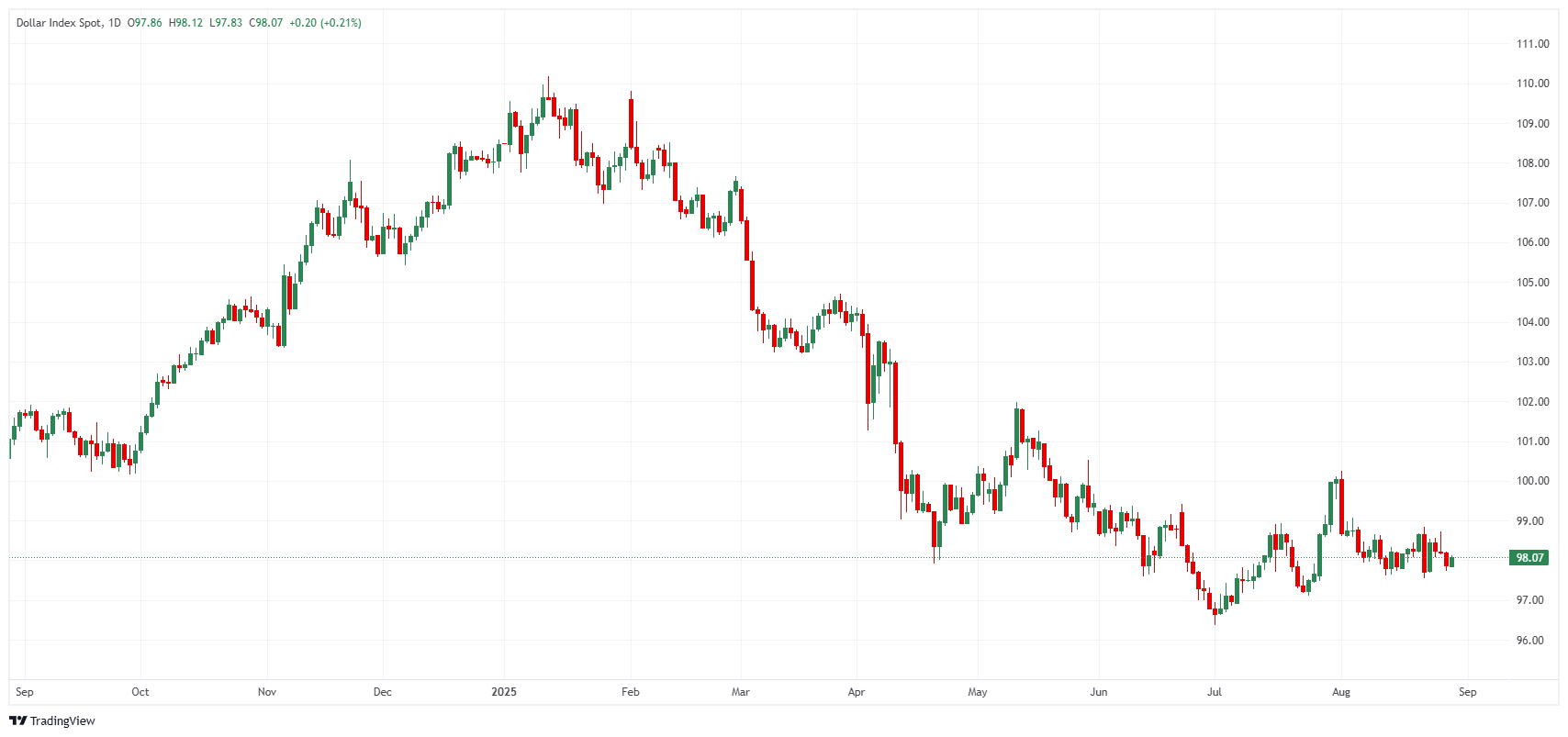
US Dollar Index daily chart. Source: FXStreet.
In Europe, national elections in countries such as Germany, France, Italy and Spain often weighed on the Euro, especially when populist or Eurosceptic parties were in a strong position.
Brexit is the most striking example of this. The announcement of the referendum in 2016 had plunged the Pound (GBP) to historic lows, and its price remains sensitive to British political developments to this day.
More recently, the multiple political crises in France have also regularly had a negative impact on the Euro, due to growing uncertainty.
Geopolitical tensions and the role of sanctions
Economic sanctions have become a political tool that immediately impacts currencies. Russia, hit by sanctions after its invasion of Ukraine, saw its Ruble (RUB) collapse before rebounding thanks to capital controls.
Iran, Venezuela and Turkey also suffered massive currency depreciations as a result of Western measures.
Geopolitical conflicts, for their part, direct flows towards "safe-haven currencies" such as the Swiss Franc (CHF), the Japanese Yen (JPY) or the US Dollar, accentuating market movements.
Populism, nationalism and the political use of currencies
The rise of populist and nationalist parties in many parts of the world is also having a lasting impact on Forex. These governments tend to favor protectionist policies and direct currency intervention.
Some economies do not hesitate to practice competitive devaluation to boost their exports, as China has often been accused of doing with the Yuan (CNY).
Turkey illustrates another scenario. President Recep Tayyip Erdoğan's determination to impose low interest rates despite galloping inflation has caused the Turkish Lira (TRY) to plummet, eroding international confidence in the country's monetary policy.
How investors can navigate this landscape
For foreign exchange traders, politics is an inescapable risk factor. There are several strategies for dealing with this volatility:
- Follow political news in real time: A speech by the Fed, a statement by US President Donald Trump or an unexpected vote in the European Parliament can trigger instantaneous movements on Forex.
- Diversify positions to avoid dependence on a single geographic zone.
- Turn to safe-haven assets such as the US Dollar, Japanese Yen, Swiss Franc or Gold during periods of great uncertainty.
- Use hedging instruments, such as options or futures, to protect against sudden movements.
The Forex market is a reflection of global political tensions. The decisions of leaders, whether Donald Trump in the United States, European institutions such as the ECB, or nationalist parties in Europe or Latin America, directly shape currency values.
Against a backdrop of fragile globalization and heightened trade rivalries, politics is increasingly influencing capital flows and therefore currencies.
For traders and investors, keeping a close eye on political developments is not just an option; it's a prerequisite for anticipating trends and protecting positions.
Information on these pages contains forward-looking statements that involve risks and uncertainties. Markets and instruments profiled on this page are for informational purposes only and should not in any way come across as a recommendation to buy or sell in these assets. You should do your own thorough research before making any investment decisions. FXStreet does not in any way guarantee that this information is free from mistakes, errors, or material misstatements. It also does not guarantee that this information is of a timely nature. Investing in Open Markets involves a great deal of risk, including the loss of all or a portion of your investment, as well as emotional distress. All risks, losses and costs associated with investing, including total loss of principal, are your responsibility. The views and opinions expressed in this article are those of the authors and do not necessarily reflect the official policy or position of FXStreet nor its advertisers. The author will not be held responsible for information that is found at the end of links posted on this page.
If not otherwise explicitly mentioned in the body of the article, at the time of writing, the author has no position in any stock mentioned in this article and no business relationship with any company mentioned. The author has not received compensation for writing this article, other than from FXStreet.
FXStreet and the author do not provide personalized recommendations. The author makes no representations as to the accuracy, completeness, or suitability of this information. FXStreet and the author will not be liable for any errors, omissions or any losses, injuries or damages arising from this information and its display or use. Errors and omissions excepted.
The author and FXStreet are not registered investment advisors and nothing in this article is intended to be investment advice.
Recommended content
Editors’ Picks

AUD/USD breaks 0.7000 as RBA inflation warning fuels two-week high
The Australian Dollar registers solid gains versus the Greenback, climbing above 0.7000 and hitting a two-week high of 0.7017 as broad US Dollar weakness pushes AUD/USD above 0.7000 amid a light economic docket in both Australia and the US.

EUR/USD trims gains, back to 1.1230
EUR/USD has kept its bullish move well in place for the fourth day in a row, this time advancing to the 1.1260 region, or two-day peaks. The continuation of the pair’s recovery has come on the back of steady weakness in the US Dollar amid mixed US Treasury yields and steady geopolitical uncertainty.

Gold just failed at $4,150. This is the next stop
Gold prices trade without a clear direction on Tuesday, hovering around the $4,170 region per troy ounce and still struggling to regain upside traction following Monday’s pullback. In the meantime, lower US Treasury yields and a marked pullback in the US Dollar come in tandem with the yellow metal’s price action.

Bitcoin resumes Nasdaq correlation as macro pressures threaten $82,500 support
Bitcoin's (BTC) correlation with the Nasdaq is rising again after last week's decline alongside tech stocks, even as macro pressures place the $82,500 support at risk. In a report on Tuesday, K33 Research highlighted that Bitcoin has resumed its correlation with the tech-heavy Nasdaq after last week's price movements.

SpaceX's earnings don't matter. What they unlock does
The Elon Musk-founded SpaceX reports third-quarter results after Tuesday's session. The figure that decides the next month for the stock isn't in them. On Thursday, the second full trading day after the release, up to 1.3 billion shares held by employees and early investors become eligible for sale.

WTI hovers around $96.00 as Trump declines nuclear weapon use in Iran
West Texas Intermediate (WTI) oil price halts its six-day winning streak, trading around $96.10 per barrel during Asian hours on Friday. Crude oil prices eased following comments from US President Donald Trump, who stated that he would not use nuclear weapons in Iran and does not foresee deploying American ground troops to the Islamic Republic, according to a report by Reuters.