For several months now, France's economy has been at the center of attention in Europe. As the Eurozone attempts to regain a stable trajectory after the successive shocks of the pandemic and the war in Ukraine, the fragility of French public finances and political instability threaten to weigh heavily on confidence in the Euro (EUR).
A weakened economy and a worrying debt burden
At the end of the first quarter of 2025, according to government figures, France had a public debt close to 114% of Gross Domestic Product, a level that places it among the most indebted countries in the European Union, just behind Greece and Italy.
The cost of this French debt has become overwhelming. By 2025, the State will be spending over 66 billion Euros on debt servicing alone, more than on education or defense.
This dynamic has alarmed the financial markets, widening the gap between ten-year French Bond yields and those of the German Bund, the Eurozone benchmark.
For investors, France is now perceived as an intermediate risk, less secure than Germany, but with a vulnerability profile comparable to that of traditionally more fragile countries.
This mistrust is helping to accentuate the volatility of the Euro, whose value depends to a large extent on the fiscal solidity of its main members.
The role of François Bayrou and political uncertainties
This economic fragility is further exacerbated by recurring political crises. French Prime Minister François Bayrou, who has been in office for less than a year, chose to put his government to a vote of confidence, deeming the budget situation a national emergency.
His plan calls for 44 billion euros in savings by 2026, including highly unpopular measures such as the abolition of public holidays.
But the government's relative majority, parliamentary deadlock and the resolute opposition of other political parties make this an extremely risky gamble.
Financial markets, already nervous, fear another government fall and a further weakening of France's credibility.
Political uncertainty is immediately reflected in the Bond market and, in turn, in the Euro.
The impact on the Euro and financial markets
The health of France's economy directly influences the future of the single currency. France is the Eurozone's second-largest economy, and an indispensable pillar of its stability.
Any sign of weakness, whether fiscal deterioration, political crisis, or weakening banks, is immediately reflected in the Euro exchange rate.
In recent weeks, the single currency has shown signs of fragility, particularly against the US Dollar (USD) and the Swiss Franc (CHF), as the yield differential between French Bonds and German sovereign Bonds has widened.
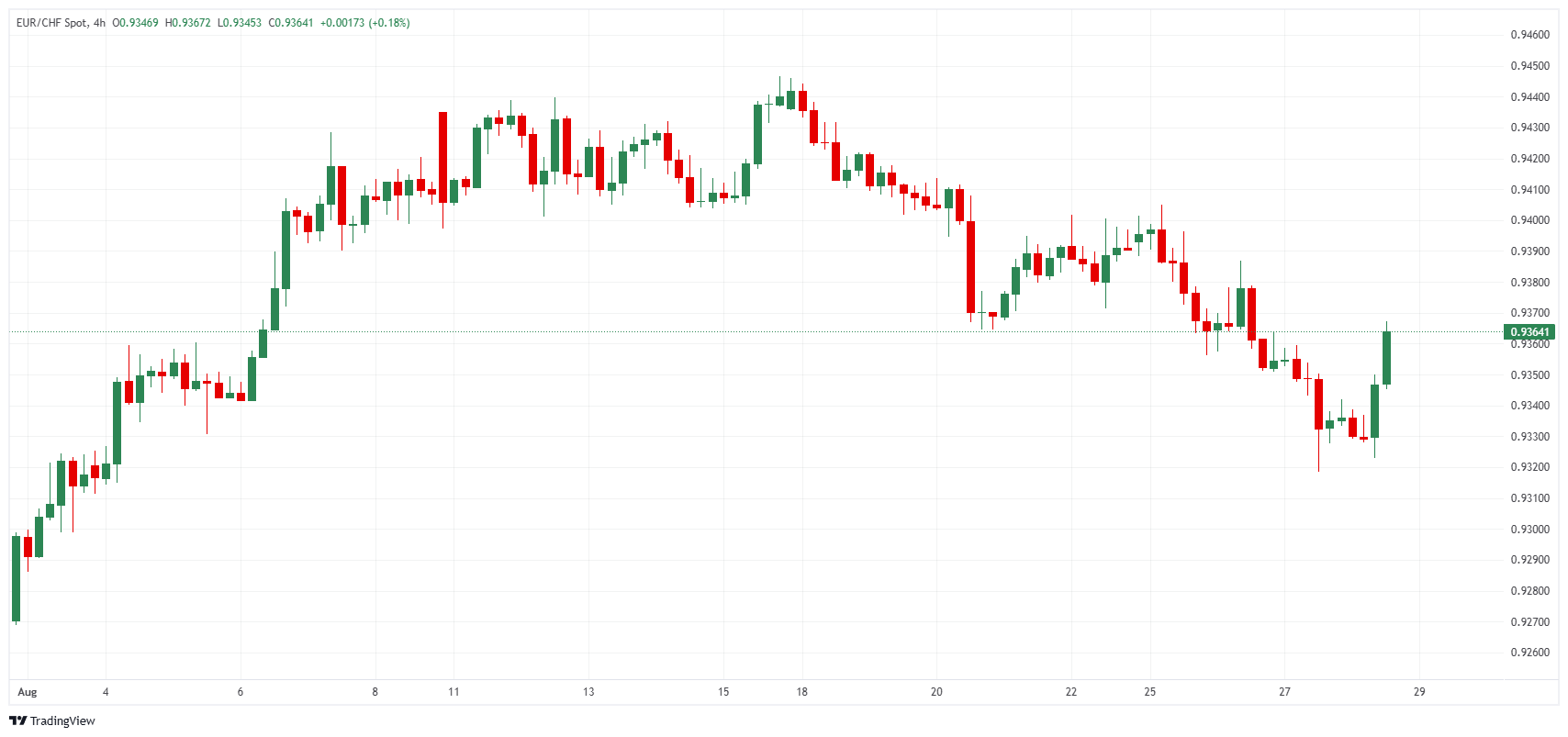
EURCHF 4-hour chart. Source: FXStreet
Investors fear a scenario in which Europe is forced to compensate for France's fragility, limiting the European Central Bank's (ECB) room for manoeuvre.
A European risk
The current crisis illustrates a fundamental truth. The Euro's stability depends not only on Germany, but also on France.
If France's economy tumbles into a spiral of political and budgetary instability, the credibility of the EUR is at stake.
Prime Minister François Bayrou's gamble, backed by French President Emmanuel Macron, is to convince the markets that France is still capable of fiscal discipline.
But with no political consensus and public opinion hostile to reform, confidence remains fragile.
For investors, the trajectory of French Bonds and French debt will, in the coming months, be the essential barometer not only of France but of the single currency itself.
Information on these pages contains forward-looking statements that involve risks and uncertainties. Markets and instruments profiled on this page are for informational purposes only and should not in any way come across as a recommendation to buy or sell in these assets. You should do your own thorough research before making any investment decisions. FXStreet does not in any way guarantee that this information is free from mistakes, errors, or material misstatements. It also does not guarantee that this information is of a timely nature. Investing in Open Markets involves a great deal of risk, including the loss of all or a portion of your investment, as well as emotional distress. All risks, losses and costs associated with investing, including total loss of principal, are your responsibility. The views and opinions expressed in this article are those of the authors and do not necessarily reflect the official policy or position of FXStreet nor its advertisers. The author will not be held responsible for information that is found at the end of links posted on this page.
If not otherwise explicitly mentioned in the body of the article, at the time of writing, the author has no position in any stock mentioned in this article and no business relationship with any company mentioned. The author has not received compensation for writing this article, other than from FXStreet.
FXStreet and the author do not provide personalized recommendations. The author makes no representations as to the accuracy, completeness, or suitability of this information. FXStreet and the author will not be liable for any errors, omissions or any losses, injuries or damages arising from this information and its display or use. Errors and omissions excepted.
The author and FXStreet are not registered investment advisors and nothing in this article is intended to be investment advice.
Recommended content
Editors’ Picks

EUR/USD: To hike or not to hike? Kevin Warsh between a rock and a hard place
The EUR/USD pair settled around 1.1600 for a third consecutive week, unable to find a clear way despite key macroeconomic headlines. The pair held within a tight 100-pip range for the second week in a row, as speculative interest awaits the Federal Reserve (Fed) monetary policy announcement scheduled for Wednesday.

Gold: Fed rate call and dot plot key for next directional action
Gold (XAU/USD) struggled to shake off the bearish pressure as US Treasury bond yields climbed higher this week. Investors gear up for the Federal Reserve’s (Fed) critical policy meeting, which could trigger the next directional action in the precious metal.

Global inflation watch: Muted momentum outside of energy
Overview: Inflation in August came in broadly as expected in both the US and euro area. Momentum in underlying inflation remained muted on both sides of the Atlantic (see chart). Rising energy prices, particularly European gas futures, have moved up near-term inflation expectations.

Bitcoin: BTC retreats as macro headwinds grow
Bitcoin (BTC) remains under pressure, down over 4% this week and trading around $76,900 at the time of writing on Friday. Institutional demand shows signs of weakness as spot BTC Exchange Traded Funds (ETFs) are on track to end their three-week inflow streak, recording nearly $500 million in net outflows through Thursday.

United States Dollar Index retreats from post-CPI high, all eyes on Fed
The US Dollar Index (DXY) reverses earlier gains on Friday as a pullback in longer-dated US Treasury yields outweighs support from the latest US Consumer Price Index (CPI) report, which strengthened expectations that the Federal Reserve (Fed) will raise interest rates next week. At the time of writing, the index trades around 99.11 after briefly climbing to 99.36 in the immediate reaction to the data.

WTI rises to near $90.00 on escalating US-Iran conflict
West Texas Intermediate gains ground after registering losses in the previous trading day, hovering around $90.00 per barrel during Asian hours on Monday. Crude oil prices climb following a fresh escalation of military strikes between the United States and Iran, raising widespread fears of prolonged disruptions to Middle Eastern energy supplies.