
Picture a trader at work:
What comes to mind? Someone entering and exiting trades. Right? Keep reading to uncover why this common perception often leads to crippling account erosion and, more importantly, how to transform it into a strategy that works to your advantage.
One
The easiest aspect of trading is buying and selling.
See the short trading in the chart below? This trading sequence occurred on Thursday.
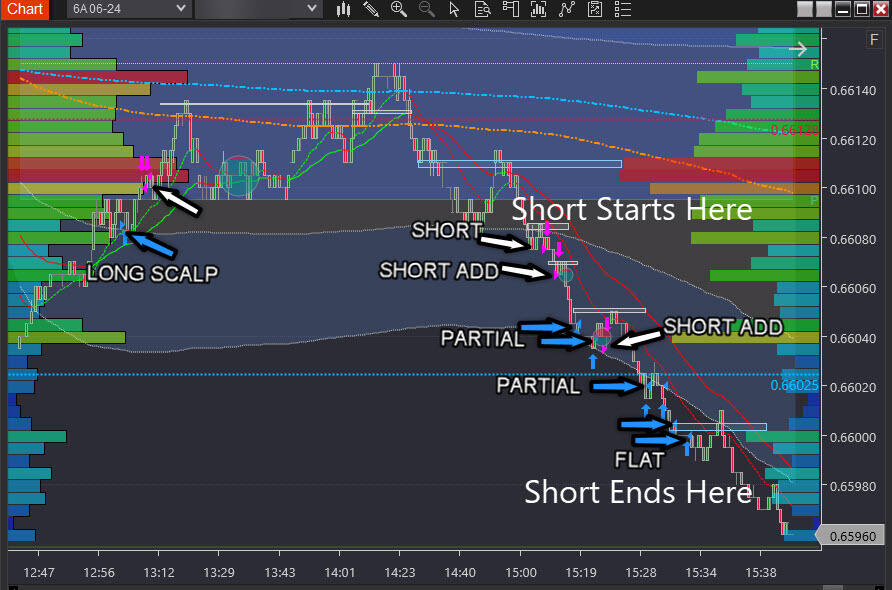
The timing of buys and sells is an automatic response. Let me explain.
When you recognise certain market conditions, you perform a sequence of actions you've traded previously.
As a 'doing' activity, you develop mastery like you mastered riding a bike.
Imagine riding a bike down a hill instead of up a mountain or on a smooth road instead of a gravel trail. All of these conditions require adaptation, which you do through repetition.
But it's intriguing to note the pace at which the market is moving is often overlooked.
As an intraday trader, your ability to buy and sell effectively is directly linked to your understanding and adaptation to the market's varying speed. This enables you to make accurate trades.
And like riding a bike—where some corners and hills require you to 'slow down' to avoid catastrophe—there are times when the market pace is too fast for you to trade, so you stand aside to avoid account catastrophe.
But I've alluded to a misunderstanding, and the outcome for most people is the erosion of their capital.
You see:
Trading is not obvious when observed from afar. And by that, I mean only looking at charts. If trading was simply a case of looking at charts, why didn't I take any trades on the same day during the period below?
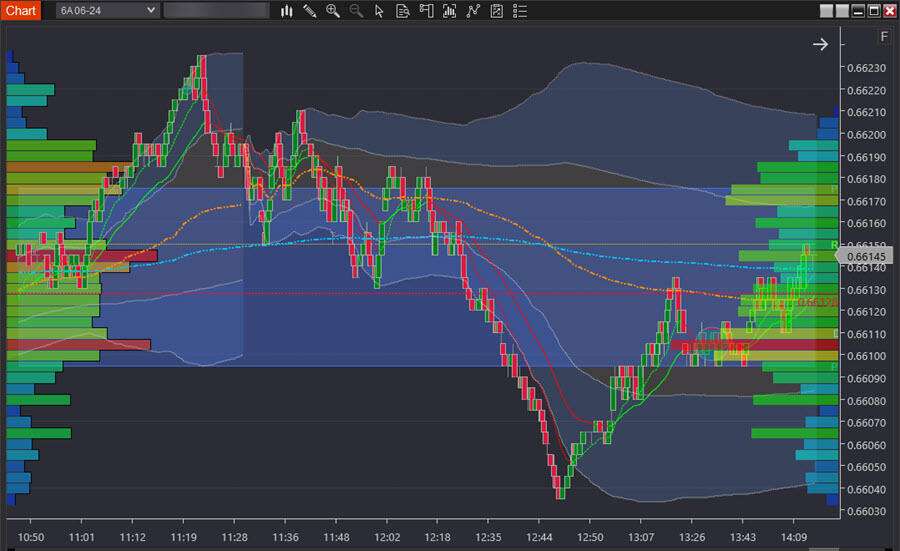
I'll tell you in a minute. But first:
If buying and selling are the easiest aspects of trading, what's more challenging? The answer is developing your 'plan' or a game plan.
Two
The simplest way to understand game planning is to imagine being dropped into the middle of a remote jungle and not knowing where you are. You want to find civilisation, but what chance do you have if you don't have a map?
Well, that's the role of your game plan—a map of where the market is going and how it will get there. Without it, you are 'lost'. You'll take wrong turns and run into dangerous or impassable terrains.
But not all maps are equal.
A map of your city from 70 years ago is likely so out-of-date that it's completely inaccurate. It will lead you down the wrong path. Correct?
The same goes for your game plan. It must be accurate. And by accurate, I mean it tells you:
-
Why will the market move and in which direction?
-
Where will the market move to?
-
How will it behave while it's moving?
-
And who will act as the fuel for the move?
Unlike riding a bike, game planning is a skill that continues to improve through guidance and feedback. Combining problem-solving and game theory, it's a different skill set from executing buys and sells.
It's worth noting that game planning uses cognitive abilities that don't fully mature until the late 40s or early 50s.
In this age bracket or more senior? You're in the prime of developing game plans that give you a competitive advantage.
Three
To be blunt:
The final trading element is the most challenging but bear with me as you're about to see how each aspect aligns—solving the crippling mounting of losses that decimate accounts.
Have you ever caught a train at a central station? You'll need to know the correct platform and train route, or you could quickly find yourself going to the wrong location.
So, while your game plan provides you with the route and destination, as is the nature of markets, many 'trains' will pass through you want to avoid getting on board. Make sense?
Your job as a trader is to identify which move matches your game plan versus which is the equivalent of the wrong train going to the wrong destination via the incorrect route.
Like the train station has signs to guide you, the market also provides signs, which I refer to as multiple points of evidence.
By following multiple points of evidence, you can identify the precise moment to action your game plan. Rather than, for example, you enter a trade only to have the market flush you out once or twice before finally moving without you—leaving you with only losses to show for it. Sound familiar?
The period shown in the chart above was an evidence-gathering exercise. So why is this the most challenging aspect of trading? I'm glad you asked!
For context, I combine 10-12 pieces of evidence. As you'll see, this is a strategic approach.
Remember, trading is a competition where the majority must lose to fund the few who win consistently. For that to happen, here's what gathering points of evidence frequently looks like:
-
You identify one, two, or three points of evidence.
-
Minutes later, you spot another two.
-
"This is going well", you feel.
-
And then, suddenly, a few points of evidence get disqualified, and you start the process over again.
Frustrating? It depends on who you ask.
The market constantly torments participants into acting out of emotional frustration or traps them unsuspectingly.
I often say, "Your biggest edge is outlasting the competition." But what does this mean?
There are periods where you can't gather enough evidence to:
- Confirm your game plan is underway
- Confirm the market is repeating a behaviour you've repeatedly traded until it became second nature.
Yet these are periods when accounts get decimated for traders busy buying and selling—working off charts alone, gut feelings, emotional frustration, assumptions, limited understanding, etc.
By contrast, you gather critical intelligence for future successful executions. You look forward to these periods because trading is straightforward once all the trickery and deceit ends.
You're now in the minority who trade this way - and it's the minority who win consistently.
You trade with sky-high confidence because the game and the tactics designed to break people have achieved their outcome, and the market gifts you simple trading sequences.
Provided your execution is akin to riding a bike, and you've achieved consistent accuracy in your game planning, the trading is now effortless.
Any exceptions?
Trading is competitive. And like all competitive endeavours, defence is as crucial as offence.
Sometimes, you can have everything aligned to enter the market and find the environment has changed a moment later, requiring you to scratch your trade or take a tiny loss.
Other times, you can be well in profit, and then the environment changes, and you take what profits you have on the table.
The competitive nature of trading—allowing only a few to win at the expense of most—makes defence crucial.
If you're going to lose, you want that loss as small as possible. Agree? That's what combining the three aspects of trading as described above does for you.
In summary:
People don't know how to play the game, so they act with limited information, which leads to account erosion.
I didn't know all this when I first started trading. I gained knowledge and practical skills through my professional trading training and experience.
Gamblers aside, independent traders' failure rate is high because they're trying to do it alone.
Related:
I discuss why mature-age trading is a competitive advantage—plus walk through a real game plan and trading example.
Forex and derivatives trading is a highly competitive and often extremely fast-paced environment. It only rewards individuals who attain the required level of skill and expertise to compete. Past performance is not indicative of future results. There is a substantial risk of loss to unskilled and inexperienced players. The high degree of leverage can work against you as well as for you. Before deciding to trade any such leveraged products you should carefully consider your investment objectives, level of experience, and risk appetite. The possibility exists that you could sustain a loss of some or all of your initial investment and therefore you should not invest money that you cannot afford to lose. You should be aware of all the risks associated with trading on margin, and seek advice from an independent
Editors’ Picks

EUR/USD tests nine-day EMA support near 1.1850
EUR/USD inches lower during the Asian hours on Monday, trading around 1.1870 at the time of writing. The 14-day Relative Strength Index momentum indicator at 56 stays above the midline, confirming improving momentum. RSI has cooled from prior overbought readings but stabilizes above 50, suggesting dips could stay limited before buyers reassert control.

GBP/USD flat lines as traders await key UK macro data and FOMC minutes
The GBP/USD pair kicks off a new week on a subdued note and oscillates in a narrow range, just below mid-1.3600s, during the Asian session. Moreover, the mixed fundamental backdrop warrants some caution for aggressive traders as the market focus now shifts to this week's important releases from the UK and the US.

USD/JPY stays firm around 153.00 after Japan's Q4 GDP miss
USD/JPY kicks off the new week on a positive note as Japan's weak Q4 GDP growth tempers bets for an immediate BoJ rate hike and undermines the Japanese Yen. Investors, however, seem convinced that the BoJ will stick to its policy normalization path amid hopes that PM Takaichi's policies will boost the Japanese economy. In contrast, cooling US consumer inflation reaffirmed bets for more Fed rate cuts in 2026, which acts as a headwind for the US Dollar and should cap the currency pair.
Editors’ Picks
EUR/USD tests nine-day EMA support near 1.1850
EUR/USD inches lower during the Asian hours on Monday, trading around 1.1870 at the time of writing. The 14-day Relative Strength Index momentum indicator at 56 stays above the midline, confirming improving momentum. RSI has cooled from prior overbought readings but stabilizes above 50, suggesting dips could stay limited before buyers reassert control.
GBP/USD flat lines as traders await key UK macro data and FOMC minutes
The GBP/USD pair kicks off a new week on a subdued note and oscillates in a narrow range, just below mid-1.3600s, during the Asian session. Moreover, the mixed fundamental backdrop warrants some caution for aggressive traders as the market focus now shifts to this week's important releases from the UK and the US.

Gold slides below $5,000 amid USD uptick and positive risk tone; downside seems limited
Gold attracts fresh sellers at the start of a new week and reverses a part of Friday's strong move up of over $150 from sub-$4,900 levels. The commodity slides back below the $5,000 psychological mark during the Asian session, though the downside potential seems limited amid a combination of supporting factors.

Bitcoin, Ethereum and Ripple consolidate within key ranges as selling pressure eases
Bitcoin and Ethereum prices have been trading sideways within key ranges following the massive correction. Meanwhile, XRP recovers slightly, breaking above the key resistance zone. The top three cryptocurrencies hint at a potential short-term recovery, with momentum indicators showing fading bearish signs.
Global inflation watch: Signs of cooling services inflation
Realized inflation landed close to expectations in January, as negative base effects weighed on the annual rates. Remaining sticky inflation is largely explained by services, while tariff-driven goods inflation remains limited even in the US.
RECOMMENDED LESSONS
Making money in forex is easy if you know how the bankers trade!

I’m often mystified in my educational forex articles why so many traders struggle to make consistent money out of forex trading. The answer has more to do with what they don’t know than what they do know. After working in investment banks for 20 years many of which were as a Chief trader its second knowledge how to extract cash out of the market.
5 Forex News Events You Need To Know

In the fast moving world of currency markets where huge moves can seemingly come from nowhere, it is extremely important for new traders to learn about the various economic indicators and forex news events and releases that shape the markets. Indeed, quickly getting a handle on which data to look out for, what it means, and how to trade it can see new traders quickly become far more profitable and sets up the road to long term success.
Top 10 Chart Patterns Every Trader Should Know

Chart patterns are one of the most effective trading tools for a trader. They are pure price-action, and form on the basis of underlying buying and selling pressure. Chart patterns have a proven track-record, and traders use them to identify continuation or reversal signals, to open positions and identify price targets.
7 Ways to Avoid Forex Scams

The forex industry is recently seeing more and more scams. Here are 7 ways to avoid losing your money in such scams: Forex scams are becoming frequent. Michael Greenberg reports on luxurious expenses, including a submarine bought from the money taken from forex traders. Here’s another report of a forex fraud. So, how can we avoid falling in such forex scams?
What Are the 10 Fatal Mistakes Traders Make
Trading is exciting. Trading is hard. Trading is extremely hard. Some say that it takes more than 10,000 hours to master. Others believe that trading is the way to quick riches. They might be both wrong. What is important to know that no matter how experienced you are, mistakes will be part of the trading process.
The challenge: Timing the market and trader psychology

Successful trading often comes down to timing – entering and exiting trades at the right moments. Yet timing the market is notoriously difficult, largely because human psychology can derail even the best plans. Two powerful emotions in particular – fear and greed – tend to drive trading decisions off course.