 Sam Seiden
Independent Analyst
Last week we discussed a trading opportunity in the AUDUSD as an illustration to show that if you know what to look for on a price chart, you can see where the smart money is buying and selling in the Forex market, or any other market for that matter. This week, as promised, let’s look at the outcome of this low risk, high reward, high probability trading opportunity.
OTA: May 2016 Daily Market Overview – AUDUSD
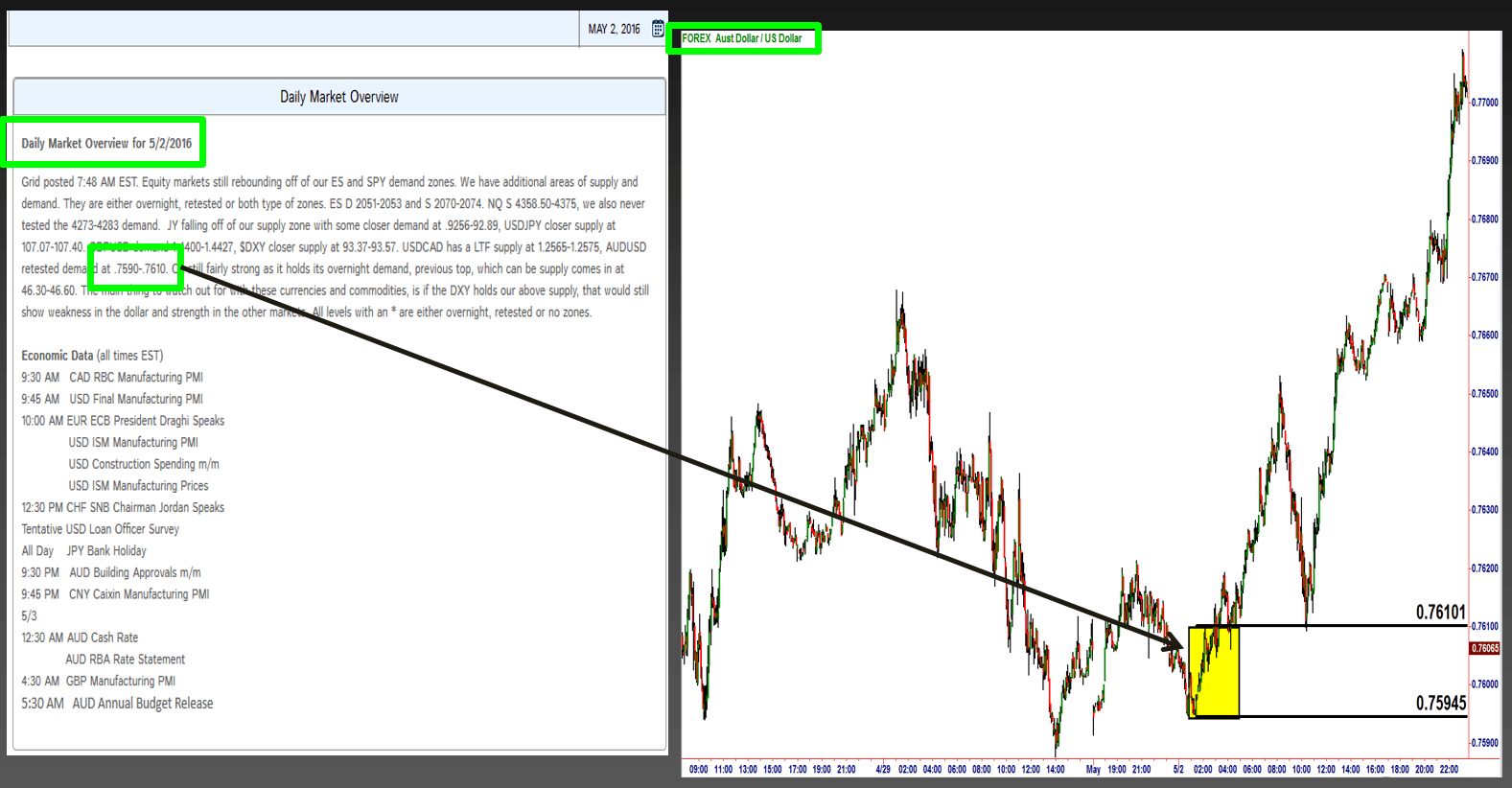
Notice that price “declined” (downtrend) to our demand level (the yellow box in the above chart) where we were willing buyers. Every trading book would say we are breaking the most important rules in trading when buying under those circumstances. Well, how many people do you know who read trading books that make consistent low risk trading profits year after year trading? I would be surprised if you knew one, so be careful with what you read.
The trading book version is conventional thinking which most often has you buying high and selling low, so be careful. Don’t take my word for it however, read a trading book and ask yourself how that book is teaching you to enter positions in markets. Is the book version entry and exit into a market the same as how you make money buying and selling anything in life? If there is any difference, good luck trying to make trading profits from the information.
Like anything in life, there is the book version way of learning to do something and the real world way. All we are doing at Online Trading Academy is simply sharing real world trading and investing with you. We are not trying to reinvent the wheel. How you make money buying and selling anything in life is exactly how you make money buying and selling in markets. I learned reality based trading during my time on the trading floor of the Chicago Mercantile Exchange. Trust me, no one on that trading floor was any smarter than anyone else.
Shortly after reaching our demand level, offering a low risk buying opportunity, price rallied for more than a 3:1 gain for those who took the income trade. This is market timing, and while it does not guarantee trading profits on every trade, it does offer the lowest risk entry, highest reward with that entry and highest probability of success. How high your winning percentage is with the strategy depends on your ability to identify key bank and institution supply and demand levels, which means following our simple strategy rules.
I sometimes hear people say, “I don’t want to try to pick market tops and bottoms; I am only trying to catch the middle of the move”. They are trend followers and say that as if doing that is somehow easier. If price is already moving higher, for example, and you want to buy, where do you enter?, where is your protective stop?, what is your risk / reward? and so on… I want our students to be in the trend as well. I just want them entering at the beginning of the trend, well before the trend is evident to everyone else. The longer we wait to enter, the greater the risk and lower the reward. Another thing I hear people say so often is this: “I wish I knew where the Banks and Institutions were buying and selling”. Every time I hear this I say: “You can see where the smart money is buying and selling if you know what to look for on a price chart”. Banks leave crystal clear footprints for those who know how to identify them. It all comes down to supply and demand, just like buying and selling anything else in life.
Hope this was helpful, have a great day.
Note: All information on this page is subject to change. The use of this website constitutes acceptance of our user agreement. Please read our privacy policy and legal disclaimer. Opinions expressed at FXstreet.com are those of the individual authors and do not necessarily represent the opinion of FXstreet.com or its management. Risk Disclosure: Trading foreign exchange on margin carries a high level of risk, and may not be suitable for all investors. The high degree of leverage can work against you as well as for you. Before deciding to invest in foreign exchange you should carefully consider your investment objectives, level of experience, and risk appetite. The possibility exists that you could sustain a loss of some or all of your initial investment and therefore you should not invest money that you cannot afford to lose. You should be aware of all the risks associated with foreign exchange trading, and seek advice from an independent financial advisor if you have any doubts.
Editors’ Picks

EUR/USD faces some resistance near 100-SMA on H4, around 1.1830 zone
The EUR/USD pair gains some follow-through positive traction for the second consecutive day and climbs to the 1.1830 region during the Asian session on Thursday. The US Dollar remains on the back foot amid concerns about the economic fallout from US President Donald Trump's erratic trade policies and acts as a tailwind for spot prices.

GBP/USD extends recovery to near 20-day EMA as US Dollar weakens
The Pound Sterling holds onto weekly gains around 1.3565 against the US Dollar during the Asian trading session on Thursday. The GBP/USD pair trades firmly as the US Dollar remains under pressure due to uncertainty surrounding the United States trade policy outlook.

USD/JPY tumbles below 156.00 on hawkish BoE-speak, risk-off mood
USD/JPY holds lower ground below 156.00 in the Asian session on Thursday, deep in the red amid hawkish BoE commentary, looming intervention fears and risk-off mood, which lend support to the Japanese Yen. The US Dollar remains on the back foot amid concerns about the fallout from Trump's trade policies, adding to the pair's downside.
Editors’ Picks
USD/JPY tumbles below 156.00 on hawkish BoE-speak, risk-off mood
USD/JPY holds lower ground below 156.00 in the Asian session on Thursday, deep in the red amid hawkish BoE commentary, looming intervention fears and risk-off mood, which lend support to the Japanese Yen. The US Dollar remains on the back foot amid concerns about the fallout from Trump's trade policies, adding to the pair's downside.

AUD/USD grinds higher toward 0.7150 on weaker USD
AUD/USD picks up bids and grinds higher toward 0.7150 in the Asian session on Thursday. The pair eyes a three-year peak amid bets for another RBA rate hike in 2026, bolstered by the latest Australian consumer inflation figures. Moreover, a softer US Dollar acts as a tailwind for the Aussie, though trade uncertainties seem to limit the Aussie's upside.

Gold struggle with $5,200 extends ahead of more US-Iran talks
Gold is replicating the recovery moves seen in Wednesday’s Asian trading early Thursday, as buyers continue to flirt with the $5,200 level. Sustained US Dollar weakness and looming US-Iran talks aid the bright metal’s rebound.

Top Crypto Gainers: Polkadot, Near Protocol, Uniswap lead market rebound
Altcoins, such as Polkadot, Near Protocol, and Uniswap, are leading gains over the last 24 hours as Bitcoin jumped 6% on Wednesday. The altcoins are holding steady at press time on Thursday following a rebound the previous day, testing the waters around their 50-day Exponential Moving Average.

Nvidia delivers another monster earnings report, and forecasts big things to come
It was another monster earnings report from Nvidia for fiscal Q4. Revenues were $68.1bn, smashing estimates of $65bn. Gross profit margin was a healthy 75%, up from 73.5% in the prior quarter, and the outlook for this quarter was monstrous.
RECOMMENDED LESSONS
Making money in forex is easy if you know how the bankers trade!

I’m often mystified in my educational forex articles why so many traders struggle to make consistent money out of forex trading. The answer has more to do with what they don’t know than what they do know. After working in investment banks for 20 years many of which were as a Chief trader its second knowledge how to extract cash out of the market.
5 Forex News Events You Need To Know

In the fast moving world of currency markets where huge moves can seemingly come from nowhere, it is extremely important for new traders to learn about the various economic indicators and forex news events and releases that shape the markets. Indeed, quickly getting a handle on which data to look out for, what it means, and how to trade it can see new traders quickly become far more profitable and sets up the road to long term success.
Top 10 Chart Patterns Every Trader Should Know

Chart patterns are one of the most effective trading tools for a trader. They are pure price-action, and form on the basis of underlying buying and selling pressure. Chart patterns have a proven track-record, and traders use them to identify continuation or reversal signals, to open positions and identify price targets.
7 Ways to Avoid Forex Scams

The forex industry is recently seeing more and more scams. Here are 7 ways to avoid losing your money in such scams: Forex scams are becoming frequent. Michael Greenberg reports on luxurious expenses, including a submarine bought from the money taken from forex traders. Here’s another report of a forex fraud. So, how can we avoid falling in such forex scams?
What Are the 10 Fatal Mistakes Traders Make
Trading is exciting. Trading is hard. Trading is extremely hard. Some say that it takes more than 10,000 hours to master. Others believe that trading is the way to quick riches. They might be both wrong. What is important to know that no matter how experienced you are, mistakes will be part of the trading process.
The challenge: Timing the market and trader psychology

Successful trading often comes down to timing – entering and exiting trades at the right moments. Yet timing the market is notoriously difficult, largely because human psychology can derail even the best plans. Two powerful emotions in particular – fear and greed – tend to drive trading decisions off course.