Remember the so-called "Trump Trade"? Both in terms of political developments and price action, it seems like November 8th was about a half-decade ago, not just five months ago. When it comes to the stock market, traders rushed out to buy industrial, material and financial stocks, while selling health care and technology stocks.
The bearish health care thesis was fairly straightforward, given the Republicans' promises to "repeal and replace" the current health care law, but the explanations for the drop in tech stocks was always a bit more tenuous. Some traders argued that Trump's tough-on-immigration stance could deprive technology companies of the highly-skilled foreign workers on H1-B visas, while others (ourselves included) believed the post-election pullback in tech stocks was simply caused by investors taking profits the strongest names in their portfolios to chase "The Next Shiny Thing," namely financial and industrial stocks.
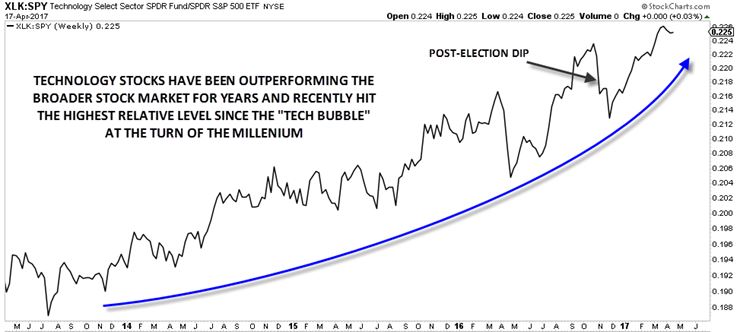
Regardless of the explanation for the initial drop, the tech sector has come roaring back of late. Though still far from the lofty "Tech Bubble" peak at the start of the millennium, technology stocks recently hit their highest levels relative to the broader stock market in 15 years.
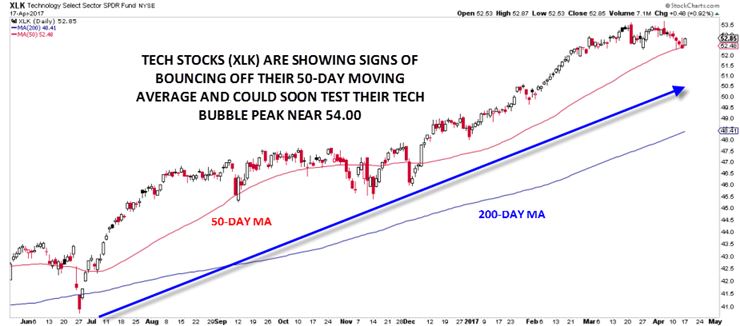
Technology stocks have hardly been slacking on an absolute basis either. As the chart below shows, the technology sector ETF (XLK) made a run at its Tech Bubble peak near 54.00 earlier this month, and after a pullback, XLK is showing signs of bouncing off its 50-day MA so far this week:
Given the strong relative and absolute bullish trends in the tech sector, we'll continue to look for buying opportunities in the days and weeks to come. Top holdings in the sector include AAPL, MSFT, FB, GOOGL, T, INTC, VZ, CSCO, V, IBM, and ORCL, all of which are in our US equity universe.
This research is for informational purposes and should not be construed as personal advice. Trading any financial market involves risk. Trading on leverage involves risk of losses greater than deposits.
Editors’ Picks
EUR/USD struggles near 1.1850, with all eyes on US CPI data
EUR/USD holds losses while keeping its range near 1.1850 in European trading on Friday. A broadly cautious market environment paired with a steady US Dollar undermines the pair ahead of the critical US CPI data. Meanwhile, the Eurozone Q4 GDP second estimate has little to no impact on the Euro.
GBP/USD recovers above 1.3600, awaits US CPI for fresh impetus
GBP/USD recovers some ground above 1.3600 in the European session on Friday, though it lacks bullish conviction. The US Dollar remains supported amid a softer risk tone and ahead of the US consumer inflation figures due later in the NA session on Friday.
Gold remains below $5,000 as US inflation report looms
Gold retreats from the vicinity of the $5,000 psychological mark, though sticks to its modest intraday gains in the European session. Traders now look forward to the release of the US consumer inflation figures for more cues about the Fed policy path. The outlook will play a key role in influencing the near-term US Dollar price dynamics and provide some meaningful impetus to the non-yielding bullion.
US CPI data set to show modest inflation cooling as markets price in a more hawkish Fed
The US Bureau of Labor Statistics will publish January’s Consumer Price Index data on Friday, delayed by the brief and partial United States government shutdown. The report is expected to show that inflationary pressures eased modestly but also remained above the Federal Reserve’s 2% target.
The weekender: When software turns the blade on itself
Autonomous AI does not just threaten trucking companies and call centers. It challenges the cognitive toll booths that legacy software has charged for decades. This is not a forecast. No one truly knows the end state of AI.
RECOMMENDED LESSONS
Making money in forex is easy if you know how the bankers trade!
I’m often mystified in my educational forex articles why so many traders struggle to make consistent money out of forex trading. The answer has more to do with what they don’t know than what they do know. After working in investment banks for 20 years many of which were as a Chief trader its second knowledge how to extract cash out of the market.
5 Forex News Events You Need To Know
In the fast moving world of currency markets where huge moves can seemingly come from nowhere, it is extremely important for new traders to learn about the various economic indicators and forex news events and releases that shape the markets. Indeed, quickly getting a handle on which data to look out for, what it means, and how to trade it can see new traders quickly become far more profitable and sets up the road to long term success.
Top 10 Chart Patterns Every Trader Should Know
Chart patterns are one of the most effective trading tools for a trader. They are pure price-action, and form on the basis of underlying buying and selling pressure. Chart patterns have a proven track-record, and traders use them to identify continuation or reversal signals, to open positions and identify price targets.
7 Ways to Avoid Forex Scams
The forex industry is recently seeing more and more scams. Here are 7 ways to avoid losing your money in such scams: Forex scams are becoming frequent. Michael Greenberg reports on luxurious expenses, including a submarine bought from the money taken from forex traders. Here’s another report of a forex fraud. So, how can we avoid falling in such forex scams?
What Are the 10 Fatal Mistakes Traders Make
Trading is exciting. Trading is hard. Trading is extremely hard. Some say that it takes more than 10,000 hours to master. Others believe that trading is the way to quick riches. They might be both wrong. What is important to know that no matter how experienced you are, mistakes will be part of the trading process.
The challenge: Timing the market and trader psychology
Successful trading often comes down to timing – entering and exiting trades at the right moments. Yet timing the market is notoriously difficult, largely because human psychology can derail even the best plans. Two powerful emotions in particular – fear and greed – tend to drive trading decisions off course.