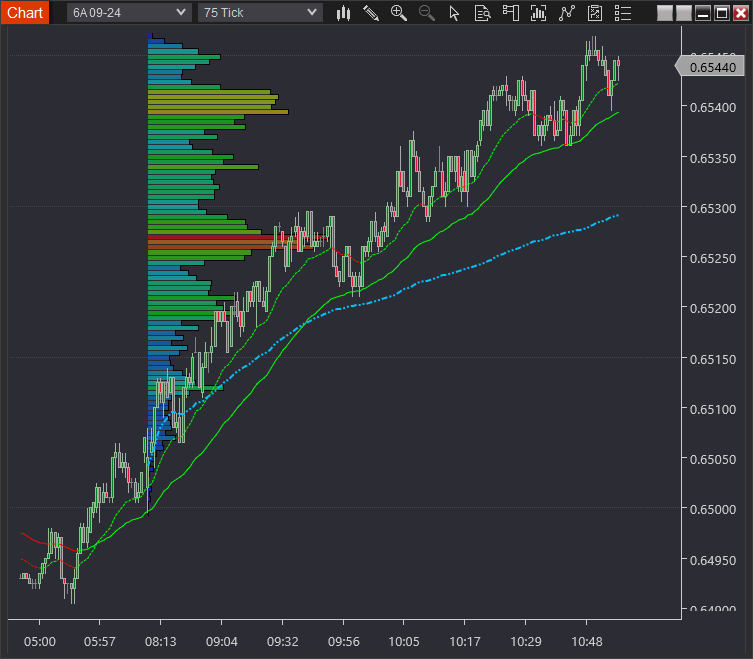
Can you see yourself buying into the move below?
It’s a strong, steep rise—the kind of trade you dream about, right?
Now imagine you're a passenger in a car travelling at 50mph/80kmph on the highway, approaching a busy intersection.
The lights are amber, and you see them change to red. But your driver must be in a dream as the car isn't slowing down.
You’re about to run a red light, and it scares the daylights out of you.
Intense fear can happen when you're trading. Felt it?
But if you knew a trade was a car crash waiting to happen, that fear would stop you from entering, wouldn’t it?
In other words, Fear is Good.
Michael Marcus, who amassed an 80 million trading fortune, is famous for saying:
"I have a real fear of markets. I have found that the greatest traders are the ones who are most afraid of the markets."
Are you surprised that great traders are afraid? It debunks the notion of 'being fearless' to trade successfully, right?
Now, let’s revisit our chart.
Based on the steep, strong move to the upside above, you buy 20 lots. No big deal, right?
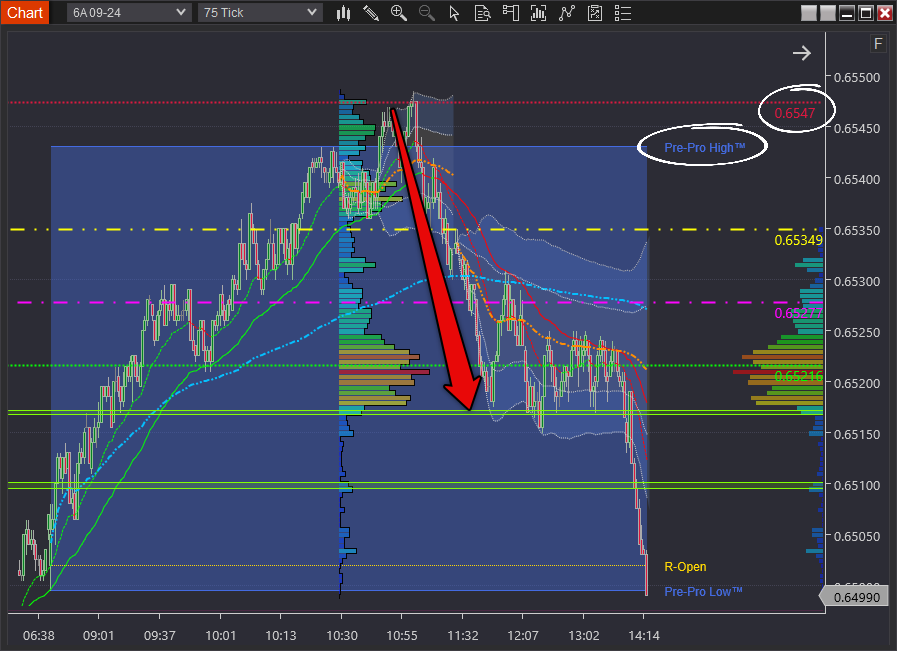
But suddenly, there's a violent move to the downside—without a buyer in sight.
While you're 'massaging' your exit, the price is slicing through levels like a knife in free fall.
With a 30bps price drop, you're down USD 6K/AUD 9K. If you continue to hold, it's double that.
The chart below shows exactly what happened.
Have you experienced something similar?
Like red traffic lights, there are numerous signs you can learn that tell you:
"Entering 'here' is a car crash for your account waiting to happen."
These signs make such trades avoidable.
In the chart above, you can see two red lights:
-
A relative value transition at 0.6547 screams out to you, "No Longer Long".
-
Another red light is the absence of buyers 'bidding up' above the Pre-Pro High™️.
Further red lights not visible on the chart relate to market pace, liquidity, and order book activity.
But the only way I know how to illustrate these is to show you during a live trading session.
If all of the above isn't enough to stop you from going long, the price has reached one standard deviation above a volume-weighted average, anchoring it to the downside.
And what do all these red traffic lights represent? Multiple points of evidence.
Just how important is evidence? Here's what high-performance coach to elite traders, Dr Brett Steenbarger says:
"If everyone engaged in evidence-based trading, there would be no overtrading--"
Multiple points of evidence are crucial in trading because this game is about knowing and seeing what most others don't.
Evidence isn't just about avoiding pitfalls; it's equally powerful for spotting green light trades.
Check out the first trades taken after the avoided car crash trade:
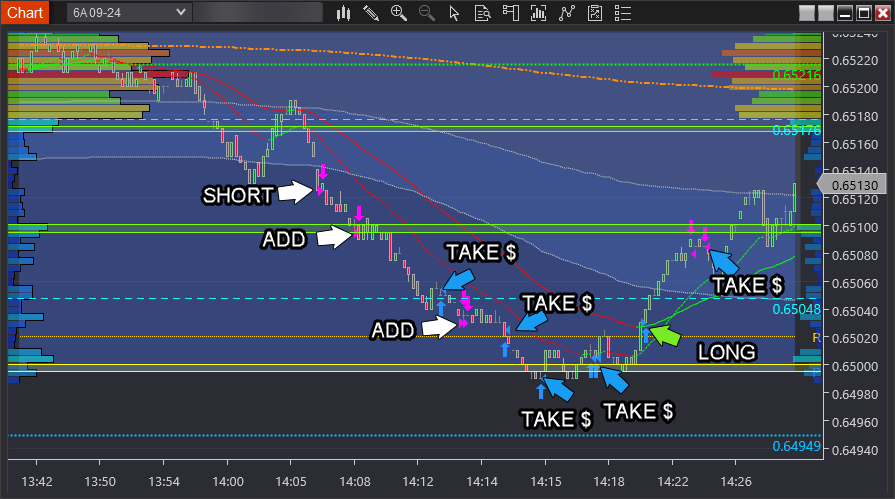
I believe anyone is capable of making these trades once you've learned how to spot multiple points of evidence—but with one important caveat...
Like surfing, playing an instrument, or tennis, trading has its nuances.
You must familiarise yourself with them—and repetition is the mother of mastery.
At first, it might feel out of reach. But as someone for whom trading didn't come naturally—failure can't cope with perseverance.
Maybe you'd feel more comfortable trading if someone could just tell you what to do. And at first, it's the fastest way to progress.
But soon enough, that 'someone' becomes the market itself—once you've learned to read its language through multiple points of evidence.
Do you know why this approach is so effective?
Paying attention to what others miss is not new. As Henry Ford said:
"A handful of men have become very rich by paying attention to details that most others ignored."
Do you now see how you can get off the 'Win Some, Lose More' trading hamster wheel—taking a dramatically different approach from everything that’s failed you so far? And don't worry, you're not starting from scratch.
To be blunt: You need to experience all of trading's raw emotions before you can learn the points of evidence related to human behaviour.
Trading isn't about fearlessness—it's about harnessing fear to steer clear of disasters. The market speaks; learn its language, and you'll find yourself not just avoiding crashes but mastering the ride. Ready to listen?
Forex and derivatives trading is a highly competitive and often extremely fast-paced environment. It only rewards individuals who attain the required level of skill and expertise to compete. Past performance is not indicative of future results. There is a substantial risk of loss to unskilled and inexperienced players. The high degree of leverage can work against you as well as for you. Before deciding to trade any such leveraged products you should carefully consider your investment objectives, level of experience, and risk appetite. The possibility exists that you could sustain a loss of some or all of your initial investment and therefore you should not invest money that you cannot afford to lose. You should be aware of all the risks associated with trading on margin, and seek advice from an independent
Editors’ Picks
EUR/USD remains below 1.1750 ahead of ECB policy decision
EUR/USD remains on the back foot below 1.1750 in the European session on Thursday. Traders move to the sidelines and refrain from placing any fresh directional bets on the pair ahead of the ECB policy announcements and the US CPI inflation data.
GBP/USD stays defensive below 1.3400, awaits BoE and US CPI
GBP/USD oscillates in a narrow band below 1.3400 in European trading on Thursday. The pair trades with caution as markets eagerly await the BoE policy verdict and US consumer inflation data for fresh directional impetus.
Gold holds losses below $4,350 ahead of US CPI report
Gold struggles to capitalize on the previous day's move higher and holds its pullback below $4,350 in the European session on Thursday. The downtick could be attributed to some profit-taking amid a US Dollar bounce. All eyes now remain on the US CPI inflation data.
BoE set to resume easing cycle, trimming interest rate to 3.75%
The Bank of England will announce its last monetary policy decision of 2025 on Thursday at 12:00 GMT. The market prices a 25-basis-point rate cut, which would leave the BoE’s Bank Rate at 3.75%.
US CPI data expected to show inflation rose slightly to 3.1%, cooling Fed rate cut bets for January
The US Bureau of Labor Statistics will publish the all-important Consumer Price Index (CPI) data for November on Thursday at 13:30 GMT. The CPI inflation in the US is expected to rise at an annual rate of 3.1% in November
RECOMMENDED LESSONS
Making money in forex is easy if you know how the bankers trade!
I’m often mystified in my educational forex articles why so many traders struggle to make consistent money out of forex trading. The answer has more to do with what they don’t know than what they do know. After working in investment banks for 20 years many of which were as a Chief trader its second knowledge how to extract cash out of the market.
5 Forex News Events You Need To Know
In the fast moving world of currency markets where huge moves can seemingly come from nowhere, it is extremely important for new traders to learn about the various economic indicators and forex news events and releases that shape the markets. Indeed, quickly getting a handle on which data to look out for, what it means, and how to trade it can see new traders quickly become far more profitable and sets up the road to long term success.
Top 10 Chart Patterns Every Trader Should Know
Chart patterns are one of the most effective trading tools for a trader. They are pure price-action, and form on the basis of underlying buying and selling pressure. Chart patterns have a proven track-record, and traders use them to identify continuation or reversal signals, to open positions and identify price targets.
7 Ways to Avoid Forex Scams
The forex industry is recently seeing more and more scams. Here are 7 ways to avoid losing your money in such scams: Forex scams are becoming frequent. Michael Greenberg reports on luxurious expenses, including a submarine bought from the money taken from forex traders. Here’s another report of a forex fraud. So, how can we avoid falling in such forex scams?
What Are the 10 Fatal Mistakes Traders Make
Trading is exciting. Trading is hard. Trading is extremely hard. Some say that it takes more than 10,000 hours to master. Others believe that trading is the way to quick riches. They might be both wrong. What is important to know that no matter how experienced you are, mistakes will be part of the trading process.
The challenge: Timing the market and trader psychology
Successful trading often comes down to timing – entering and exiting trades at the right moments. Yet timing the market is notoriously difficult, largely because human psychology can derail even the best plans. Two powerful emotions in particular – fear and greed – tend to drive trading decisions off course.