Middle East conflict ramps up a gear as energy price spike rips through markets

It’s another risk off day as geopolitical headwinds continue to batter financial markets. Although markets calmed during the US session and US stocks managed to post gains on Monday, this has not fed through to the European session, and stocks and bonds are sharply lower for a second day.
Strait of Hormuz effectively closed for the foreseeable
The conflict between the US and Iran is escalating and fear is growing that this will be a prolonged conflict with US targets continuing to get hit across the region. The US embassy in Saudi Arabia was targeted this morning. The continued attacks mean that the Strait of Hormuz is effectively closed. No one nation can physically close the Strait, but Iran can make it so dangerous that no tankers will pass through there. Iran has said that any ship that passes through is at risk of attack, which is a change of tune from the weekend when it said it would not close the Strait. Who knows if their threats are real, however, ship owners and tankers are self-sanctioning since underwriters are withdrawing insurance.
Is $100 Oil coming?
This is why energy prices are soaring once more this morning. Brent crude has risen above $81 per barrel for the first time this decade, and is rising rapidly. This increases the chance of $100 oil, especially if there is no sign of an off ramp for Iran or the US to end the conflict.
Gas market pricing in the worst case scenario
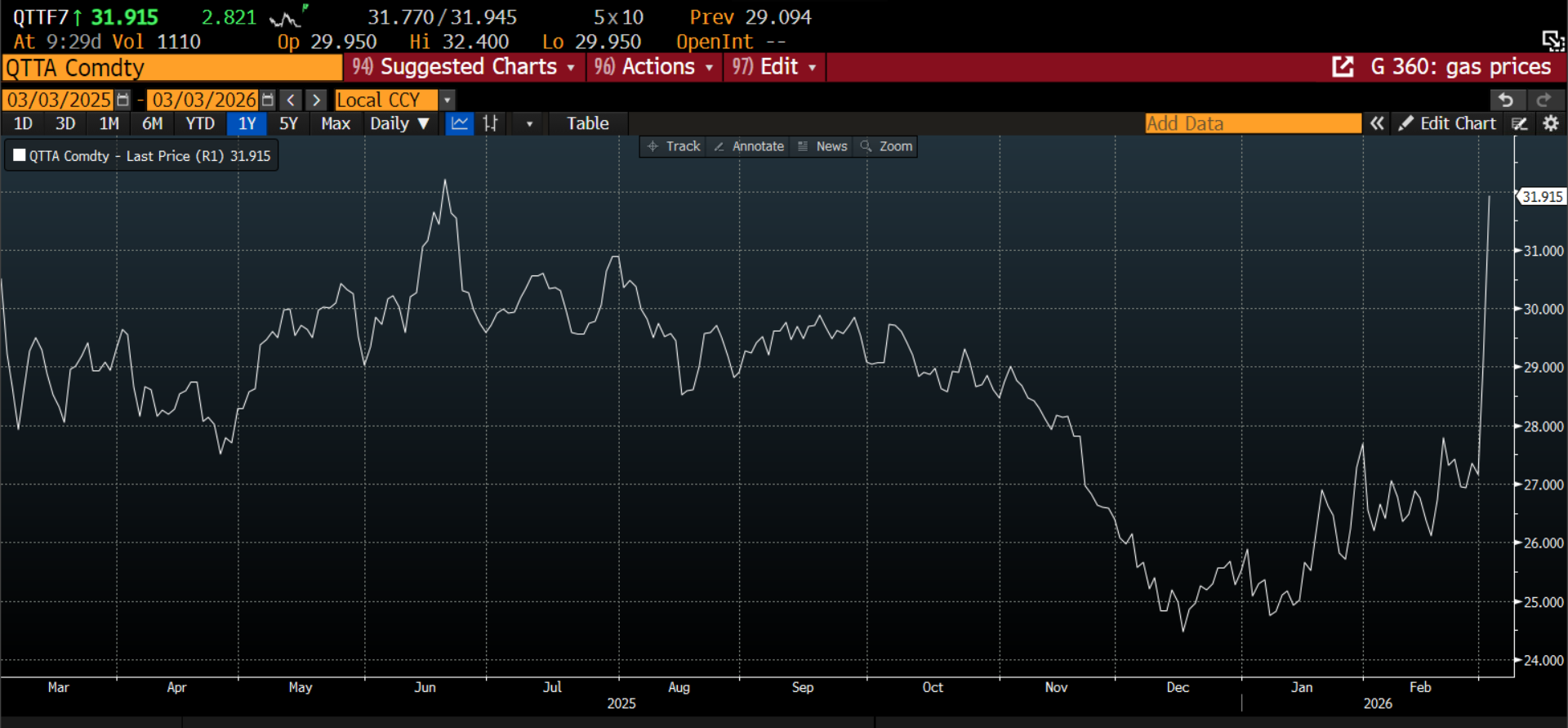
Natural gas prices have soared for another day, and European Nat Gas is higher by 24% on Tuesday. Qatar is continuing to halt production, which will massively disrupt the LNG market. However, the question is, are we going back to a 2022 scenario where soaring energy prices triggered a massive wave of inflation that battered the global economy?
Stable US Gas prices matter for European energy bills
For now, the chances of that are low. In 2022, when Russia invaded Ukraine, the price spike was combined with a very low inventory of European gas, which sent prices soaring. While gas inventories tend to be slim, Europe is much less reliant on gas from Russia and the Middle East and instead gets the bulk of its LNG from the US, another major producer. This means that the European market should be able to absorb a few weeks of disruptions to Qatari LNG flow. However, if Qatar’s production takes longer to come back on line, or if it cannot be exported due to the dangers of tankers travelling through the Strait of Hormuz, then we may start to see US gas prices rise. So far, US gas prices have risen by a moderate 6%, compared with an 82% increase in European Nat gas prices in the past week. We will be watching US Nat Gas prices closely in the coming days, any significant uplift to these prices would signal another energy price shock for Europe is coming.
Bond markets are not resting on their laurels, and sovereign bonds were one of the biggest financial casualties of this conflict on Monday. Bond prices are tanking once again today, and bond yields are soaring, the UK 10-year Gilt yield is higher by 10bps today, French yields are higher by 9bps, and US Treasury yields are up by 5bps so far. The bond market is usually more restrained than commodities and stock markets, so the fact that bonds have sold off sharply suggests that the panic is real.
BoE rate cut bets slashed
Events in the Middle East are also playing out in the interest rate futures market. The market is rapidly pricing out the chance of a rate cut this month from the Bank of England. Energy prices have been the main driver of UK inflation in recent years and the BOE will not want to lose control of price stability this year. Last week there was an 80% chance of a rate cut on 19th March, this now stands at just over 20%. The interest rate futures market has also rushed to price out a second rate cut from the BOE for 2026, with only one cut expected in late Q3.
Commodity prices drive bond markets
The longer-term direction of sovereign bond yields and interest rate expectations will be determined by energy prices in the short term. If Qatar resumes production of LNG, and if the conflict is swiftly resolved from here, with ships able to pass through the region, then bonds will recover, yields will fall and rate cuts will resume.
Signs of capitulation in European stock markets
US equity futures are also selling off this morning, The Nasdaq is set for a 2% decline, and the S&P 500 is expected to fall 1.5% this morning, as a wave of risk aversion knocks investor sentiment. In Europe, the selloff is indiscriminate, with all sectors in the red, led by financials and utilities, even the energy sector is posting a loss. Even defense stocks are lower this morning, as rising borrowing costs threaten defense spending pledges in Europe.
The FTSE 100 is also capitulating after showing signs of resilience on Monday. Materials stocks are one of the weakest sectors on the UK index as miners come under pressure. While energy prices are soaring, the price of industrial commodities and metals is falling. Even gold and silver are down today, as traders rotate out of metals, stocks and bonds, and into the energy space. Only three UK stocks are posting gains today, including BP.
Markets digest news that the 'big one' is coming
There is a whiff of capitulation in the air today. After a moderate reaction to the situation in the Middle East on Monday, panic is building in markets as President Trump threatened Iran by saying that ‘the big one’ is coming. Who knows that that means, but it suggests that this conflict will not be wrapped up in the next few days, that the Iranian regime may be down, but it is not out and it has the capability to fight back. These are uncomfortable days for risk takers, and for now, energy is king. But, when energy prices spike, this is very damaging for the global economy and causes pain elsewhere. We are witnessing that today.
Chart 1: European Gas prices soar for another day
Author

Kathleen Brooks
XTB UK
Kathleen has nearly 15 years’ experience working with some of the leading retail trading and investment companies in the City of London.














