Imagine you're discovering the first signature playbook trade.

Playbook trades go hand in hand with the market's narrative, which we'll cover shortly.

But before that, each playbook trade features signature characteristics making the trade uniquely identifiable.

Yet the reason for grasping this trade first is that it offers an unusually high 'don't-get-hurt' percentage—meaning over 90% of the outcomes fall into three categories:

  1. You take money.

  2. You don't take or lose money.

  3. You have a slight paper cut loss.

(A paper cut loss occurs when the initial risk on a trade is reduced to a fraction of that amount.)

Once you can identify it, you 'time' your entry to ensure more than 90% of these trades fall into the three categories.

Let’s say it’s Saturday, the market’s closed. You’re walking through how to identify and time your entry into the first signature trade—guided by someone who’s traded it daily for years.

From knowledge to the real-life game

But before placing this trade on your live account, it's essential to confirm you can enter it as covered—during real market conditions. For safety, you use a simulated account.

What happens next?

It doesn't matter if you've been trading for 3, 5, or 10 years—you mess it up.
Why? Because everyone messes up a 'doing' activity in the beginning.

But this signature trade appears every single day—once, twice, or several times—giving you the chance to repeat it.

And with an experienced trader reviewing your progress and giving feedback to steer you in the right direction—you get better and better.

And that's when it hits you

Now you know the importance of playbook trades—isolating trading to a specific scenario where there are no shades of grey—just absolute clarity on what the trade looks like and how to trade it.

It's so specific, you rinse and repeat. Competence lives in repetition.

Yet, simultaneously, you make a powerful insight into the trading game—call it an 'ah ha' moment.

If you didn't know the significance of a playbook trade and the process of repeating it until you can trade it successfully...

Imagine how many other traders aren't aware of this—but are attempting to compete with you?

And now you understand why you don't trade to make money—but trade to take it.

You take money from traders who aren't trading with the same level of 'doing' skill as you do.

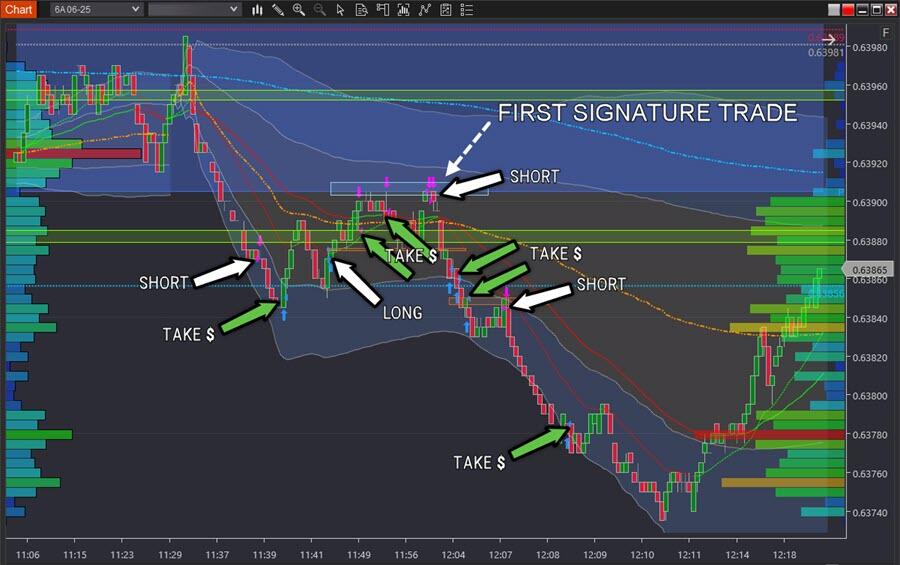
Now let's look at a chart of trading from today:
At first glance, it might appear overwhelming because you are looking at numerous executions representing various playbook trades.

But do you see the 'First Signature Trade' amongst all these trades?
Chart

The first signature trade is still present because of its high success and safety. It always remains part of your trading arsenal.

But by focusing first on that one playbook trade, you fast-track consistency—because your focus compounds. Spread it across several, and progress slows.

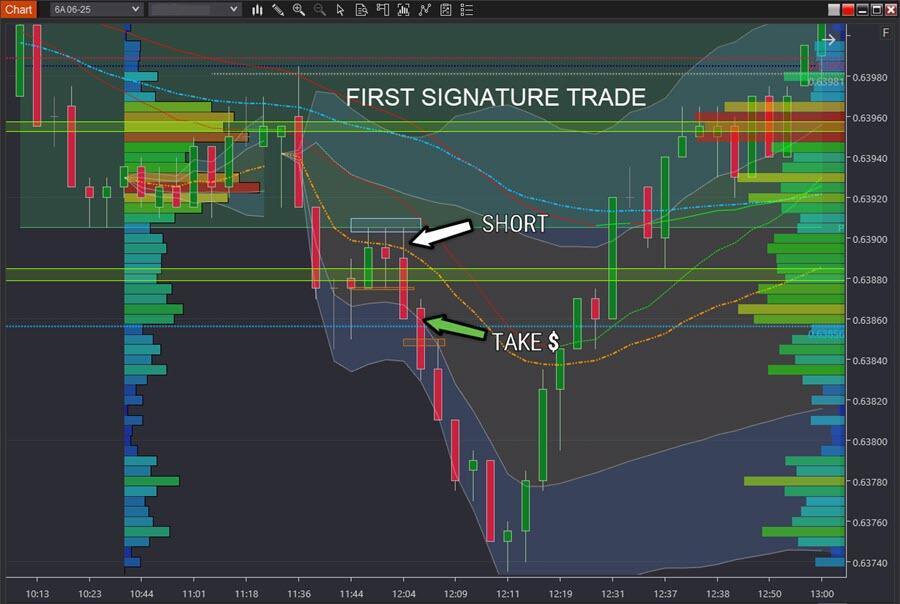
So, in the beginning, a chart view of your trading over the same period would look like the view below. Yes, it's a different-looking chart derived from a different data set.

Chart

Opportunities multiply with skill

The more times you take the same trade, the sooner it becomes an unconscious behaviour, freeing up your mental capital.

You recognise this happening because you now notice more of what's happening in the market—now that you're not as mentally consumed with the first playbook trade.

But the difference is—now you're seeing the market from the viewpoint of having gained some refined trading skills—hence, you're noticing more intelligible trading behaviours only specialist knowledge can decipher.

Which brings us to the market narrative.

The 'narrative'

The advanced trading phase involves seeing beyond the lines, numbers and charts to recognise the different characters in the market—including:

  • Gamblers not traders.

  • Under-skilled traders.

  • Highly skilled traders.

  • Institutional players.

  • Market makers, and

  • Algorithmic and high-frequency players.

  • Based on where and how they trade.

When you know all the different characters, you truly comprehend the story behind the market's movements to act accordingly.

And as you gain unconscious competence in your first playbook trade, second, and so on, your narrative comprehension deepens. Your opportunities multiply with skill.

You can take more out of the market the more you can comprehend the story.

Consider the first chart of trades:

40 minutes of trading, comprehending the narrative, and executing numerous playbook trades—which was preceded by allocating time to the day's game plan.

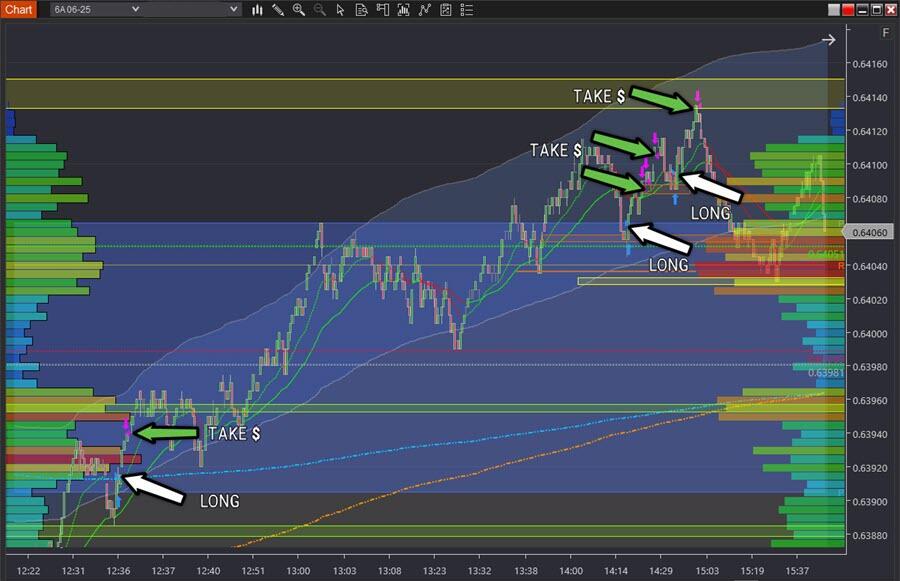
Then it was time for a break, only to return later in the afternoon to resume:

  • Comprehending the market narrative.

  • Waiting for the market to align with a daily game plan.

  • Executing those signature trades which align with the first two points.
Chart

Note: This is an unusual day on which no taxes were paid.

Most trading days include necessary losers—the tax you pay to keep the game exclusive to the minority who consistently take money out of the market. I'll expand on that in the next article.

In the meantime, if this level of structured, feedback-driven repetition is missing from your trading—you’re not seeing what’s possible.


Forex and derivatives trading is a highly competitive and often extremely fast-paced environment. It only rewards individuals who attain the required level of skill and expertise to compete. Past performance is not indicative of future results. There is a substantial risk of loss to unskilled and inexperienced players. The high degree of leverage can work against you as well as for you. Before deciding to trade any such leveraged products you should carefully consider your investment objectives, level of experience, and risk appetite. The possibility exists that you could sustain a loss of some or all of your initial investment and therefore you should not invest money that you cannot afford to lose. You should be aware of all the risks associated with trading on margin, and seek advice from an independent

Editors’ Picks

EUR/USD falls toward 1.1700 on broad USD recovery

EUR/USD falls toward 1.1700 on broad USD recovery

EUR/USD turns south and declines toward 1.1700 on Wednesday. The US Dollar gathers recovery momentum and forces the pair to stay on the back foor, as traders look to USD short-covering ahead of US inflation report on Thursday. However, the downside could be capped by hawkish ECB expectations. 

GBP/USD trades deep in red below 1.3350 after soft UK inflation data

GBP/USD trades deep in red below 1.3350 after soft UK inflation data

GBP/USD stays under strong selling pressure midweek and trades below 1.3350. The UK annual headline and core CPI rose by 3.2% each, missing estimates of 3.5% and 3.4%, respectively, reaffirming dovish BoE expectations and smashing the Pound Sterling across the board ahead of Thurday's BoE policy announcements. 

USD/JPY jumps higher to near 155.50 as US Dollar outperforms; BoJ decision eyed

USD/JPY jumps higher to near 155.50 as US Dollar outperforms; BoJ decision eyed

The USD/JPY pair gains 0.55% and jumps higher to near 155.50 during the European trading session on Wednesday. The pair strengthens as the US Dollar outperforms its peers, following the release of the United States Nonfarm Payrolls report for October and November.


Editors’ Picks

EUR/USD falls toward 1.1700 on broad USD recovery

EUR/USD falls toward 1.1700 on broad USD recovery

EUR/USD turns south and declines toward 1.1700 on Wednesday. The US Dollar gathers recovery momentum and forces the pair to stay on the back foor, as traders look to USD short-covering ahead of US inflation report on Thursday. However, the downside could be capped by hawkish ECB expectations. 

GBP/USD trades deep in red below 1.3350 after soft UK inflation data

GBP/USD trades deep in red below 1.3350 after soft UK inflation data

GBP/USD stays under strong selling pressure midweek and trades below 1.3350. The UK annual headline and core CPI rose by 3.2% each, missing estimates of 3.5% and 3.4%, respectively, reaffirming dovish BoE expectations and smashing the Pound Sterling across the board ahead of Thurday's BoE policy announcements. 

Gold clings to moderate daily gains above $4,300

Gold clings to moderate daily gains above $4,300

Following Tuesday's volatile action, Gold regains its traction on Wednesday and trades in positive territory above $4,300. While the buildup in the USD recovery momentum caps XAU/USD's upside, the cautious market stance helps the pair hold its ground.

Bitcoin risks deeper correction as ETF outflows mount, derivative traders stay on the sidelines

Bitcoin risks deeper correction as ETF outflows mount, derivative traders stay on the sidelines

Bitcoin (BTC) remains under pressure, trading below $87,000 on Wednesday, nearing a key support level. A decisive daily close below this zone could open the door to a deeper correction.

Monetary policy: Three central banks, three decisions, the same caution

Monetary policy: Three central banks, three decisions, the same caution

While the Fed eased its monetary policy on 10 December for the third consecutive FOMC meeting, without making any guarantees about future action, the BoE, the ECB and the BoJ are holding their respective meetings this week. 

RECOMMENDED LESSONS

5 Forex News Events You Need To Know

In the fast moving world of currency markets where huge moves can seemingly come from nowhere, it is extremely important for new traders to learn about the various economic indicators and forex news events and releases that shape the markets. Indeed, quickly getting a handle on which data to look out for, what it means, and how to trade it can see new traders quickly become far more profitable and sets up the road to long term success.

Top 10 Chart Patterns Every Trader Should Know

Chart patterns are one of the most effective trading tools for a trader. They are pure price-action, and form on the basis of underlying buying and selling pressure. Chart patterns have a proven track-record, and traders use them to identify continuation or reversal signals, to open positions and identify price targets.

7 Ways to Avoid Forex Scams

The forex industry is recently seeing more and more scams. Here are 7 ways to avoid losing your money in such scams: Forex scams are becoming frequent. Michael Greenberg reports on luxurious expenses, including a submarine bought from the money taken from forex traders. Here’s another report of a forex fraud. So, how can we avoid falling in such forex scams?

What Are the 10 Fatal Mistakes Traders Make

Trading is exciting. Trading is hard. Trading is extremely hard. Some say that it takes more than 10,000 hours to master. Others believe that trading is the way to quick riches. They might be both wrong. What is important to know that no matter how experienced you are, mistakes will be part of the trading process.

Strategy

Money Management

Psychology

Best Brokers of 2025