 Rick Wright
Online Trading Academy
Here, I’ll cover the three parts to every trade, and which one you actually have control of…
OK, so at Online Trading Academy, we look for the supply and demand zones formed by institutions to enter and exit our trades. The main reason for this is to be able ride the waves on the charts from one area of buying pressure to another area of selling pressure. The demand zones (when going long) allow us to use the massive buy orders from these institutions to help push prices higher; and the supply zones (when going short) allow us to use these massive sell orders to help push prices lower.
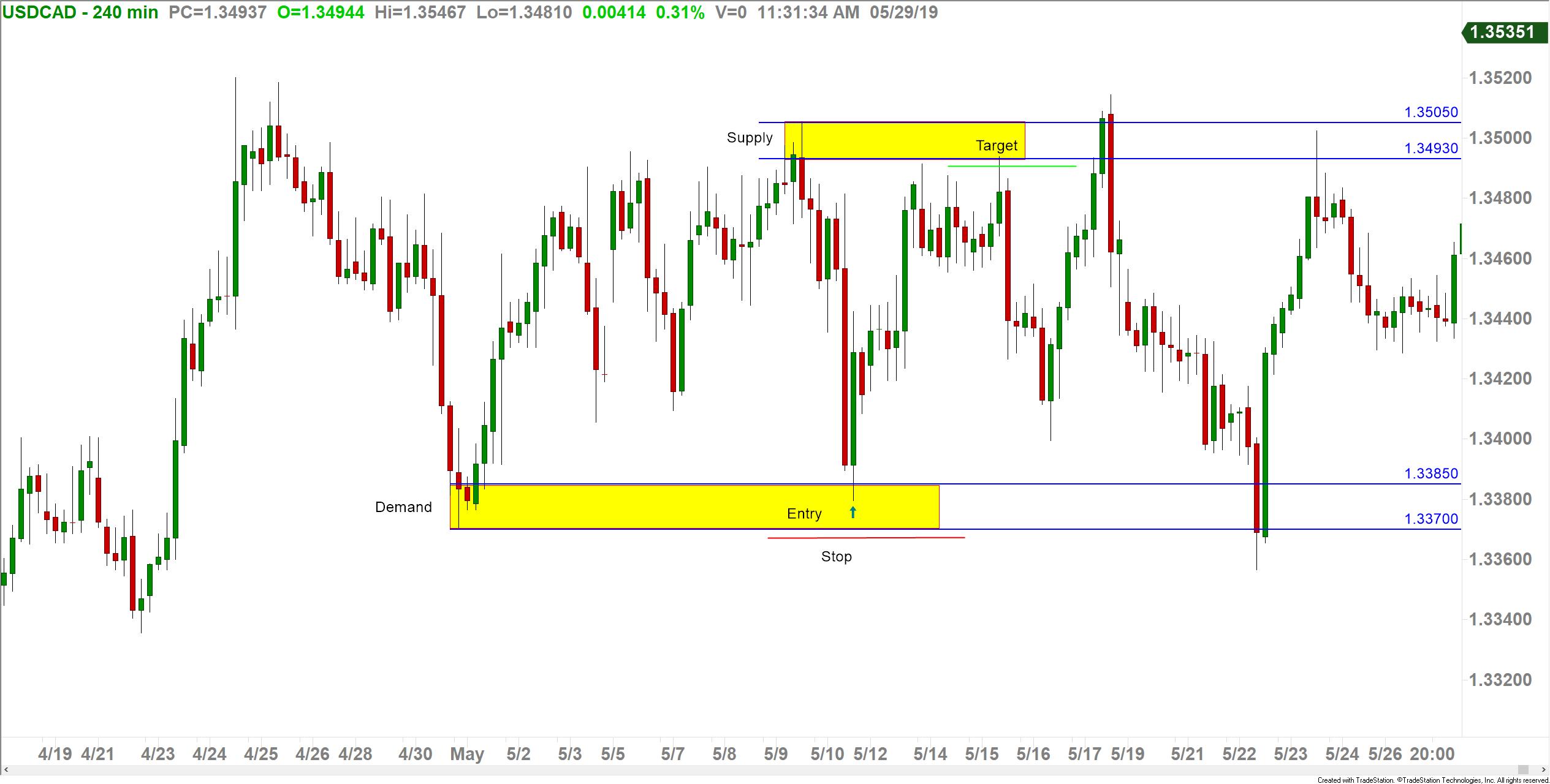
On the attached USDCAD chart, I’ve marked out a couple of obvious demand zones at 1.3370 – 1.3385, and supply zones at 1.3493 – 1.3505. When price returned to the demand zone on May 10, a buy order could have been placed to go long near 1.3385, and the subsequent target at 1.3492.
Three Parts to Every Trade
STOP LOSS – an order that is used to take exit a position either for a small loss if the trade went opposite expectations, a breakeven if price has moved as expected allowing the stop to be moved to the entry price, or for a profit when price has moved further as expected allowing the stop to be moved as price goes up to lock in profits.
ENTRY – the act of getting into a position; buy in demand to go long, sell in supply to go short
TARGET – an order to exit the position with a predefined profit
Now, as far as I’m concerned the only one of these orders I actually have control over is the entry. My stop loss always goes on the OTHER SIDE of the zone I use for entry (below the demand zone for a long, above the supply zone when going short.) My target always goes JUST BEFORE price could get to the opposing zone (just below the supply zone on a long profit target, and just above demand for a short profit target.)
If I only have true control over my entry, then I want to enter my trades as CLOSE TO the stop loss as possible. This way I can maximize the pips on this trade. If a trader were to enter this trade at the top of the zone at a price of 1.3385, with a stop just below the zone at 1.3368, it would have given us risk of 17 pips, with a potential profit target of 1.3490. The reward, then, would have been 105 pips. The reward to risk ratio would have been about 6:1 which is not bad at all! Now consider this, if the trader would have missed the good entry and not entered until about 1.3440, their reward to risk ratio would have been WORSE than a 1:1!
The point is this: institutions and their orders rule the markets. Traders need to be able to recognize where they have their orders positioned, so they can ride the moves between these massive buy and sell orders, (demand and supply zones). If the stop loss is placed randomly, they aren’t using the institutions to their advantage!
Another great thing about getting a very good entry is this: it could be possible to make A LOT more pips with potentially NO MORE RISK. The first time this was explained to me I was flabbergasted! Here is how it works:
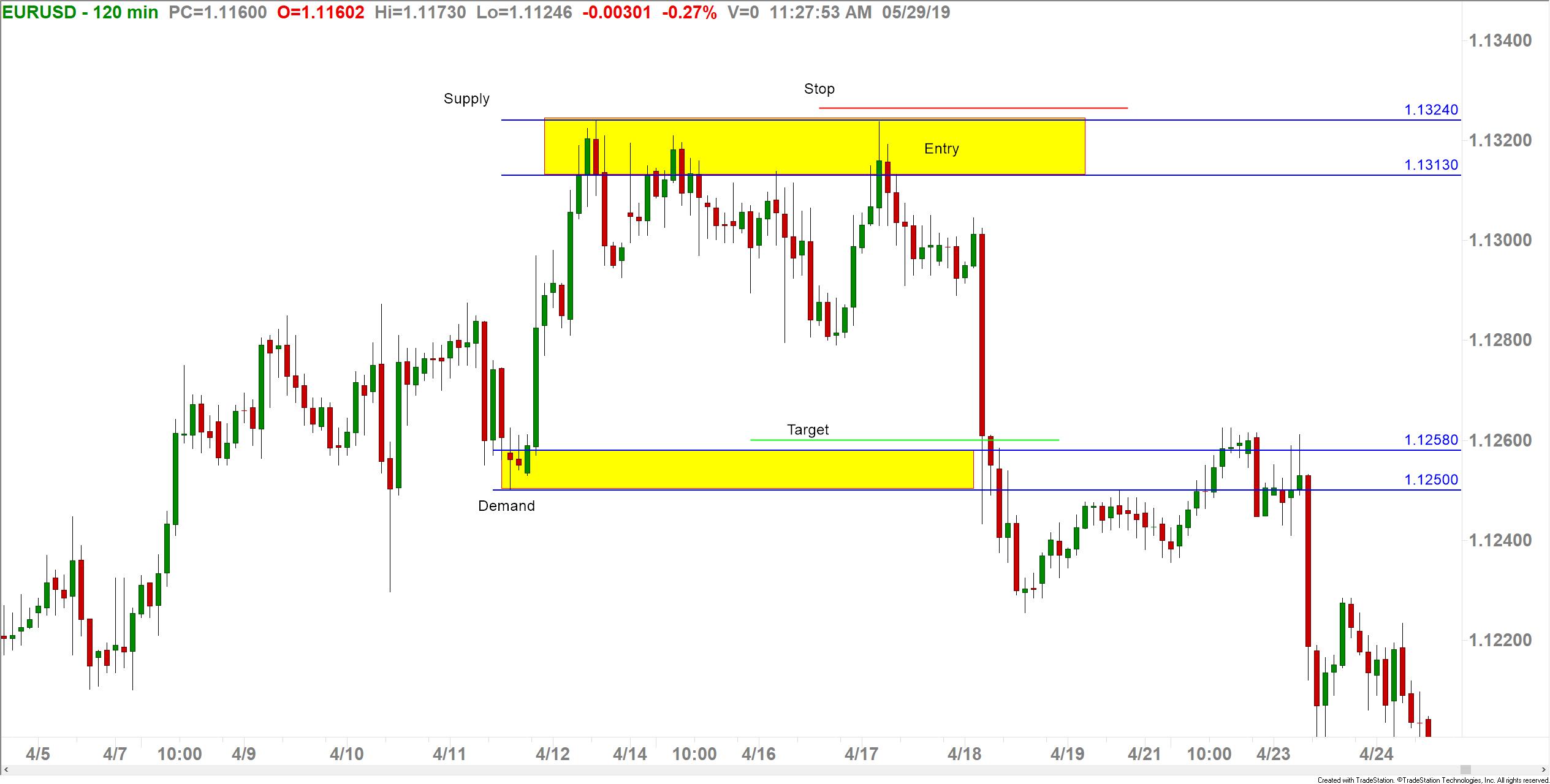
Let’s say we have a $100,000 trading account, and we have a rule in our trading plan that says we will risk no more than 2% ($2,000) on a position. Using the following EURUSD as an easy example, with an entry at 1.1313 and a stop above the zone at 1.1326, our risk is 13 pips and, with a target of 1.1260, our reward is 53 pips. With the 13 pips of risk and $2,000 of risk on any one position, our position size would be about 15.38 standard lots. With that position size, our gain in pips would be about 815 pips! (15.38 lots x 53 pips of reward.)
Now, with a much better entry, say, 1.1320, our risk would be 6 pips (remember, the chart tells you where the stop is!) and target would then be 60 pips. With the same $2,000 of risk, our position size is now 33.3 lots, approximately twice as large but with virtually no more risk! What do you think happens to the reward in pips when the position size doubles?
Be aware, it is NOT advisable to put this huge position size on in a $100,000 account! While the risk is theoretically limited to only 2%, if something unusual happens over a weekend, for example, a giant gap in the wrong direction could crush the account. This would be another example of a risk management rule, which we’ll have to save for another time. To learn more about additional risk management rules, check out our Professional Forex Course or contact your local center for more information.
To summarize, there are three parts to every trade: stop, entry, and target. When using the charts properly with supply and demand zones, traders only need to concentrate on the entry. With a very good entry, trade position size could increase dramatically with risk remaining virtually the same!
Read the original article here - The Three Parts to Every Trade
This content is intended to provide educational information only. This information should not be construed as individual or customized legal, tax, financial or investment services. As each individual's situation is unique, a qualified professional should be consulted before making legal, tax, financial and investment decisions. The educational information provided in this article does not comprise any course or a part of any course that may be used as an educational credit for any certification purpose and will not prepare any User to be accredited for any licenses in any industry and will not prepare any User to get a job. Reproduced by permission from OTAcademy.com click here for Terms of Use: https://www.otacademy.com/about/terms
Editors’ Picks

EUR/USD climbs to daily highs on US CPI
EUR/USD now accelerates it rebound and flirts with the 1.1880 zone on Friday, or daily highs, all in response to renewed selling pressure on the US Dollar. In the meantime, US inflation figures showed the headline CPI rose less than expected in January, removing some tailwinds from the Greenback’s momentum.

GBP/USD clings to gains above 1.3600
GBP/USD reverses three consecutive daily pullbacks on Friday, hovering around the low-1.3600s on the back of the vacillating performance of the Greenback in the wake of the release of US CPI prints in January. Earlier in the day, the BoE’s Pill suggested that UK inflation could settle around 2.5%, above the bank’s goal.

USD/JPY edges up above 153.50 with all eyes on US CPI figures
USD/JPY appreciates above 153.00 but remains on track for a 2.4% weekly loss. Trading volumes remain subdued on Friday, ahead of the IS CPI release. The Yen remains supported by hopes of a stable government and calls for further BoJ tightening.
Editors’ Picks
EUR/USD climbs to daily highs on US CPI
EUR/USD now accelerates it rebound and flirts with the 1.1880 zone on Friday, or daily highs, all in response to renewed selling pressure on the US Dollar. In the meantime, US inflation figures showed the headline CPI rose less than expected in January, removing some tailwinds from the Greenback’s momentum.
GBP/USD clings to gains above 1.3600
GBP/USD reverses three consecutive daily pullbacks on Friday, hovering around the low-1.3600s on the back of the vacillating performance of the Greenback in the wake of the release of US CPI prints in January. Earlier in the day, the BoE’s Pill suggested that UK inflation could settle around 2.5%, above the bank’s goal.

Gold: Upside remains capped by $5,000
Gold is reclaiming part of the ground lost on Wednesday’s marked retracement, as bargain-hunters seem to have stepped in. The precious metal’s upside, however, appears limited amid the slightly better tone in the US Dollar after US inflation data saw the CPI rise less than estimated at the beginning of the year.

Crypto Today: Bitcoin, Ethereum, XRP in choppy price action, weighed down by falling institutional interest
Bitcoin's upside remains largely constrained amid weak technicals and declining institutional interest. Ethereum trades sideways above $1,900 support with the upside capped below $2,000 amid ETF outflows.

Week ahead – Data blitz, Fed Minutes and RBNZ decision in the spotlight
US GDP and PCE inflation are main highlights, plus the Fed minutes. UK and Japan have busy calendars too with focus on CPI. Flash PMIs for February will also be doing the rounds. RBNZ meets, is unlikely to follow RBA’s hawkish path.
RECOMMENDED LESSONS
Making money in forex is easy if you know how the bankers trade!

I’m often mystified in my educational forex articles why so many traders struggle to make consistent money out of forex trading. The answer has more to do with what they don’t know than what they do know. After working in investment banks for 20 years many of which were as a Chief trader its second knowledge how to extract cash out of the market.
5 Forex News Events You Need To Know

In the fast moving world of currency markets where huge moves can seemingly come from nowhere, it is extremely important for new traders to learn about the various economic indicators and forex news events and releases that shape the markets. Indeed, quickly getting a handle on which data to look out for, what it means, and how to trade it can see new traders quickly become far more profitable and sets up the road to long term success.
Top 10 Chart Patterns Every Trader Should Know

Chart patterns are one of the most effective trading tools for a trader. They are pure price-action, and form on the basis of underlying buying and selling pressure. Chart patterns have a proven track-record, and traders use them to identify continuation or reversal signals, to open positions and identify price targets.
7 Ways to Avoid Forex Scams

The forex industry is recently seeing more and more scams. Here are 7 ways to avoid losing your money in such scams: Forex scams are becoming frequent. Michael Greenberg reports on luxurious expenses, including a submarine bought from the money taken from forex traders. Here’s another report of a forex fraud. So, how can we avoid falling in such forex scams?
What Are the 10 Fatal Mistakes Traders Make
Trading is exciting. Trading is hard. Trading is extremely hard. Some say that it takes more than 10,000 hours to master. Others believe that trading is the way to quick riches. They might be both wrong. What is important to know that no matter how experienced you are, mistakes will be part of the trading process.
The challenge: Timing the market and trader psychology

Successful trading often comes down to timing – entering and exiting trades at the right moments. Yet timing the market is notoriously difficult, largely because human psychology can derail even the best plans. Two powerful emotions in particular – fear and greed – tend to drive trading decisions off course.