 Markus Heitkoetter
Rockwell Trading
Yesterday, Snowflake (SNOW), one of the most anticipated IPOs in recent history, hit markets. With names like Berkshire Hathaway and Salesforce getting in on the IPO, should you be looking at SNOW as your next big investment?
Snowflake Inc. is a cloud-based data-warehousing startup that was founded in 2012, and yesterday they hit public markets. So what exactly does that mean?
What Is An Initial Public Offering (IPO)?
Well, an IPO, or Initial Public Offering, is a way for a company to raise capital in exchange for small pieces of their company called stock shares… and let’s just say that the SNOW IPO was a big one!
In fact, their IPO set a record for software companies and has been the biggest in the U.S. this year.
Originally their IPO price was supposed to be between $75-$85, but last week both Berkshire Hathaway and Salesforce committed to buying millions of shares.
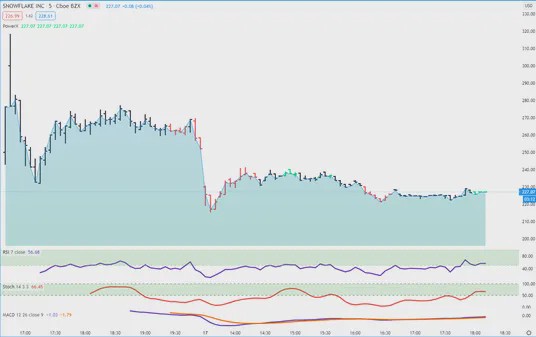
Because of this, the price was then set to release between $100-$110. But this afternoon, around noon when they finally started trading, it opened up at $249.99.
Within a matter of minutes it shot up as high as $318.01. That was over a 27% move within 3 minutes… crazy! That is what we call FOMO (Fear Of Missing Out) in the trading world. And that’s what tends to happen with IPOs.
By the end of yesterday’s trading, Snowflake (SNOW) closed up on the day 3.64%.
How Did The Top IPOs Of 2019 Do?
Last year we had a few noteworthy IPOs like UBER, LYFT, CHWY and PINS. So let’s take a look how all of these different stocks performed out of the gate.
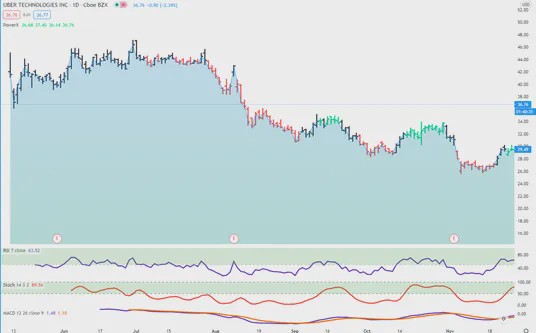
First, we’ll look at UBER. Much like Snowflake (SNOW), UBER had an explosive first day of trading. Then for about two months it basically moved sideways, until its first earnings report. From there, things got pretty ugly! In a matter of months the stock went from $43 to as low as $25.58.
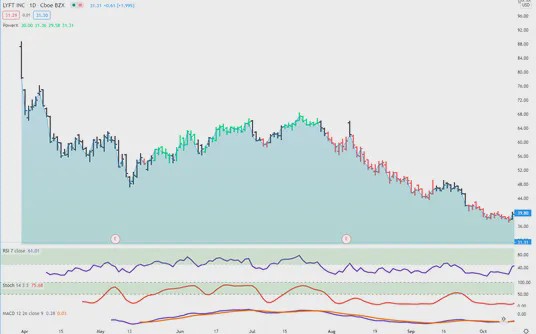
Now let’s take a look at their competitor, LYFT. Very much like SNOW and UBER, it too had a very volatile first day of trading but nearly immediately started moving lower. LYFT IPO’d at $87.24 in March of 2019, and by October it found a temporary bottom at $37.07.
Starting to notice a pattern yet?
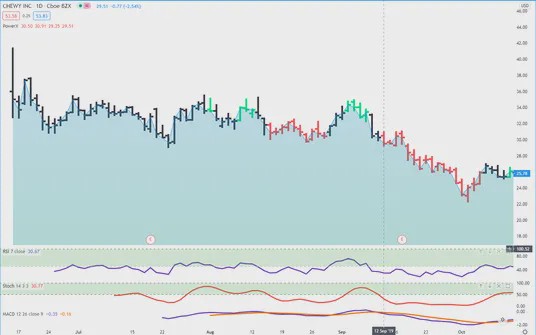
Well, let’s take a look at another IPO that was really hyped last year, Chewy (CHWY). Its first day of trading was also very volatile. It opened up at $36 on its first day of trading in June of last year. By November it finally found a temporary bottom, trading as low as $21.68.
A few other great examples from last year would be Pinterest and Slack. Both acted nearly identically to the other IPOs we just discussed.
Slack was hyped up as the “Skype Killer,” and although that may turn out to be true, their stock basically went straight lower from the start.
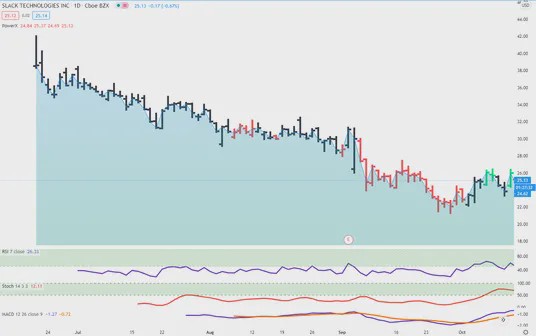
From what I’ve seen over the last few years, this has sort of been the MO of these ultra hyped IPOs.
Taking a look at iposcoop.com you can see all the recent IPOs, and as I’m sure you’ll see, there are plenty you’ve probably never heard of before.
Will I Be Investing or Trading Snowflake (SNOW)?
So after all that discussion, should you invest in Snowflake (SNOW)? Well, ultimately that is up to you. I’m a short term trader, so I like to hold things for as little as a day or two and typically no longer than a few weeks. So for me, I will not be investing in (or trading) Snowflake.
If you’ve followed me for any length time you’ve probably heard me say:
Trade What You SEE, Not What You Think.
And for me, I don’t SEE a trade setup. Could SNOW break the mold for over-hyped IPOs and go higher with out a sharp move lower…of course! But that’s not how I approach the markets.
I stick with SRC Profits:
– Systematic.
– Repeatable.
– Consistent.
Trading Futures, options on futures and retail off-exchange foreign currency transactions involves substantial risk of loss and is not suitable for all investors. You should carefully consider whether trading is suitable for you in light of your circumstances, knowledge, and financial resources. You may lose all or more of your initial investment. The lower the day trade margin, the higher the leverage and riskier the trade. Leverage can work for you as well as against you; it magnifies gains as well as losses. Past performance is not necessarily indicative of future results.
Editors’ Picks

EUR/USD holds steady above 1.1850 as markets eye Eurozone GDP, US CPI inflation releases
The EUR/USD pair trades on a flat note near 1.1870 during the early Asian session on Friday. The major pair steadies amid mixed signals from the latest release of US economic indicators. Traders await the preliminary reading of the Eurozone Gross Domestic Product for the fourth quarter and US inflation data, which are published later on Friday.

GBP/USD consolidates around 1.3600 vs. USD; looks to US CPI for fresh impetus
The GBP/USD pair remains on the defensive through the Asian session on Friday, though it lacks bearish conviction and holds above the 1.3600 mark as traders await the release of the US consumer inflation figures before placing directional bets.

USD/JPY rebounds above 153.00 ahead of US inflation data
USD/JPY stages a comeback and regains 153.00 in the Asian session, snapping a four-day losing streak amid some repositioning ahead of the US CPI report. However, expectations that Japan's PM Sanae Takaichi could be more fiscally responsible, along with bets that the BoJ will stick to its policy normalization path and the risk-off mood, could support the safe-haven Japanese Yen, capping the pair's upside.
Editors’ Picks
USD/JPY rebounds above 153.00 ahead of US inflation data
USD/JPY stages a comeback and regains 153.00 in the Asian session, snapping a four-day losing streak amid some repositioning ahead of the US CPI report. However, expectations that Japan's PM Sanae Takaichi could be more fiscally responsible, along with bets that the BoJ will stick to its policy normalization path and the risk-off mood, could support the safe-haven Japanese Yen, capping the pair's upside.

Gold: Will US CPI data trigger a range breakout?
Gold retakes $5,000 early Friday amid a turnaround from weekly lows as US CPI data loom. The US Dollar consolidates weekly losses as AI concerns-driven risk-off mood stalls downside. Technically, Gold appears primed for a big range breakout, with risks skewed toward a bullish break.

AUD/USD consolidates below 0.7100 as traders await US CPI report
AUD/USD consolidates the previous day's retracement slide from the vicinity of mid-0.7100s, or a three-year high, holding below 0.7100 as traders move to the sidelines ahead of Friday's release of the US consumer inflation figures. In the meantime, the divergent RBA-Fed outlooks might continue to support spot prices amid subdued US Dollar demand, though the risk-off impulse could act as a headwind for the Aussie.

Ethereum investors face huge unrealized losses following price slump
US spot Ethereum exchange-traded funds flipped negative again on Wednesday after recording net outflows of $129.1 million, reversing mild inflows seen at the beginning of the week, per SoSoValue data. Fidelity's FETH was responsible for more than half of withdrawals, posting outflows of $67 million.

A tale of two labour markets: Headline strength masks underlying weakness
Undoubtedly, yesterday’s delayed US January jobs report delivered a strong headline – one that surpassed most estimates. However, optimism quickly faded amid sobering benchmark revisions.
RECOMMENDED LESSONS
Making money in forex is easy if you know how the bankers trade!

I’m often mystified in my educational forex articles why so many traders struggle to make consistent money out of forex trading. The answer has more to do with what they don’t know than what they do know. After working in investment banks for 20 years many of which were as a Chief trader its second knowledge how to extract cash out of the market.
5 Forex News Events You Need To Know

In the fast moving world of currency markets where huge moves can seemingly come from nowhere, it is extremely important for new traders to learn about the various economic indicators and forex news events and releases that shape the markets. Indeed, quickly getting a handle on which data to look out for, what it means, and how to trade it can see new traders quickly become far more profitable and sets up the road to long term success.
Top 10 Chart Patterns Every Trader Should Know

Chart patterns are one of the most effective trading tools for a trader. They are pure price-action, and form on the basis of underlying buying and selling pressure. Chart patterns have a proven track-record, and traders use them to identify continuation or reversal signals, to open positions and identify price targets.
7 Ways to Avoid Forex Scams

The forex industry is recently seeing more and more scams. Here are 7 ways to avoid losing your money in such scams: Forex scams are becoming frequent. Michael Greenberg reports on luxurious expenses, including a submarine bought from the money taken from forex traders. Here’s another report of a forex fraud. So, how can we avoid falling in such forex scams?
What Are the 10 Fatal Mistakes Traders Make
Trading is exciting. Trading is hard. Trading is extremely hard. Some say that it takes more than 10,000 hours to master. Others believe that trading is the way to quick riches. They might be both wrong. What is important to know that no matter how experienced you are, mistakes will be part of the trading process.
The challenge: Timing the market and trader psychology

Successful trading often comes down to timing – entering and exiting trades at the right moments. Yet timing the market is notoriously difficult, largely because human psychology can derail even the best plans. Two powerful emotions in particular – fear and greed – tend to drive trading decisions off course.