Determining a Buy Put Option's Moneyness

Now that you are comfortable determining the ‘moneyness’ of buy call options, I will introduce you to the power of buy put options and their “moneyness”.
AUD/USD has been in a steady downtrend over the past six months. This Thursday, the market has several volatile events for the Australian dollar and the U.S. dollar, such as Australian Employment Change, Australian Unemployment Rate, and U.S. Retail Sales. Those events are likely to impact the AUD/USD. Buying a Put option would allow you profit from a continuation of the pairs downtrend. Read “The Put Option” lesson for an introduction on buying Put options.
Next, you need to decide on the strike of the put option. Depending on the strike level, an option can be in one of three states:
• An option is at-the-money (ATM) when the strike rate equals the underlying market rate. For example, if AUD/USD is trading at 0.7700 and you buy a Put option with strike 0.7700, the option is ATM.
• An option is in-the-money (ITM) when the strike rate is better than the underlying market rate. For example, if AUD/USD is trading at 0.7700 and you buy a Put with strike 0.7800, the option would be considered ITM because 0.7800 is a better sell rate than 0.7700.
• An option is out-of-the-money (OTM) when the strike rate is worse than the underlying market rate. For example, if AUD/USD is trading at 0.7700 and you buy a Put with strike 0.7600, the option would be considered OTM because 0.7600 is a worse sell rate than 0.7700.
The table below shows the different states of a Put and Call of a strike level in relation to market level changes.
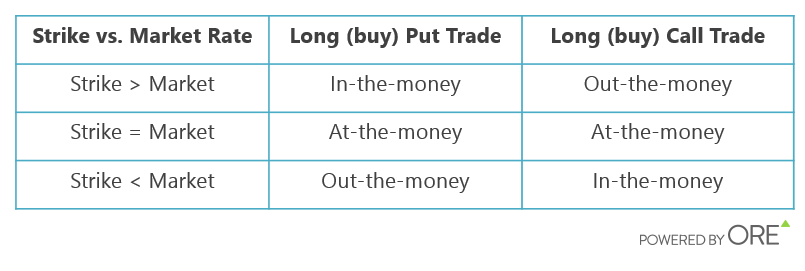
Note: A Put option, with the same strike rate, will always be in a different state to the Call option unless the strike rate equals the market, then both the Put and Call will be at-the-money (ATM).
When an option is in-the-money (ITM), it is more valuable, i.e. its premium is higher. Hence, ITM options are the most expensive to buy, whereas out-of-the-money (OTM) options are the cheapest. Paying more for an option means you are risking more, however an ITM option has a higher probability of returning a profit. Buying an OTM option is a smaller risk, but the probability of profit is lower. In each trade, you enter a strike rate depending on your market outlook and risk appetite.
AUD/USD has been in a steady downtrend over the past six months. This Thursday, the market has several volatile events for the Australian dollar and the U.S. dollar, such as Australian Employment Change, Australian Unemployment Rate, and U.S. Retail Sales. Those events are likely to impact the AUD/USD. Buying a Put option would allow you profit from a continuation of the pairs downtrend. Read “The Put Option” lesson for an introduction on buying Put options.
Next, you need to decide on the strike of the put option. Depending on the strike level, an option can be in one of three states:
• An option is at-the-money (ATM) when the strike rate equals the underlying market rate. For example, if AUD/USD is trading at 0.7700 and you buy a Put option with strike 0.7700, the option is ATM.
• An option is in-the-money (ITM) when the strike rate is better than the underlying market rate. For example, if AUD/USD is trading at 0.7700 and you buy a Put with strike 0.7800, the option would be considered ITM because 0.7800 is a better sell rate than 0.7700.
• An option is out-of-the-money (OTM) when the strike rate is worse than the underlying market rate. For example, if AUD/USD is trading at 0.7700 and you buy a Put with strike 0.7600, the option would be considered OTM because 0.7600 is a worse sell rate than 0.7700.
The table below shows the different states of a Put and Call of a strike level in relation to market level changes.
Note: A Put option, with the same strike rate, will always be in a different state to the Call option unless the strike rate equals the market, then both the Put and Call will be at-the-money (ATM).
When an option is in-the-money (ITM), it is more valuable, i.e. its premium is higher. Hence, ITM options are the most expensive to buy, whereas out-of-the-money (OTM) options are the cheapest. Paying more for an option means you are risking more, however an ITM option has a higher probability of returning a profit. Buying an OTM option is a smaller risk, but the probability of profit is lower. In each trade, you enter a strike rate depending on your market outlook and risk appetite.
Buying an at-the-money (ATM) Put option
When you buy a Put option with a strike equal to the market rate, it is at-the-money (ATM). If the market subsequently rises, the option will be out-of-the-money (OTM) because the sell price of the strike is lower than the market. But if the market falls, the option will be in-the-money (ITM) as the strike is more attractive than market. The diagram below demonstrates this concept.
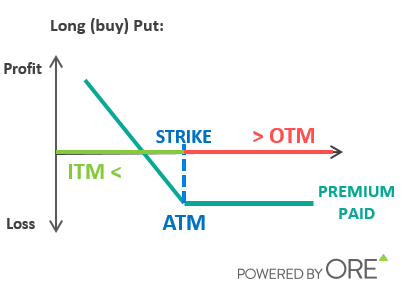
Example of buying Long Put option – ATM, OTM, ITM
The following three images depict AUD/USD buy Put options ATM, OTM, and ITM.
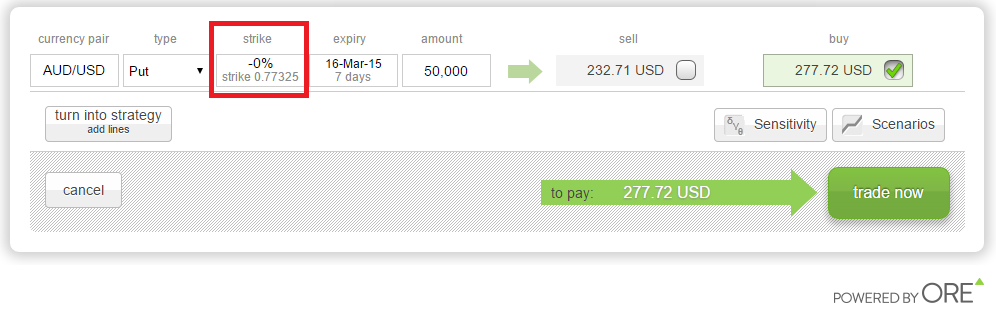
In the ATM buy Put option image above, the underlying AUD/USD market rate and the strike are the same at 0.77325 and the option costs 277.72 USD to buy
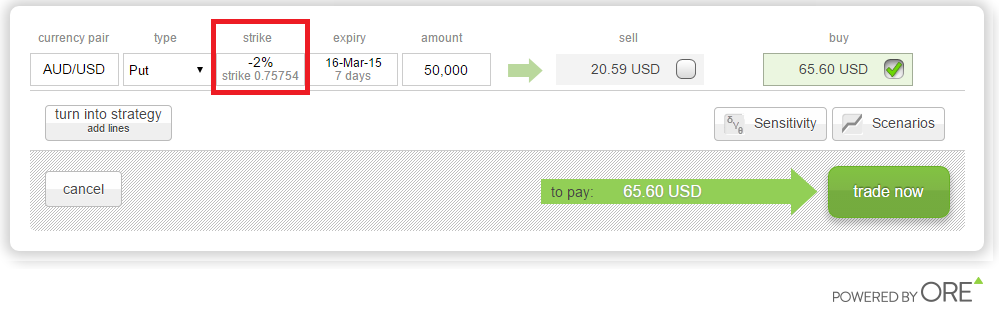
In the OTM buy Put option above, a strike price -2% below market has been selected. This means the trader is reserving a worse rate than what is currently available in the market and the cost to buy the option has decreased to 65.60 USD.
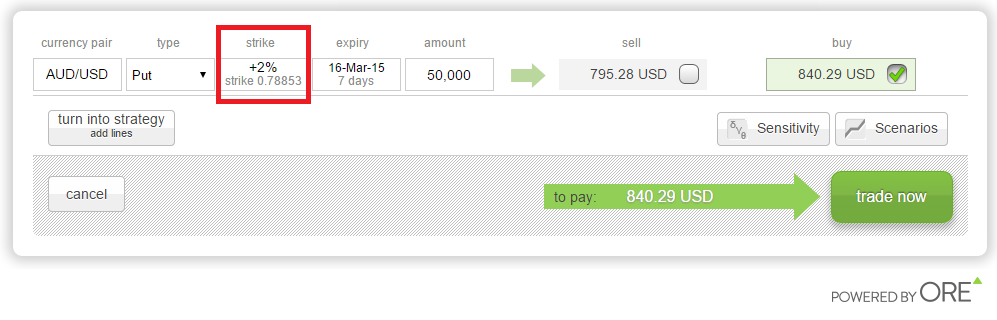
In the ITM buy call option above, a strike price +2% above market has been selected. This means the trader is reserving a better rate than the market and the cost to buy the option has increased to 840.29 USD.
In the ATM buy Put option image above, the underlying AUD/USD market rate and the strike are the same at 0.77325 and the option costs 277.72 USD to buy
In the OTM buy Put option above, a strike price -2% below market has been selected. This means the trader is reserving a worse rate than what is currently available in the market and the cost to buy the option has decreased to 65.60 USD.
In the ITM buy call option above, a strike price +2% above market has been selected. This means the trader is reserving a better rate than the market and the cost to buy the option has increased to 840.29 USD.
Author

Davina Becker is a Product Specialist at ORE with over 10 years of experience in the financial markets.
More from Davina Becker