 Markus Heitkoetter
Rockwell Trading
Markus is a self-made multi-millionaire who was born in Germany. He came to the US in 2002 with $30,000 in his pocket and a dream to become a successful trader.
Over the past 20 years, he traded and invested his way to success in the stock and real estate market, making millions of dollars in the process.
Markus has written three best-selling books about trading and investing that have been translated into multiple languages. His youtube channel with over 4 million views is dedicated to his favorite topic — which is trading stocks and options.
Markus has connected with over 300,000 traders in more than 200 countries across the globe.
He lives in Austin, TX where he enjoys spending time on the lake watching his kids racing their sailboats.

n this article, I want to show you exactly how I am planning to achieve more in 12 weeks than others achieve in 12 months.
First of all, I’m not saying that I’m an expert on goal setting, because I’m not. I’m just sharing the planning process that works for me, it might be completely different for you.
The Most Important Thing For Me In My Planning Process
One of the things that I have learned over the years that works best for me is, I don’t create a plan for everything. Let me explain what I mean by this.
Many, years ago, I heard about a concept that they use in the military, which is called Backwards Planning. And you might have heard about this.
Backwards Planning
The idea here is that you start with the exact goal in mind and then plan backwards.
I have heard this example many years ago where it was used in the military where they say, for example, let’s say you want to invade a camp on the enemy’s territory.
So the idea here now, is to go backward and say, “OK, what exactly has to happen right before you invade the camp?” Well, this is where obviously you need to have your troops surrounding the camp.
Then you go one step backward. What needs to happen before you have your troops surrounding the camp? And I’m making this up here as we go. I don’t recall this example exactly.
I was not in the military, this is just an example that I’ve heard. So in order to surround this camp with your troops, what do you need to do? You need to get your troops to that camp that you want to invade.
In order to do this, first of all, let’s assume that this is on foreign soil, so you need to get your troops to foreign soil. So this is what the military often uses, so I was told, which is backward planning.
The idea here with backwards planning is that you create a detailed step by step plan of what to do.
Here’s one of the challenges. I don’t do this, because based on my experience, the problem with this is what do you do if something goes wrong?
So let’s say that one of the first steps is that you are getting your troops on foreign soil, well what happens if somehow you can’t because there’s bad weather or you’re getting attacked?
This is where I found that often when you do this, the whole plan becomes kind of useless. This is where for me, I figured out that planning can be overwhelming. It can make the process daunting and can make me feel paralyzed.
I don’t know about you, but what happened in the past before I did what I’m about to show you here is, I got paralyzed. I never achieved my goals because I couldn’t get over the first hurdle of planning.
I want to show you exactly what I do these days to avoid this.
4 Steps To My Planning Process
Step One: I write down my goal.
Step Two: I plan the next two to three steps, and here’s why.
My idea is, and this is what I found to be true, when I walk the first steps the path will reveal itself.

Imagine walking down a foggy path. You don’t actually see the end of the path where it is leading.
When I have a goal, I realized that when I plan out the first few steps and start walking, as soon as I get towards the end where I can see, the path will again reveal itself.
So this is where, going back to my planning process, it works really for me to plan the next two to three steps.
Step Three: I take action and complete these steps.
Step Four: When the fog starts clearing and I see the next step, then I add more steps or to dos to it.
Planning Process Example
This article is all about my planning process and how to achieve more in 12 weeks than most people achieve in 12 months. So let me give you a very specific example of how I’m doing this.
One of my goals is to buy a resort in Mexico.
Goal & Overview
Usually I write myself a quick overview of what is it that I want to achieve. I’m meeting with my private Mastermind members usually three times per year in exotic locations to trade, relax and make money together.
In the past, we have done it in the Cayman Islands, Bahamas, Puerto Rico, and Mexico and other locations, but finding a hotel with reliable Wi-Fi as well as getting all of our equipment there has been really challenging.
Right now I think that there’s a tremendous opportunity because I know for a fact that the travel and hospitality industry is hurt because of Covid-19.
I don’t know for a fact, but there might be a possibility to buy a hotel or resort for $0.60 to $0.70 on the dollar. So if that’s the case, it would be possible to make a 50% ROI within one to two years and that’s not bad at all, right?
It could be even more, it could be 100%. So this is now where I write down a few to dos.
This is where it goes back to my planning process. So I write down my goal and an overview of what I want to accomplish.
So now you know why I’m doing this, what I want to accomplish here, and now I plan the next two to three steps.
Planning Process Steps
My first step is I want to get an idea of what kind of investment is needed. Is a resort around one million dollars? Two million dollars? Is it more, is it less?
Then I want to get an idea if this is at all possible to make money with, because ultimately if I can make money with it, why wouldn’t I do it?
I mean, just having a hotel to have a hotel does not make sense. So what’s the best location? The location should be up to 1,000 miles away from Austin and here’s why.
I’m planning to buy a plane, and this plane that I have in mind right now has a reach of 1,000 miles.
So I’m looking at possibly Mexico, Puerto Rico, Belize, Dominican Republic, Honduras, who knows. This is where I first wanted to find out what a possible price point is?
Last weekend I was in Sacramento meeting with my head coach Mark, my CEO Debbie, and marketing director Jared. I shared this crazy idea with them and we had some fun looking for hotels online.
Here are a few that we found.

This is the first one. It has, for example, 20 rooms and costs around two million dollars.
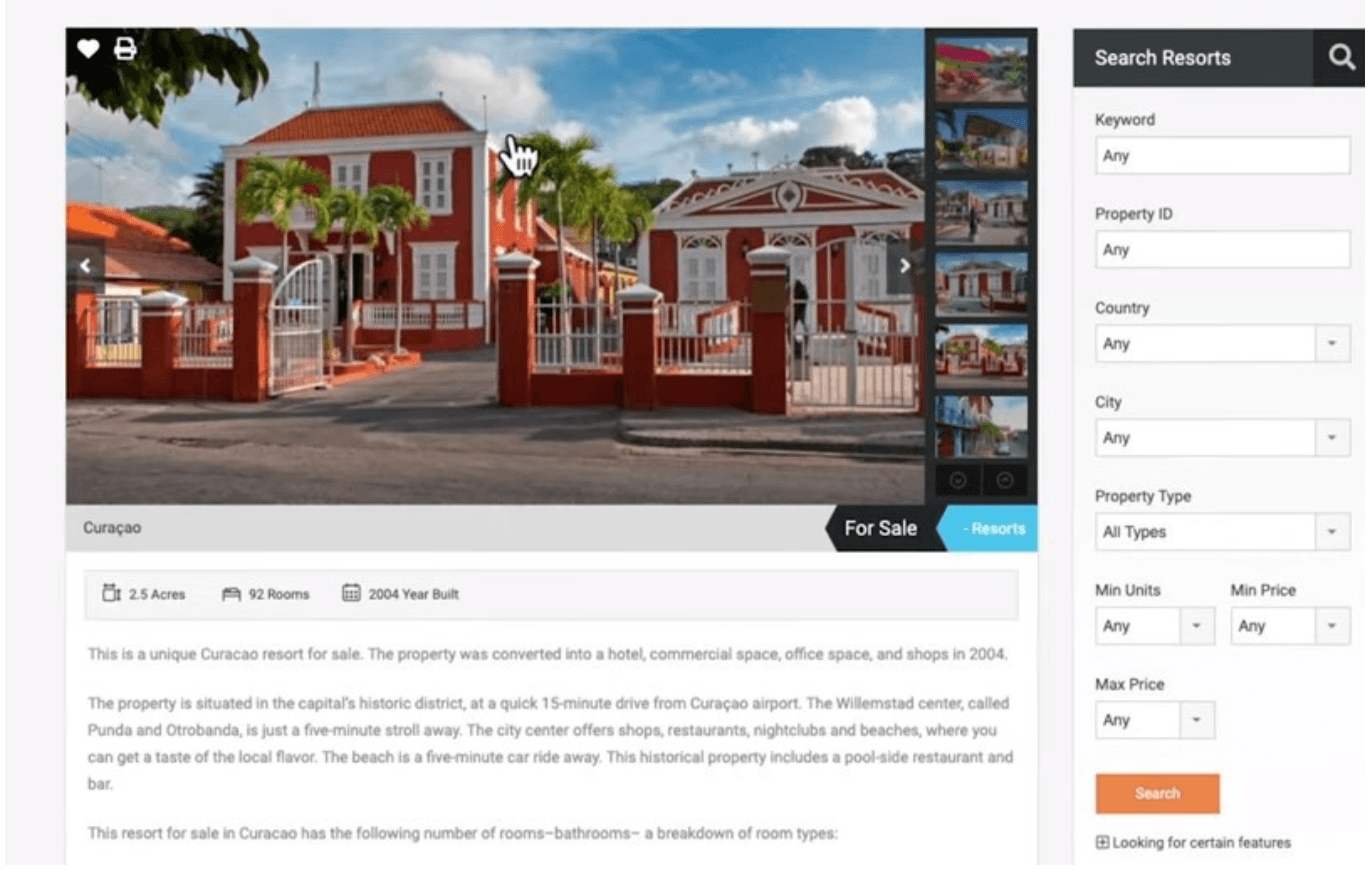
This one has 92 rooms, that might be a little bit too big, right? And they also didn’t disclose the price.
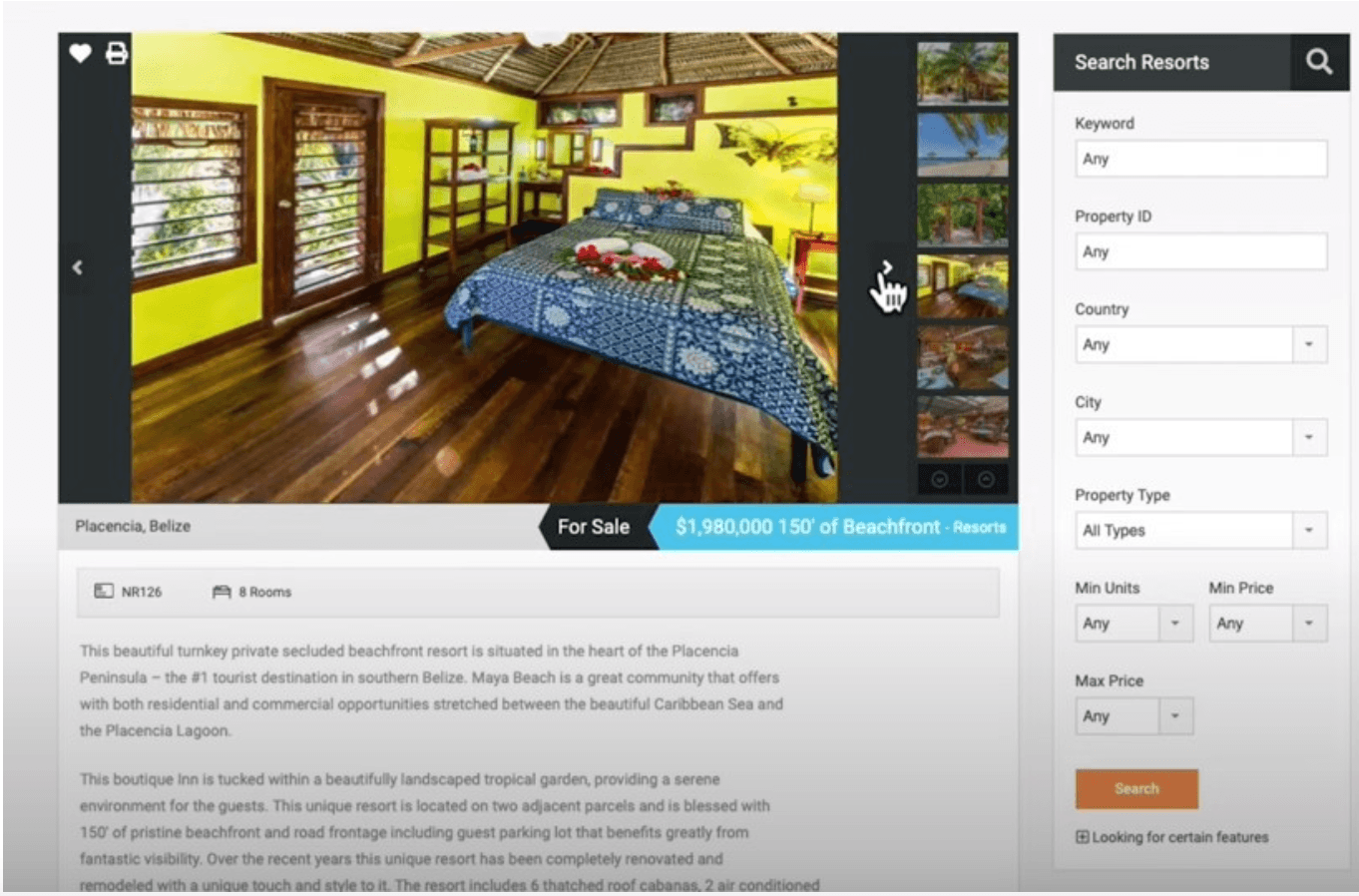
Then we found another one in Belize. This one has 6 cabanas, which might not be big enough for what I have in mind, and it costs 1.9 Million dollars.
Pretty cool, right? It’s on the beach, I like this idea.
I found other hotels in Belize, the Dominican Republic & Honduras as well
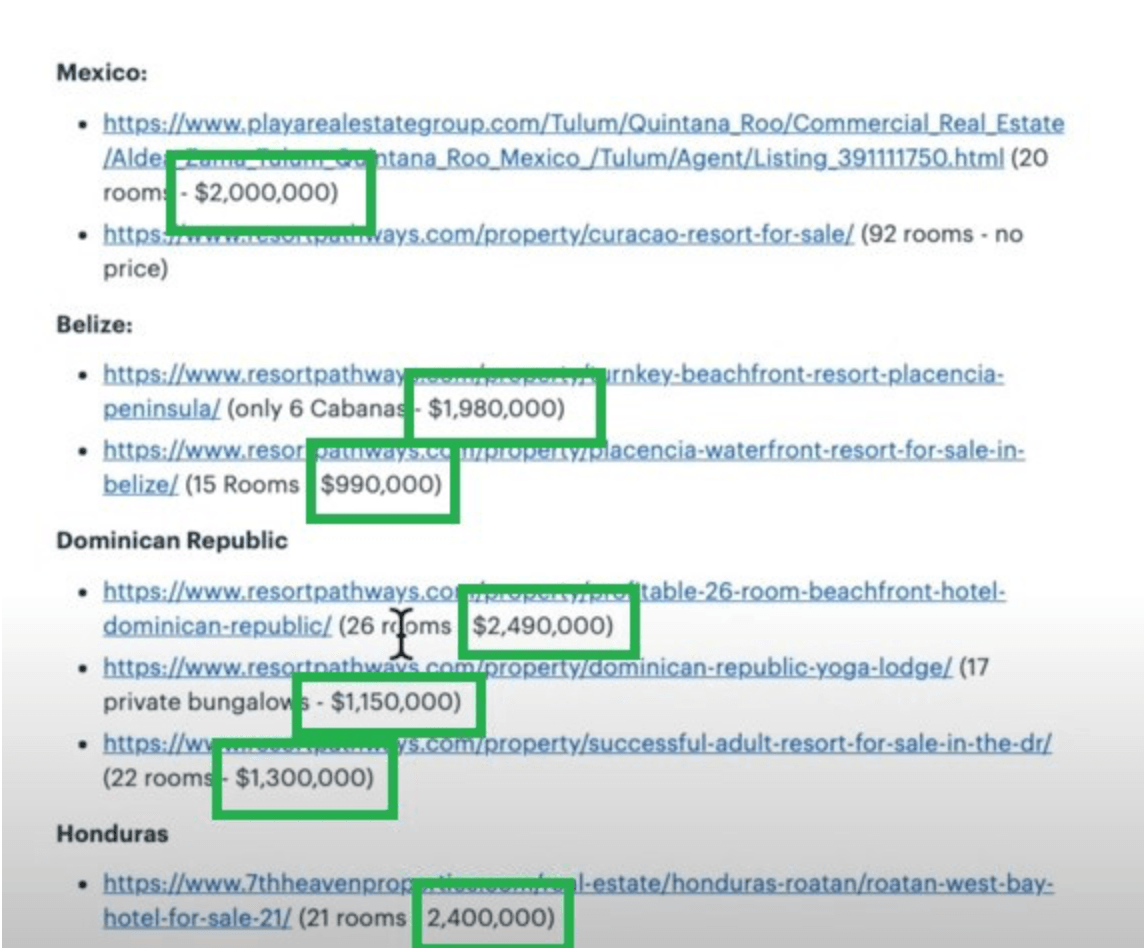
You get the idea, but based on my research, I’ve found it’s probably between 1 to 2 million dollars that I would have to invest for anywhere between 20 and 30 rooms.
That was fairly easy and only took me a few hours. I can now move on to the next step in the planning process.
Now the question is, is it possible at all to make money with this? Because if not, then I can stop right here.
Does It Make Sense?
I have been investing in apartment complexes for the past five years. To give you an example, I bought an apartment complex with 48 units here in Austin for 2.3 million dollars.
I’m making $30,000 in rent per month so I know how to run this.
$30,000 in rent per month is covering my financing, which is a mortgage, also insurance. This is also taking care of the property management, utilities, maintenance, renovations as well as capital improvements.
Now I know, having an apartment complex is not the same as running a hotel or resort, but I just wanted to see if this is feasible, and in a moment, I’ll show you why this is making sense.
So you see, I already know on 48 units, which is quite a lot, on $30,000, I can do all of this and I’m making a profit. So that’s good, not a big profit but I’m making a profit.
Now the question is if I need $30,000, let’s divide this by 30 days because now we are going to the resort, this means that I would have to bring in $1,000 in revenue per day.
The resorts that I started to look into were around 26 rooms, 17 rooms, 22 rooms, so let’s just say that I will find something around the 2 million dollar mark that has maybe 25 rooms.
This is what I’m looking for. So the key question is, can I make $1,000 per day in revenue, not in profits, with 25 rooms? It sounds like it’s possible, right?
Again, I have no clue. There’s probably more vacancy, but if I can rent out half of the rooms every day, so 50% vacancy, and I rent them out for $80 per day, this means that I would have rented 12 rooms for $80, which is $1,000.
I know that there’s housekeeping, so there’s probably more than property management and maintenance, right?
But I believe that these are quite realistic assumptions. If they are not, and if you have experience in this space, leave me a comment below and let me know.
Summary
Here’s the important thing. Let’s tie this back to what today’s show is all about, right? How I get more done in 12 weeks than most people get in 12 months.
Now, here’s the deal. How long did it take me to do the first two things thus far? Well, I can tell you four to five hours. And now I know whether it makes sense to pursue it before I go down a rabbit hole.
What is my point with all of this? My point is to stick to something really, really simple when going through the planning process.
Keep it easy where you set a goal, then plan the next two to three steps.
Or if you want to go crazy, as I did here, we could do three to five steps.
Then the most important thing is to take action and complete these first steps. Once you do this, you’ll see whether it makes sense and you can plan the next three to five steps and complete this process.
Trading Futures, options on futures and retail off-exchange foreign currency transactions involves substantial risk of loss and is not suitable for all investors. You should carefully consider whether trading is suitable for you in light of your circumstances, knowledge, and financial resources. You may lose all or more of your initial investment. The lower the day trade margin, the higher the leverage and riskier the trade. Leverage can work for you as well as against you; it magnifies gains as well as losses. Past performance is not necessarily indicative of future results.
Editors’ Picks

EUR/USD holds firm near 1.1850 amid USD weakness
EUR/USD remains strongly bid around 1.1850 in European trading on Monday. The USD/JPY slide-led broad US Dollar weakness helps the pair build on Friday's recovery ahead of the Eurozone Sentix Investor Confidence data for February.

GBP/USD hovers near 1.3600 as UK government crisis weighs on Pound Sterling
GBP/USD moves sideways after registering modest gains in the previous session, trading around 1.3610 during the European hours on Monday. The pair could come under pressure as the Pound Sterling may weaken amid a fresh government crisis in the United Kingdom.

USD/JPY keeps the red below 157.00 on intervention risks
The Japanese Yen sticks to its modest intraday recovery gains against a broadly weaker US Dollar on the back of speculations that authorities will step in to stem weakness in the domestic currency. In fact, Japanese officials stepped up intervention warnings and confirmed close coordination with the US against disorderly FX moves. This, in turn, triggered an intraday USD/JPY turnaround from the 157.65 region, or a two-week top, touched in reaction to Prime Minister Sanae Takaichi's landslide win in Sunday's election.
Editors’ Picks
EUR/USD holds firm near 1.1850 amid USD weakness
EUR/USD remains strongly bid around 1.1850 in European trading on Monday. The USD/JPY slide-led broad US Dollar weakness helps the pair build on Friday's recovery ahead of the Eurozone Sentix Investor Confidence data for February.
USD/JPY keeps the red below 157.00 on intervention risks
The Japanese Yen sticks to its modest intraday recovery gains against a broadly weaker US Dollar on the back of speculations that authorities will step in to stem weakness in the domestic currency. In fact, Japanese officials stepped up intervention warnings and confirmed close coordination with the US against disorderly FX moves. This, in turn, triggered an intraday USD/JPY turnaround from the 157.65 region, or a two-week top, touched in reaction to Prime Minister Sanae Takaichi's landslide win in Sunday's election.

Gold remains supported by China's buying and USD weakness as traders eye US data
Gold struggles to capitalize on its intraday move up and remains below the $5,100 mark heading into the European session amid mixed cues. Data released over the weekend showed that the People's Bank of China extended its buying spree for a 15th month in January. Moreover, dovish US Fed expectations and concerns about the central bank's independence drag the US Dollar lower for the second straight day, providing an additional boost to the non-yielding yellow metal.

Cardano steadies as whale selling caps recovery
Cardano (ADA) steadies at $0.27 at the time of writing on Monday after slipping more than 5% in the previous week. On-chain data indicate a bearish trend, with certain whales offloading ADA. However, the technical outlook suggests bearish momentum is weakening, raising the possibility of a short-term relief rebound if buying interest picks up.

Japanese PM Takaichi nabs unprecedented victory – US data eyed this week
I do not think I would be exaggerating to say that Japanese Prime Minister Sanae Takaichi’s snap general election gamble paid off over the weekend – and then some. This secured the Liberal Democratic Party (LDP) an unprecedented mandate just three months into her tenure.
RECOMMENDED LESSONS
Making money in forex is easy if you know how the bankers trade!

I’m often mystified in my educational forex articles why so many traders struggle to make consistent money out of forex trading. The answer has more to do with what they don’t know than what they do know. After working in investment banks for 20 years many of which were as a Chief trader its second knowledge how to extract cash out of the market.
5 Forex News Events You Need To Know

In the fast moving world of currency markets where huge moves can seemingly come from nowhere, it is extremely important for new traders to learn about the various economic indicators and forex news events and releases that shape the markets. Indeed, quickly getting a handle on which data to look out for, what it means, and how to trade it can see new traders quickly become far more profitable and sets up the road to long term success.
Top 10 Chart Patterns Every Trader Should Know

Chart patterns are one of the most effective trading tools for a trader. They are pure price-action, and form on the basis of underlying buying and selling pressure. Chart patterns have a proven track-record, and traders use them to identify continuation or reversal signals, to open positions and identify price targets.
7 Ways to Avoid Forex Scams

The forex industry is recently seeing more and more scams. Here are 7 ways to avoid losing your money in such scams: Forex scams are becoming frequent. Michael Greenberg reports on luxurious expenses, including a submarine bought from the money taken from forex traders. Here’s another report of a forex fraud. So, how can we avoid falling in such forex scams?
What Are the 10 Fatal Mistakes Traders Make
Trading is exciting. Trading is hard. Trading is extremely hard. Some say that it takes more than 10,000 hours to master. Others believe that trading is the way to quick riches. They might be both wrong. What is important to know that no matter how experienced you are, mistakes will be part of the trading process.
The challenge: Timing the market and trader psychology

Successful trading often comes down to timing – entering and exiting trades at the right moments. Yet timing the market is notoriously difficult, largely because human psychology can derail even the best plans. Two powerful emotions in particular – fear and greed – tend to drive trading decisions off course.