A Brief History Of The Candlestick
Candlesticks were developed by Japanese rice traders nearly 300 years ago.
There are a number of different candlestick patterns which are worth keeping an eye out for, but since we haven’t got 300 years, we’re going to have a look at just one of the top candlesticks patterns for now, which should set you off on the right track.
Introducing The Engulfing Pattern
So say hello to the Engulfing Pattern, which is when the second candlestick ‘engulfs’ the previous candlestick in the opposite direction.
This shows a pure rejection of the previous price action and is a definite sign that the market did not take kindly to the previous move. The engulfing pattern can therefore be both a Bearish reversal signal (if spotted at the top of an uptrend) or a Bullish one (if at the bottom of a downtrend).
Bullish Engulfing
A Bullish Engulfing candlestick pattern is when an initial downward candlestick (close lower than open) is immediately followed by an upward (close higher than open) candlestick that is bigger than it, or entirely engulfs it, that is to say the low is equal to or lower than the previous low, the high is higher than the previous high, and the close is higher than the previous open.
Take a look at these charts to help you better understand what we’re talking about.
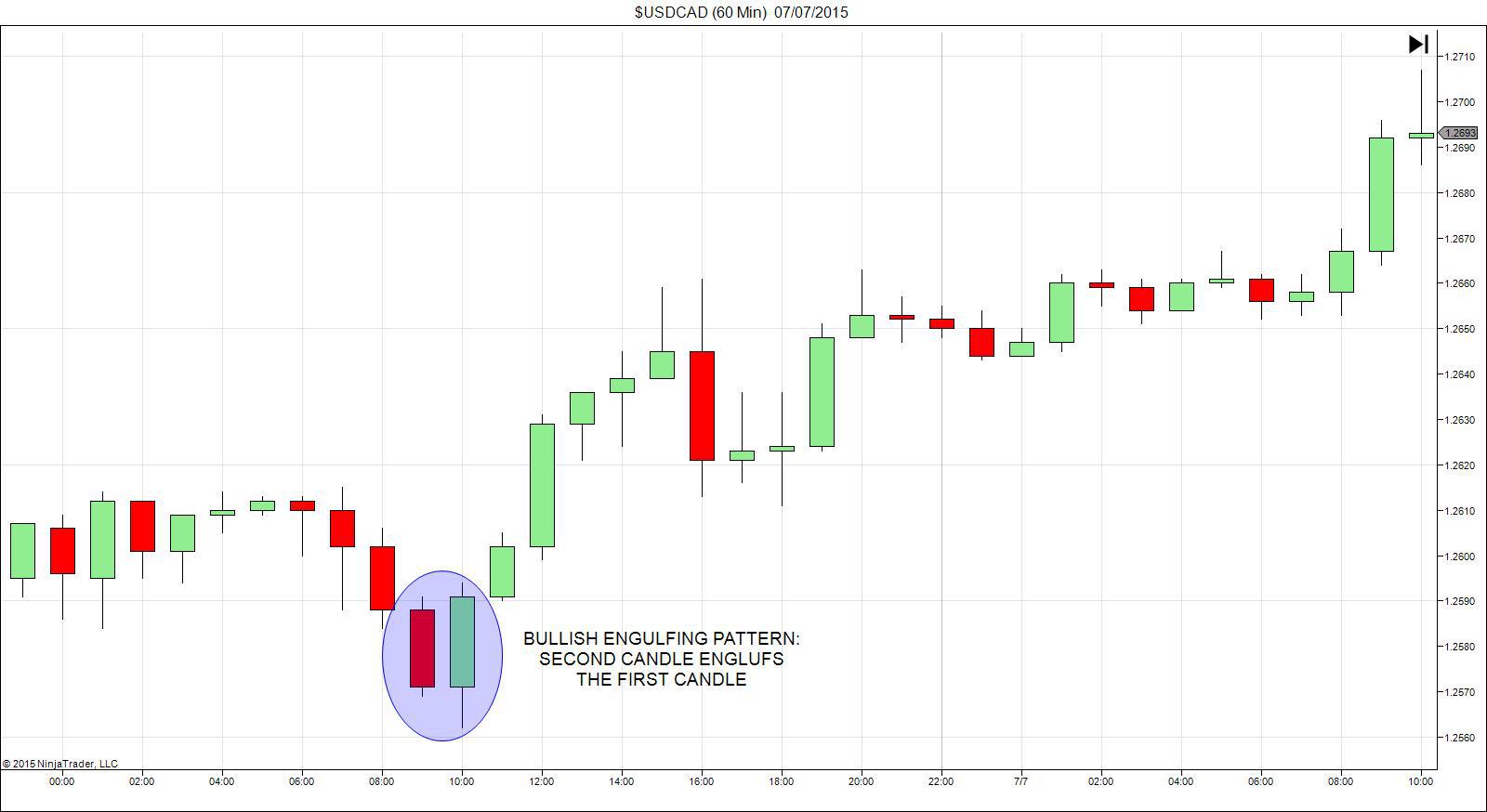
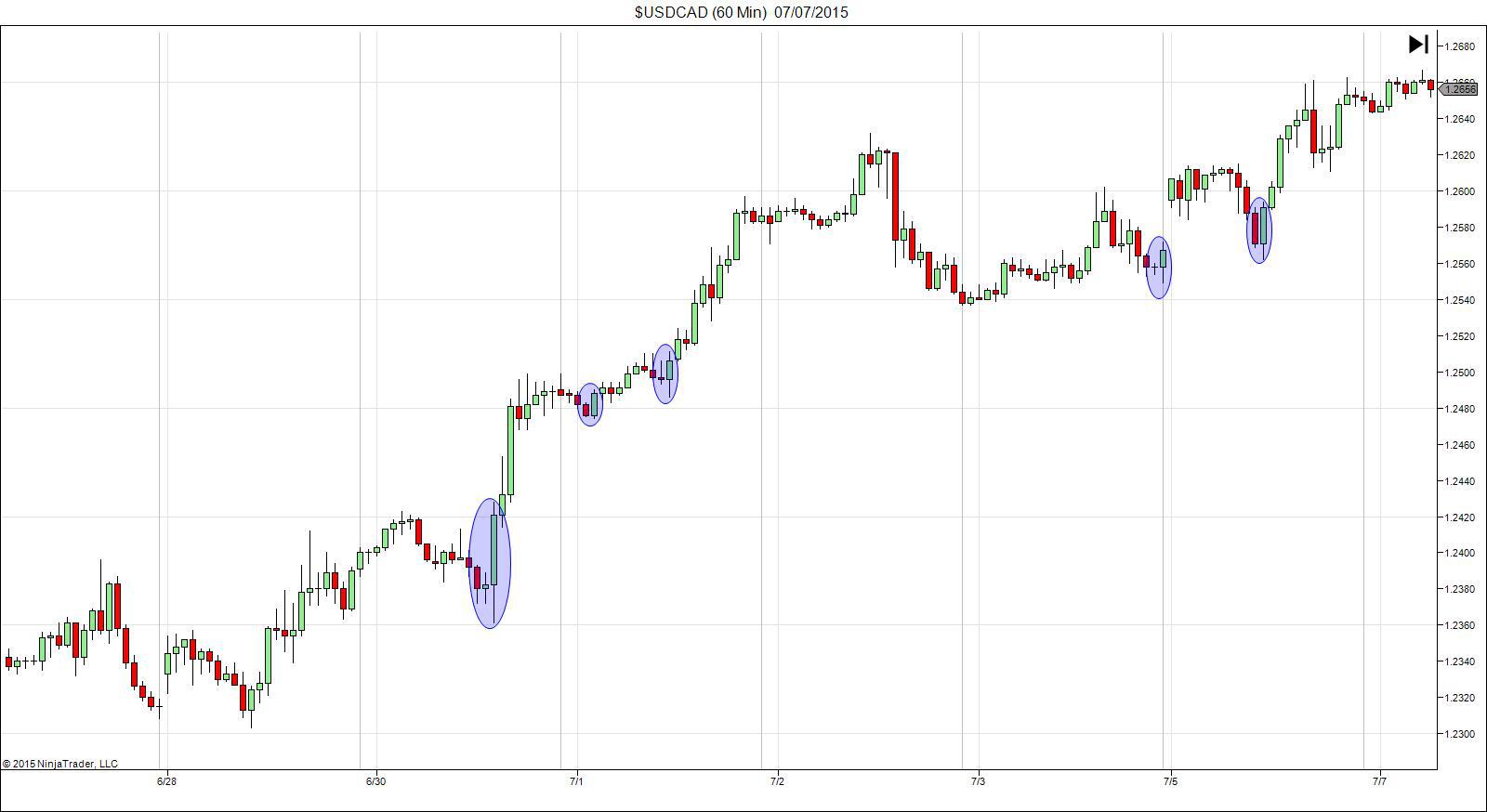
This essentially means that from a supply and demand point of view, the buyers have stepped into the market to ensure it doesn’t drop any lower. This could then result in a push higher as the buyers overwhelm the sellers. Therefore, it can be taken as a Bullish signal.
Bearish Engulfing
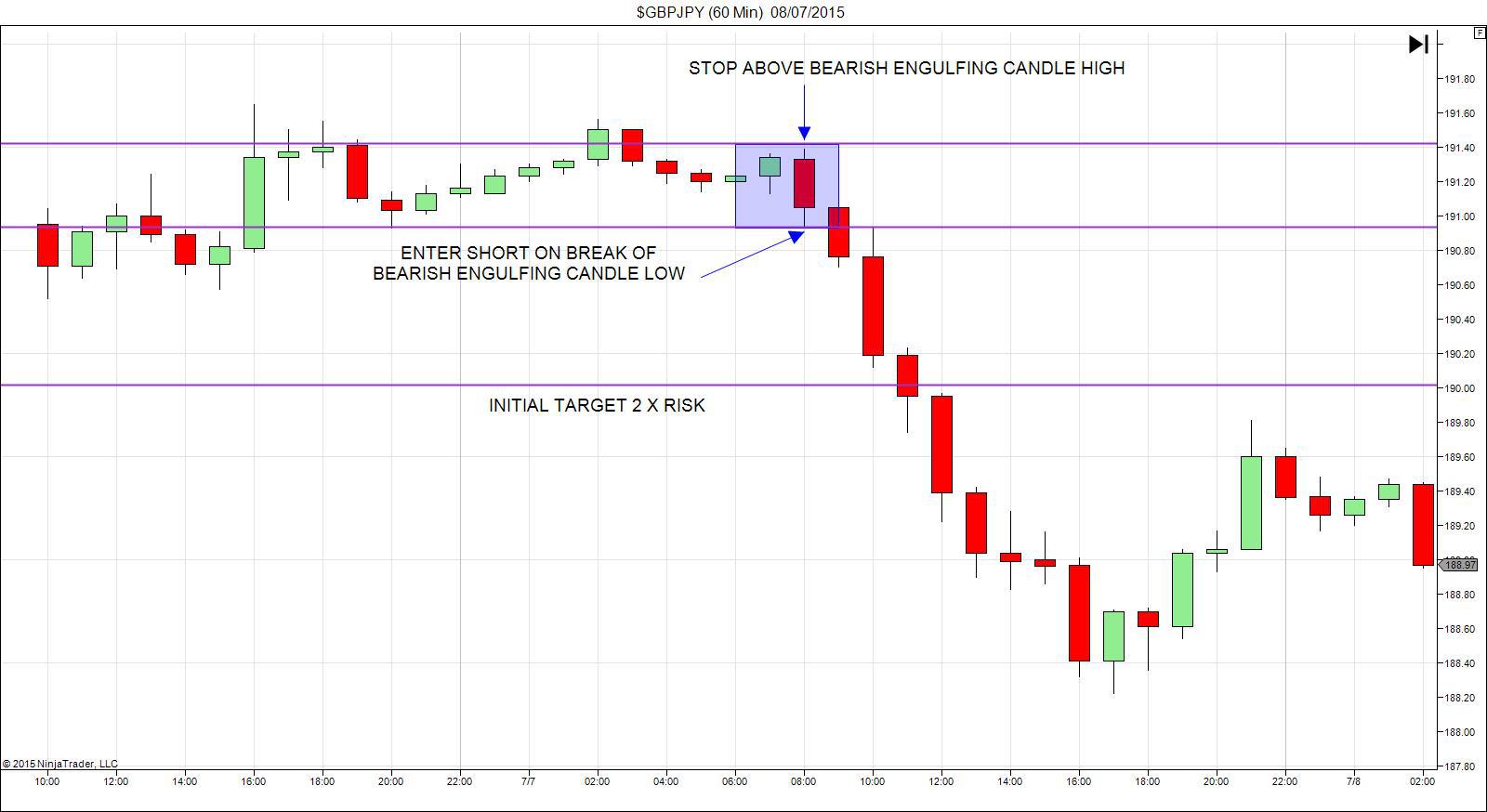
The Bearish Signal is simply the opposite of this, as seen below.
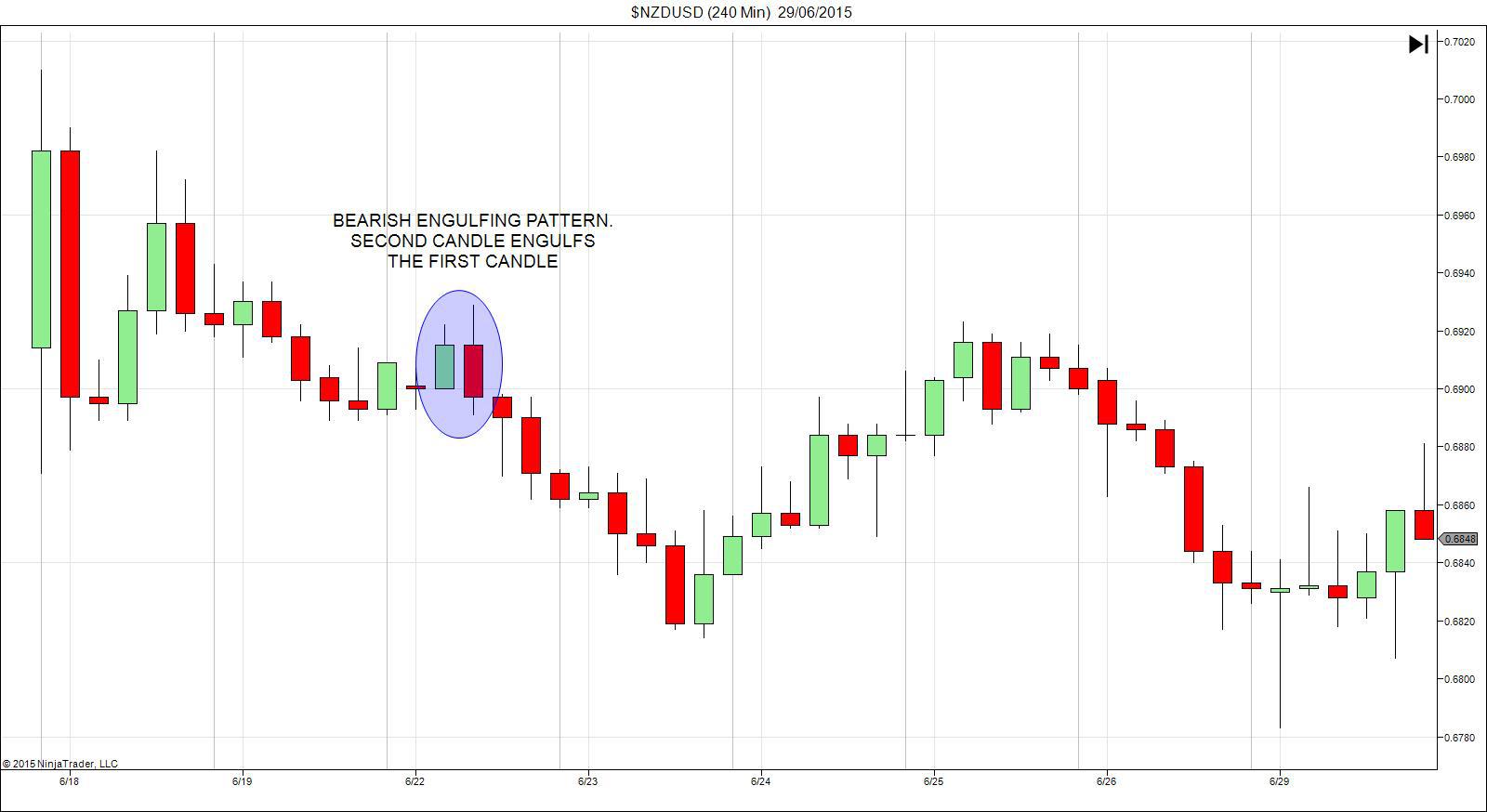
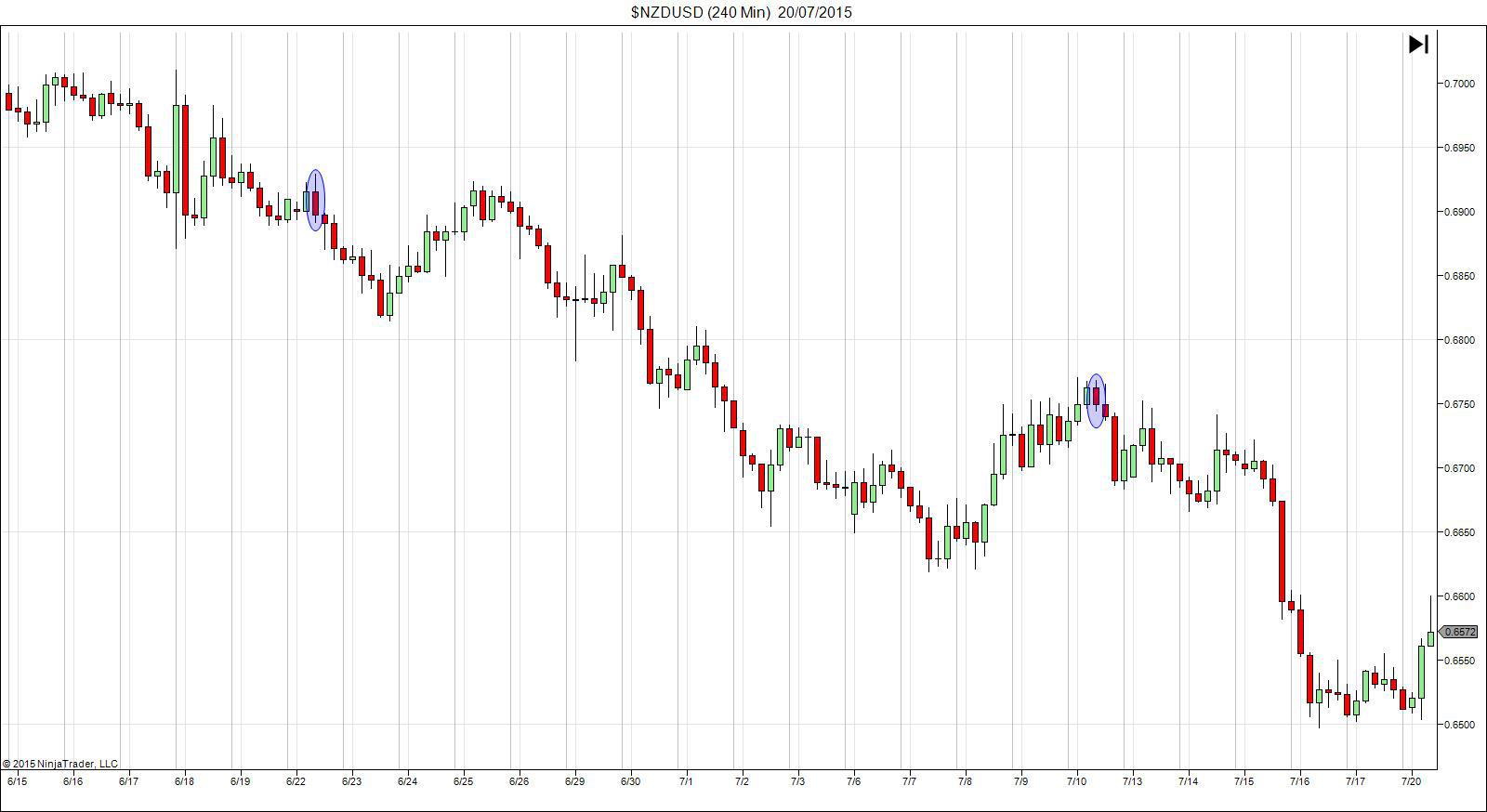
This is a great pattern to look out for and is very effective in two forms, at bottoms and tops looking for turning points, which is relatively high risk, or for trend continuation patterns.
Engulfing In A Strategy
A really nice trading strategy is to look for Bullish engulfing signals in uptrends and Bearish engulfing patterns in downtrends, as they can be good signs of trend continuation.
Like Pin Bars, the real trick to this is to look for obvious signals, the ones that really stand out. For instance, if you have an overall downtrend but have recently retraced higher, you will then get a nice Bearish engulfing which could be a great entry to join the trend lower.
As in the Pin Bar strategy, what we want to look for is the ability to place the stop above the Bearish engulfing high or below the Bullish engulfing low, and then look for at least 2:1 risk reward for the trend continuation.
All comments, charts and analysis on this website are purely provided to demonstrate our own personal thoughts and views of the market and should in no way be treated as recommendations or advice. Please do not trade based solely on any information provided within this site, always do your own analysis.
Editors’ Picks
EUR/USD: US Dollar to remain pressured until uncertainty fog dissipates Premium
The EUR/USD pair lost additional ground in the first week of February, settling at around 1.1820. The reversal lost momentum after the pair peaked at 1.2082 in January, its highest since mid-2021.
Gold: Volatility persists in commodity space Premium
After losing more than 8% to end the previous week, Gold (XAU/USD) remained under heavy selling pressure on Monday and dropped toward $4,400. Although XAU/USD staged a decisive rebound afterward, it failed to stabilize above $5,000.
GBP/USD: Pound Sterling tests key support ahead of a big week Premium
The Pound Sterling (GBP) changed course against the US Dollar (USD), with GBP/USD giving up nearly 200 pips in a dramatic correction.
Bitcoin: The worst may be behind us
Bitcoin (BTC) price recovers slightly, trading at $65,000 at the time of writing on Friday, after reaching a low of $60,000 during the early Asian trading session. The Crypto King remained under pressure so far this week, posting three consecutive weeks of losses exceeding 30%.
Three scenarios for Japanese Yen ahead of snap election Premium
The latest polls point to a dominant win for the ruling bloc at the upcoming Japanese snap election. The larger Sanae Takaichi’s mandate, the more investors fear faster implementation of tax cuts and spending plans.
RECOMMENDED LESSONS
Making money in forex is easy if you know how the bankers trade!
I’m often mystified in my educational forex articles why so many traders struggle to make consistent money out of forex trading. The answer has more to do with what they don’t know than what they do know. After working in investment banks for 20 years many of which were as a Chief trader its second knowledge how to extract cash out of the market.
5 Forex News Events You Need To Know
In the fast moving world of currency markets where huge moves can seemingly come from nowhere, it is extremely important for new traders to learn about the various economic indicators and forex news events and releases that shape the markets. Indeed, quickly getting a handle on which data to look out for, what it means, and how to trade it can see new traders quickly become far more profitable and sets up the road to long term success.
Top 10 Chart Patterns Every Trader Should Know
Chart patterns are one of the most effective trading tools for a trader. They are pure price-action, and form on the basis of underlying buying and selling pressure. Chart patterns have a proven track-record, and traders use them to identify continuation or reversal signals, to open positions and identify price targets.
7 Ways to Avoid Forex Scams
The forex industry is recently seeing more and more scams. Here are 7 ways to avoid losing your money in such scams: Forex scams are becoming frequent. Michael Greenberg reports on luxurious expenses, including a submarine bought from the money taken from forex traders. Here’s another report of a forex fraud. So, how can we avoid falling in such forex scams?
What Are the 10 Fatal Mistakes Traders Make
Trading is exciting. Trading is hard. Trading is extremely hard. Some say that it takes more than 10,000 hours to master. Others believe that trading is the way to quick riches. They might be both wrong. What is important to know that no matter how experienced you are, mistakes will be part of the trading process.
The challenge: Timing the market and trader psychology
Successful trading often comes down to timing – entering and exiting trades at the right moments. Yet timing the market is notoriously difficult, largely because human psychology can derail even the best plans. Two powerful emotions in particular – fear and greed – tend to drive trading decisions off course.