One of my favorite phrases when I was growing up was, as American as apple pie! It’s one of those phrases that sticks with you whether you’re a proud American or you simply love apple pie! However, as I’ve gotten older and learned the way the financial world works I’ve created my own version of that saying: “as American as debt!” No matter how we look at it debt is an integral part of our day-to-day lives.
Unfortunately, most Americans have taken on far too much bad debt, which eats away at their financial growth and wellbeing. Taking on too much debt can prevent you from achieving financial goals and put you in a position where you have no money left to live the life you want. Your goal should be to be debt free and use all that money you would have paid in interest to grow your net worth. Paying off your debt is actually much simpler than most people believe it is. It all begins with having a thorough understanding of three important variables: income, expenses and debt.
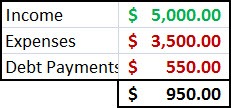
Let’s look at a simple example: Kevin works a 9-to-5 job and brings home a monthly paycheck of $5000. His expenses total $3000 a month. Included in the expenses are things like rent, gas, gym membership, groceries, entertainment, etc. He currently pays $550 a month in minimum payments for his credit cards and car loan. Now that we know the 3 key variables, we can calculate exactly how much disposable income is left over each month. As you can see in the table, after deducting monthly expenses and debt payments from income earned, Kevin is left with $950 each month.
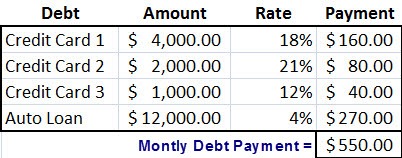
Kevin’s total debt equals $17,000, $7,000 in revolving and $12,000 in installment. Unfortunately, many people perceive all debt as being equal. When you write it down with the interest rates charged, you can clearly see it is NOT all equal! Card #1 looks bad due to the high balance, but card #2 is a full 3% higher interest rate!
Now the question is what to do with that $950 Kevin has left each month! If he was smart, he would use that extra monthly savings to pay down some of his debt. The key here is paying down the debt with the highest interest rate first! Most people’s first inclination would be to pay down the card with the $4000 balance. However, that card only has an interest rate of 18%. Card #2 has a balance of $2000 with a rate of 21%. Without looking at other factors, it would be prudent to pay down credit card #2 first because it has a higher rate. If he made the minimum payments on credit card #2, it would take him 2 years and 10 months to pay off that balance and cost him $653 in interest. If Kevin took $100 from his extra $950 each month and added that to credit card #2’s payments, he would pay off that balance in 1 year and 1 month and pay only $244 in interest. He would not only be cutting the length of time he has to make payments on this debt by 62%, he would also be saving nearly $400 in interest paid. Once he paid off the balance on credit card #2, he could now take the extra $100 plus the $80 that he was paying for credit card #2 and apply that to credit card #1. This is called the Debt-snowball method. It is one of the simplest, most effective strategies you can begin applying today to reduce your debt.
While this is just a simple example, it illustrates the importance of understanding where you stand financially. We know by looking at Kevin’s financial situation that he has $950 to do with as he pleases every month. If he simply took half of that monthly savings, $475, and applied it towards his current debt he could pay off all of his credit card debt in just over one year. The question is, where do you stand financially? Have you done analysis of all of your debt, income and expenses? How much money could you save by simply paying an extra $100 per month on your credit card balances? How about $300? The impacts of reducing your debt can significantly affect your credit score, net worth and much more! In our credit management course, we focus on several other ways to quickly reduce your debt exposure and introduce strategies to become debt free with a very high credit score! The key is being proactive. Get involved and understand every aspect of your financial health. The more you know, the more likely you will eliminate debt, grow your net worth and live the life you want!
Read the original article here - How to Pay off Your Debt
This content is intended to provide educational information only. This information should not be construed as individual or customized legal, tax, financial or investment services. As each individual's situation is unique, a qualified professional should be consulted before making legal, tax, financial and investment decisions. The educational information provided in this article does not comprise any course or a part of any course that may be used as an educational credit for any certification purpose and will not prepare any User to be accredited for any licenses in any industry and will not prepare any User to get a job. Reproduced by permission from OTAcademy.com click here for Terms of Use: https://www.otacademy.com/about/terms
Editors’ Picks
USD/JPY gathers strength to near 157.50 as Takaichi’s party wins snap elections
The USD/JPY pair attracts some buyers to around 157.45 during the early Asian session on Monday. The Japanese Yen weakens against the US Dollar after Japan’s ruling Liberal Democratic Party won an outright majority in Sunday’s lower house election, opening the door to more fiscal stimulus by Prime Minister Sanae Takaichi.
Gold jumps above $5,000 as China's gold buying drives demand
Gold price rises to near $5,035 during the early Asian session on Monday. The precious metal extends its recovery amid a weaker US Dollar and rising demand from central banks. The delayed release of the US employment report for January will be in the spotlight later on Wednesday.
AUD/USD eyes 0.7050 hurdle amid supportive fundamental backdrop
AUD/USD builds on Friday's goodish rebound from sub-0.6900 levels and kicks off the new week on a positive note, with bulls awaiting a sustained move and acceptance above mid-0.7000s before placing fresh bets. The widening RBA-Fed divergence, along with the upbeat market mood, acts as a tailwind for the risk-sensitive Aussie amid some follow-through US Dollar selling for the second straight day.
Week ahead: US NFP and CPI data to shake Fed cut bets, Japan election looms
US NFP and CPI data awaited after Warsh’s nomination as Fed chief. Yen traders lock gaze on Sunday’s snap election. UK and Eurozone Q4 GDP data also on the agenda. China CPI and PPI could reveal more weakness in domestic demand.
Three scenarios for Japanese Yen ahead of snap election Premium
The latest polls point to a dominant win for the ruling bloc at the upcoming Japanese snap election. The larger Sanae Takaichi’s mandate, the more investors fear faster implementation of tax cuts and spending plans.
RECOMMENDED LESSONS
Making money in forex is easy if you know how the bankers trade!
I’m often mystified in my educational forex articles why so many traders struggle to make consistent money out of forex trading. The answer has more to do with what they don’t know than what they do know. After working in investment banks for 20 years many of which were as a Chief trader its second knowledge how to extract cash out of the market.
5 Forex News Events You Need To Know
In the fast moving world of currency markets where huge moves can seemingly come from nowhere, it is extremely important for new traders to learn about the various economic indicators and forex news events and releases that shape the markets. Indeed, quickly getting a handle on which data to look out for, what it means, and how to trade it can see new traders quickly become far more profitable and sets up the road to long term success.
Top 10 Chart Patterns Every Trader Should Know
Chart patterns are one of the most effective trading tools for a trader. They are pure price-action, and form on the basis of underlying buying and selling pressure. Chart patterns have a proven track-record, and traders use them to identify continuation or reversal signals, to open positions and identify price targets.
7 Ways to Avoid Forex Scams
The forex industry is recently seeing more and more scams. Here are 7 ways to avoid losing your money in such scams: Forex scams are becoming frequent. Michael Greenberg reports on luxurious expenses, including a submarine bought from the money taken from forex traders. Here’s another report of a forex fraud. So, how can we avoid falling in such forex scams?
What Are the 10 Fatal Mistakes Traders Make
Trading is exciting. Trading is hard. Trading is extremely hard. Some say that it takes more than 10,000 hours to master. Others believe that trading is the way to quick riches. They might be both wrong. What is important to know that no matter how experienced you are, mistakes will be part of the trading process.
The challenge: Timing the market and trader psychology
Successful trading often comes down to timing – entering and exiting trades at the right moments. Yet timing the market is notoriously difficult, largely because human psychology can derail even the best plans. Two powerful emotions in particular – fear and greed – tend to drive trading decisions off course.