How to build a successful trading strategy

Trading is a risky business.
Even before you begin your adventure into the world of stock trading, you need to have a trading strategy, which is essential for your long-term survival in this space.
There are many components that compose a good trading strategy; however, there are two key steps that any successful trading plan needs to follow. It’s absolutely critical when it comes to creating your own trading strategy to first make sure your winners are larger than your losers and secondly to implement sound risk management strategies.
Moving forward, we’re going to explore what ingredients are needed to build your step-by-step trading strategy.
Why Have a Trading Strategy?
First and foremost, it helps you monitor your trades. If you don’t have a system behind your trade it will become very difficult to find new trading opportunities and respond to the new market conditions once you have the trade on.
Developing a successful trading strategy will also introduce consistency because if you already know systematically what you’re looking for, it will improve your ability to spot trading opportunities.
Essentials of a Trading Strategy
The essential components of a good trading strategy are comprised of four basic elements:
-
Developing directional bias, qualify the entry
-
Determining stop-loss and take-profit targets
-
Define your preferred time frame
-
Utilize risk management
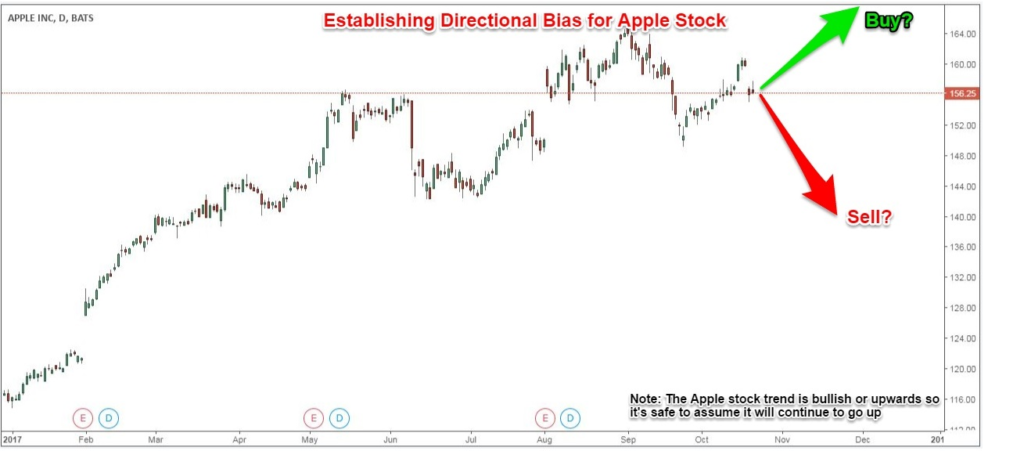
Establishing a directional bias is simply a matter of deciding whether you think the stock is going up or if you think the stock is going down.
Basically, developing a directional bias will assist you in determining the trend direction and whether you’re going to buy or you’re going to sell.
The process of establishing a directional bias can be broken down into two components:
-
Predicting where the stock price is more likely to go: up or down
-
Trading rules that validate your directional bias
To qualify your entry you have two alternatives:
-
Fundamental analysis
-
Technical analysis.
When trading stocks, it’s also recommended to understand the actual fundamentals of the trade that you’re doing even if you’re trading solely based on technical. You only need to know what fundamentals are currently affecting your stock.
For example, you need to know the dividend dates because it can really affect the stock in a big way and you can take advantage of it by using your technical skills.
As far as technical analysis goes you need to establish your key technical levels and then you look for price to either break them or bounce. There are many stock investing patterns and technical tools we have already reviewed such as MACD, RSI, Bollinger bands, Fibonacci, moving averages and more - all of them can be relevant and determine whether you’re going to go long or short.
1. Determining Stop Loss and Take Profit Targets
Determining your stop loss and potential profit target is one of those things you need to establish, right before you ever place a trade. This is going to be absolutely critical to establish if the trade is making sense from a risk-reward perspective.
By having a protective stop loss established you’re going to minimize your losses. You’re going to know in advance how much you’re going to lose if you’re wrong on the trade.
You also have to set realistic profit targets and your price actin reading skills can be very handy in helping you pick pragmatic profit levels.
2. Define your Preferred Time Frame
There is no right or wrong time frame to trade as it really depends on your personality. If you need to be in control of your trades and can’t endure any drawdowns when in a trade or you want to cash in quick profits then the lower intraday charts can work best for your situation.
If you have a day job it will be quite hard to focus on the intraday time frames like the 5 minutes, 15-minutes or the 1 hour time chart. However, the good news is that stock trading is most suitable for long-term investing having a time horizon from 1 to 3 years.
There are no magic techniques or secrets to picking the perfect time frame; this is something that you’ll have to decide for yourself.
3. Risk Management Strategy
Risk management is by far the most important aspect of your stock trading strategy. You’ll have to stick to very strict money management parameters if you want to be a successful trader and develop a winning stock trading strategy.
Make sure your risk is at least half the reward or in other words your potential profit is twice as big as your potential loss. The higher the risk to reward ratio you have, the better. You’ll still be profitable even if your strategy only generates winners less than 50% of the time.
The 2% money management rule is a well-known strategy. It states that you should never risk more than 2% of your account balance on a single trade. The 2% rule not only that will make your losses more manageable, but it can also remove the chances of losing your entire account balance.
For example:
Let’s assume you have $25,000 in your trading account. If you only bet 2% of your equity on a particular trade that has a risk to reward ratio of 1:3 then your potential loss on this trade is only $500 while your potential profit is $1,500.
The goal of trading is to make money and a sound risk management strategy can help you achieve that goal.
Conclusion
It is absolutely critical when determining your trading strategy to understand your own personality. Why? because your personality is going to be intimately tied to your strategy. No two traders are the same. One person can be more successful as an active stock trader and others are a lot more successful as a long-term trader.
Author

Baruch Silvermann
The Smart Investor
Baruch Silvermann is a personal finance expert, investor for more than 15 years, digital marketer and founder of The Smart Investor.