An Elliott Wave Structure: Triple Three Corrections

Firstly, triple three corrections are a sideways combination of three corrective patterns in Elliott Wave Theory. These corrections are one of the five types of corrective patterns that correct the completed cycle of the prevailing trend. Zigzags (5-3-5), Flats (3-3-5), Triangles (3-3-3-3-3), Double threes which are a combination of two corrective patterns previously mentioned. Then lastly a Triple three that is a combination of three corrective patterns mentioned above. That structure is the focus of this particular article.
Secondly here are some guidelines. The corrective structures are labeled as WXYXZ. They are an 11 swing structure. The subdivision of wave W, wave Y, and wave Z can be a zigzag, a flat, a double three of smaller degree, or a triple three of smaller degree. The Wave X can be any corrective structure including a stand alone triangle.
The Fibonacci ratio relationships are as follows. Wave X will retrace anywhere from 50%, 61.8%, 76.4%, or 85.4% of wave W. Wave Y can not pass 161.8% of wave W or it can become an impulsive wave three. The second wave X will retrace the wave Y in the same aforementioned Fibonacci retracement levels as it did the wave W. The second wave X structure does not have be the same structure as the first wave X. The Wave Z target area to finish the triple three correction will be a Fibonacci extension 61.8%, 100%, or 123.6% of the wave W.
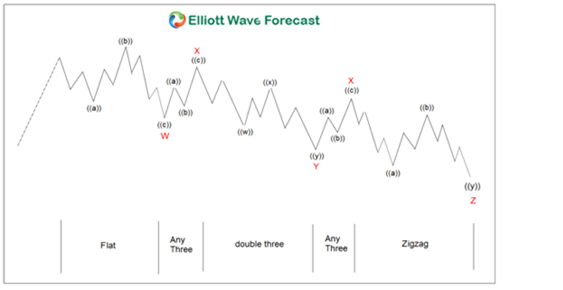
The graphic below is an example of three corrective structure combinations that can form triple three corrections. In this one wave W is an expanded flat with a zigzag connector first wave X. This is followed by a double three wave Y. The second wave X connector is a zigzag. Lastly the wave Z is also a zigzag. Continued below the graphics.
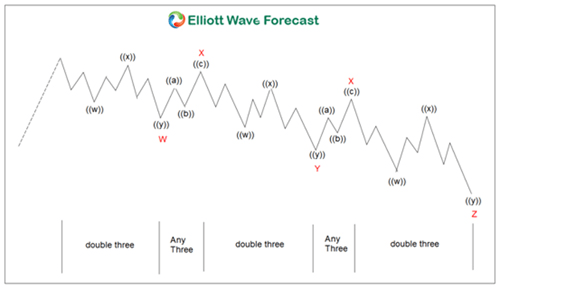
The graphic below is another example of three corrective structure combinations that can form triple three corrections. In the same fashion this particular one is a double three wave W followed by the first wave X being a zigzag. Likewise as the wave W, the wave Y is a double three. This is followed by a zigzag second wave X connector. The wave Z ends with another double three. Continued below the graphics.
In conclusion. As has been noted triple threes are a combination of three corrective patterns. They can occur in either a bearish trending market or as in the illustrations shown above a bullish trending market.
Author

Elliott Wave Forecast Team
ElliottWave-Forecast.com