When you trade currencies or commodities, you may not be very aware of “market crashes” and large sell-offs on the stock market. However, for stock traders specifically, there’s much tension related to a recent significant decline in stock prices. Many of them have a cash account, i.e. don’t have the ability to play on the short side.
So, this article is for those who are still searching for profitable opportunities in the “red area” of falling stocks.
Option 1. Buying 3x inverted ETFS:
When there’s a bloodbath on the stock market, you can play one short side without actually selling any stocks. There’s a set of instruments designed exclusively for that purpose. They allow you to benefit from declining stock indexes, and sometimes, even certain sectors. I’m talking about “inverted ETFs” - complex structured products, which are traded on the exchange just like any stocks.
For example, you may purchase SQQQ, a 3X short for “QQQ”, which follows the Nasdaq stock index. When tech stocks are falling (and they are falling quite quickly), SQQQ grows. The recent decline of Nasdaq creates buying opportunities for SQQQ.
Option 2. Buying low-beta and negative-beta stocks.
Not all stocks are following the main trends. Some of them are more robust and have even strong opposite reaction when the broad market movements. The less stock correlates with a benchmark (a stock index), the less it’s beta is. Sometimes, it’s even negative.
For example, take a look at MCD - McDonald’s corporation. With a beta of 0.5 as of November 23, 2018, it shows outstanding performance in comparison to the broad market:
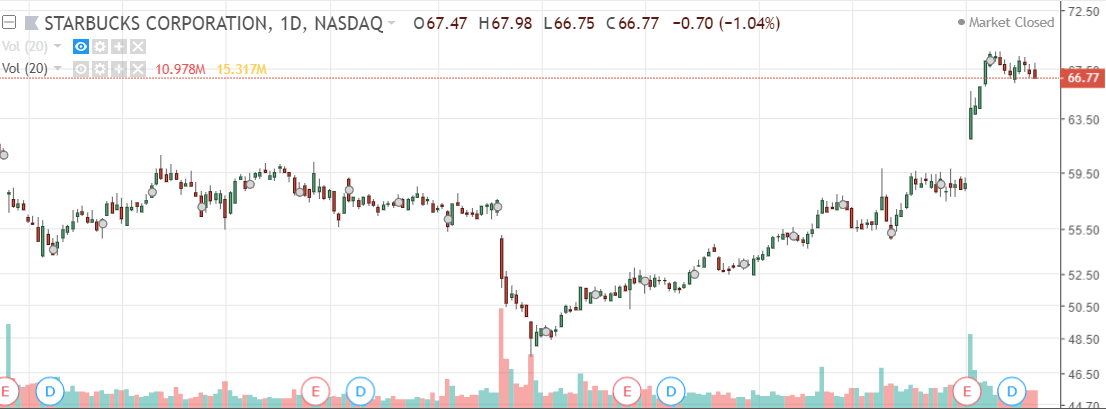
Or, let’s take SBUX (Starbucks). With a beta of 0.49 it seems bulletproof, considering the previous decline in major stocks.
Of course, not only beta parameters is important, but that’s one of the main factors which trader has to take into consideration while making decitions.
Option 3. Buying volatility ETFs.
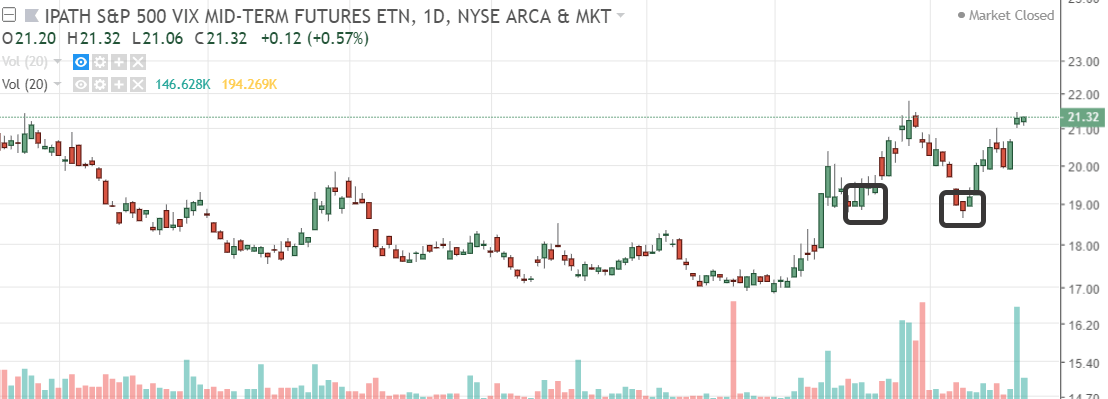
Every time a stock market declines, we observe increasing volatility of ATM options linked to the corresponding index futures (VIX). This volatility can not only be observed but also it can be traded via volatility ETFs.
If you expect a stock index to fall, you can purchase VXX (short-term volatility) or VXZ (long-term volatility). You can see below what happens while the stock market sell-off:
Good luck and have a good trading!
Trading the financial markets is associated with increased level of risk. Past performance is not indicative of future results. All materials are provided for educational purposes only and by no means may serve as a trading or investment advice.
Editors’ Picks
EUR/USD trims gains, nears 1.1700
The EUR/USD pair eases in the American afternoon and approaches the 1.1700 mark. The pair surged earlier in the day after the ECB left interest rates unchanged and upwardly revised inflation and growth figures. The US CPI rose 2.7% YoY in November, nearing Fed’s goal.
GBP/USD returns to 1.3370 after BoE, US CPI
The GBP/USD pair jumped towards the 1.3440 early in the day, following the BoE decision to cut rates, and US CPI data, which was much softer than anticipated. The US Dollar, however, managed to regain the ground lost during US trading hours.
Gold extends its consolidative phase around $4,330
The bright metal cannot attract speculative interest on Thursday, despite central banks announcements and the United States latest inflation update. XAU/USD is stuck around $4,330, confined to a tight intraday range.
Crypto Today: Bitcoin, Ethereum hold steady while XRP slides amid mixed ETF flows
Bitcoin eyes short-term breakout above $87,000, underpinned by a significant increase in ETF inflows. Ethereum defends support around $2,800 as mild ETF outflows suppress its recovery. XRP holds above at $1.82 amid bearish technical signals and persistent inflows into ETFs.
Bank of England cuts rates in heavily divided decision
The Bank of England has cut rates to 3.75%, but the decision was more hawkish than expected, leaving market rates higher and sterling slightly stronger. It's a close call whether the Bank cuts again in February or March.
RECOMMENDED LESSONS
Making money in forex is easy if you know how the bankers trade!
I’m often mystified in my educational forex articles why so many traders struggle to make consistent money out of forex trading. The answer has more to do with what they don’t know than what they do know. After working in investment banks for 20 years many of which were as a Chief trader its second knowledge how to extract cash out of the market.
5 Forex News Events You Need To Know
In the fast moving world of currency markets where huge moves can seemingly come from nowhere, it is extremely important for new traders to learn about the various economic indicators and forex news events and releases that shape the markets. Indeed, quickly getting a handle on which data to look out for, what it means, and how to trade it can see new traders quickly become far more profitable and sets up the road to long term success.
Top 10 Chart Patterns Every Trader Should Know
Chart patterns are one of the most effective trading tools for a trader. They are pure price-action, and form on the basis of underlying buying and selling pressure. Chart patterns have a proven track-record, and traders use them to identify continuation or reversal signals, to open positions and identify price targets.
7 Ways to Avoid Forex Scams
The forex industry is recently seeing more and more scams. Here are 7 ways to avoid losing your money in such scams: Forex scams are becoming frequent. Michael Greenberg reports on luxurious expenses, including a submarine bought from the money taken from forex traders. Here’s another report of a forex fraud. So, how can we avoid falling in such forex scams?
What Are the 10 Fatal Mistakes Traders Make
Trading is exciting. Trading is hard. Trading is extremely hard. Some say that it takes more than 10,000 hours to master. Others believe that trading is the way to quick riches. They might be both wrong. What is important to know that no matter how experienced you are, mistakes will be part of the trading process.
The challenge: Timing the market and trader psychology
Successful trading often comes down to timing – entering and exiting trades at the right moments. Yet timing the market is notoriously difficult, largely because human psychology can derail even the best plans. Two powerful emotions in particular – fear and greed – tend to drive trading decisions off course.