What is Ethereum EIP-1559 and how will it affect ETH price?
- Ethereum is about to see a network adjustment that will introduce a new base fee feature on the blockchain.
- EIP-1559 will change the way that transactions get processed on the network with added certainty.
- A model estimates that around 1,000 ETH would be issued per day, while 6,000 tokens would be burned.

The second-largest blockchain network in the world, Ethereum, is expecting to witness its London hard fork on August 4 that would change the way that transactions are processed. Its native token, Ether, would also see a reduction in supply, which could see a spike in ETH price.
EIP-1559 will change the supply of Ether
One of the newest Ethereum Improvement Proposals (EIPs) will aim to change the fee market mechanism of the blockchain. EIP-1559 will remove the first-price auction as the main gas fee calculation, where users typically bid a dedicated amount of money to pay for their transaction to be processed on the Ethereum blockchain.
Currently, users who create transfers or transactions on the Ethereum blockchain pay a gas fee in ETH for miners to process their transactions without knowing the exact price to pay beforehand.
In order to make sure the transaction gets processed, some users may overpay to ensure the transfer goes ahead smoothly. Other users face the uncertainty of whether the transaction will get processed in a timely fashion.
The EIP-1559 changes the method by which transactions are processed on the blockchain by enabling clear pricing on a base transaction fee paid to miners in Ether to validate the transfers. A small amount of the tokens will be burnt and taken out of the circulating supply permanently.
Users may also choose to include an optional tip, a “priority fee,” along with their base fee to incentivize miners for a quicker process if desired.
With a more predictable base fee, EIP-1559 may introduce a reduction in gas prices if the current method assumes that users will overpay fees less in the future with the introduction of the new proposal.
The base fee will increase or decrease by up to 12.5%, depending on how much demand surpasses the ideal gas limit per block. Taking a look at how much the base fee is, Ethereum users will then have the knowledge of how congested the network is.
Miners’ income will be impacted by the burning of the base fee. However, they can still earn from the tips and block rewards.
Similar to the Bitcoin halving event that has boosted BTC price, EIP-1559 would introduce a reduced supply of Ether.
Following Ethereum’s move to proof-of-stake, Justin Drake’s model estimates that around 1,000 ETH would be issued per day, and around 6,000 ETH would be burned in the same period.
Therefore, the suggested annual supply change of Ether would be roughly negative 1.6 million ETH, with a reduction of the annual supply rate by 1.4%.
The more transactions that occur on the Ethereum network, the more deflationary pressure ETH will face, given the burning of the base fee.
Andrew Keys, managing partner at DARMA Capital, suggests that the EIP-1559 adjustment and the upcoming upgrade expected in Q1 2022 could “easily quintuple the price of Ether” next year.
Ethereum hangs onto the 100-day SMA, unwilling to pull back
Ethereum price has seen a remarkable run since July 20, printing 13 consecutive green candles. ETH has lost its momentum currently and is resting on the 100-day Simple Moving Average (SMA) as support.
Although Ethereum price appears to be retracing after its recent rally, the second-largest cryptocurrency by market capitalization has ample support should selling pressure spike.
The 78.6% Fibonacci extension level at $2,492 acts as the first line of defense for Ethereum price, then the 61.8% Fibonacci extension level at $2,333, and then $2,165, of which the diagonal trend line, 50-day SMA and 200-day SMA meet.
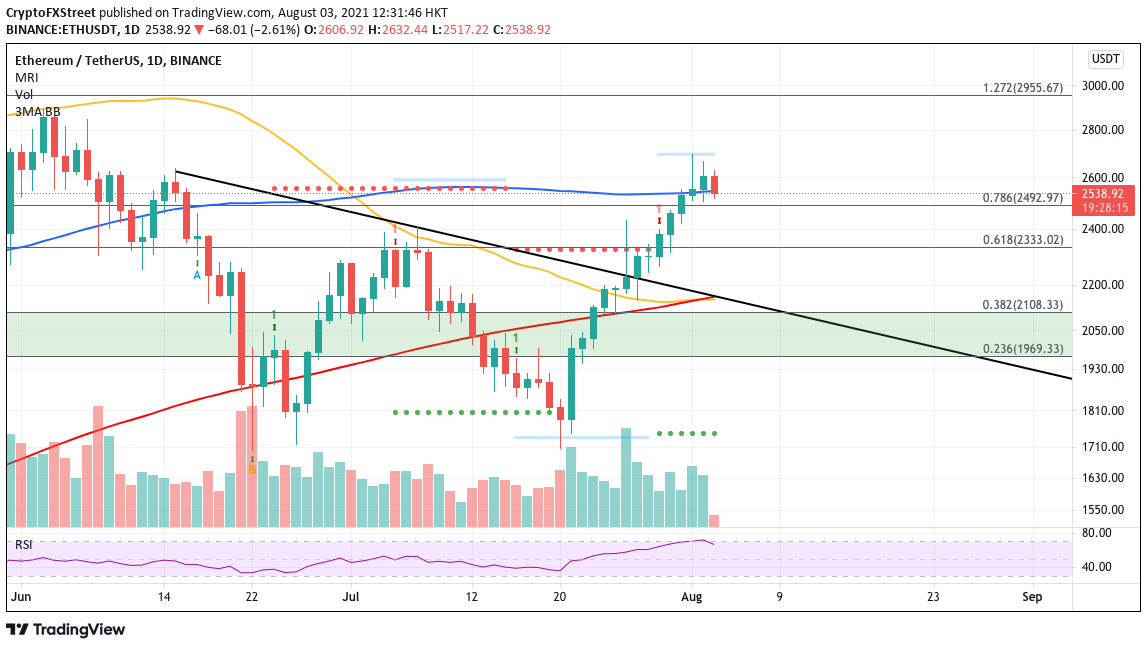
ETH/USDT daily chart
However, slicing below $2,165 could spell trouble for the bulls, as ETH could fall into the demand zone, which extends from $1,969 to $2,108.
Should the buyers be able to lift prices higher against the sellers, Ethereum price would need to break above the breakout line given by the Momentum Reversal Indicator (MRI) at $2,696 before making a move to the upside.
If Ethereum price manages to close above the 100-day SMA and the 78.2% Fibonacci extension level, bullish investors could aim for $2,847, which marked the June 7 high, and the 127.2% Fibonacci extension level at $2,955 next.
Author

Sarah Tran
Independent Analyst
Sarah has closely followed the growth of blockchain technology and its adoption since 2016.