‘The Splurge’ to seek better cryptography to plan for quantum computers: Buterin

Ethereum co-founder Vitalik Buterin says a goal of one of the blockchain’s roadmap stages is to research “advanced cryptography” to make it resistant to future quantum computers, which could break encryption.
“There is a heck of a lot left to do,” Buterin wrote in an Oct. 29 blog post, which shared his thoughts on a part of the blockchain’s roadmap dubbed “The Splurge.”
However, he said that quantum computers — which would be powerful enough to break encryption — “do not even exist.”
Buterin added any purported quantum computer currently touted on the internet “are either prototypes” or are just “not real quantum computers, in the sense that while they may have quantum parts in them, they cannot run actually meaningful computations.”
“Even if ‘real’ quantum computers come soon, the day when regular people have quantum computers on their laptops or phones may well be decades after the day when powerful institutions get one that can crack elliptic curve cryptography.”
The Ethereum co-founder’s thoughts were shared in a post on his plan for The Splurge, the sixth in a series of ideas he’s shared on Ethereum’s roadmap, with this stage aiming to “fix everything else” with the blockchain.
Each stage — including The Merge, The Surge, The Scourge, The Verge and The Purge — happens concurrently and focuses on different aspects of the blockchain.
Buterin said The Splurge is largely focused on Ethereum Virtual Machine (EVM) improvements and “various niche topics.”
“There are lots of ‘little things’ in Ethereum protocol design that are very valuable for Ethereum’s success, but don’t fit nicely into a larger sub-category,” he said. “This is what ‘the Splurge’ is for.”
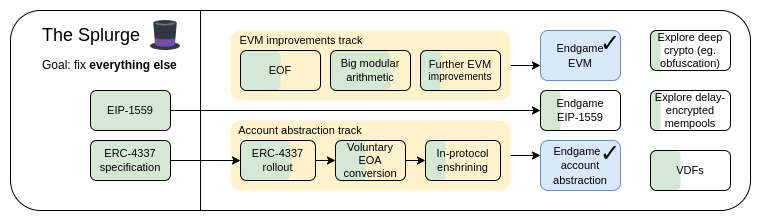
A diagram showing The Splurge portion of Ethereum’s roadmap. Source: Vitalik Buterin
He added The Splurge’s key goals are to bring the EVM to a “stable ‘endgame state’” bring account abstraction in-protocol and optimize the economics of transaction fees alongside looking into “advanced cryptography.”
Ethereum’s next update, called Pectra and slated sometime late this year or early next, will include “the first step” to improving EVMs — a series of proposals specifying a new version of EVM code, Buterin said.
The code — called EVM Object Format (EOF) — would, among many other features, separate code and data which aims to make it easier for layer 2 blockchains to process code.
“Arguably, a roadmap which prioritizes continued improvement to the Ethereum L1 would include and build on EOF,” Buterin wrote.
Another proposal slated for launch in Pectra would make account abstraction’s “convenience features” available to all users, Buterin said. Account abstraction means users could use a wallet-like smart contract, greatly increasing the range of ways they could interact with the blockchain.
One convenience feature Buterin noted was the ability for an account to be able to pay transaction fees with ERC-20 tokens, compared to now where users can only pay in Ether (ETH $2,619.64) .
“The main remaining thing to figure out is how to fully bring account abstraction into the protocol,” he said. “A recently popular enshrined account abstraction EIP is EIP-7701, which implements account abstraction on top of EOF.”
Separately, Buterin discussed Ethereum’s transaction fee economics, where he pitched “multidimensional gas,” which he described as “having separate prices and limits for separate resources” in order to better price the blockchain’s available resources.
“We have multidimensional gas for execution and blobs today,” he explained. “In principle, we could increase this to more dimensions: calldata, state reads/writes, and state size expansion.”
He claimed multidimensional gas could reduce “worst-case” uses of resources, which would “reduce pressure on the need to optimize performance.”
Author

Cointelegraph Team
Cointelegraph
We are privileged enough to work with the best and brightest in Bitcoin.