Ethereum Dencun Upgrade causes a flurry of L2 restoration queries
- Ethereum’s Dencun Upgrade went live on Wednesday, expected to significantly reduce transaction costs on Ethereum's Layer-2.
- ARB and LDO are up nearly 5% as part of ETH beta plays.
- Anonymous crypto user Spreek reports many queries about how to restore an L2 back online.
- Blast L2 reported challenges relating to Ethereum’s upgrade

Ethereum Dencun Upgrade went live on Wednesday, a landmark event expected to have a significant impact on transaction costs for the network’s layer 2 (L2) projects. With its, several L2 tokens have rallied, including Arbitrum (ARB) and Lido DAO (LDO), which are bother up nearly 5%. Amid the euphoria, the update has put ducks up for shooting.
Also Read: ARB, OP, LDO, METIS: ETH beta plays heat up this week as Dencun Upgrade goes live on Gnosis
Ethereum Dencun Upgrade impact on dead L2s
Ethereum Dencun Upgrade had already been pushed live on several of Ethereum's testnets. However, the real push, to Ethereum's mainnet occurred on March 13, roughly a year after the Shanghai upgrade from April 2023. This was when the newly upgraded Proof-of-Stake (PoS) network made it possible for users to un-stake their ETH.
Key rewards of the upgrade include:
- Significantly reduced transaction costs on Ethereum L2s.
- Enhanced network efficiency
- Cost-effective for users
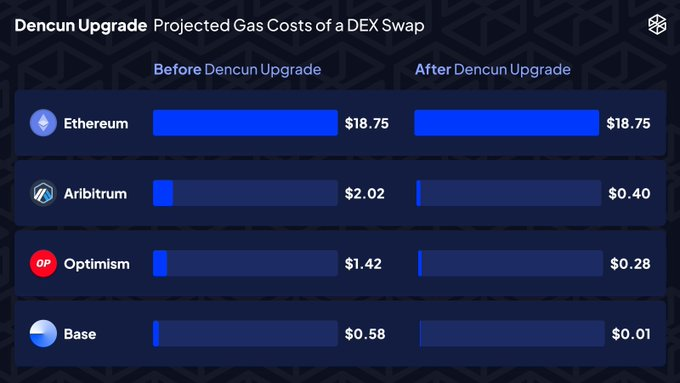
Dencun upgrade reduction estimates for a few of the L2s in the Ethereum ecosystem
With these perks coming together, anonymous crypto user @spreekaway reported that there were many queries about how to restore an L2 back online. This is likely as users looked to leverage the provisions of the upgrade.
fiverr devs and chatgpt receiving unprecedented number of queries about how to bring an L2 back online
— Spreek (@spreekaway) March 13, 2024
Testimonies are already out, with @DwarfBattles indicating, “After the Dencun upgrade, fees per mint of our NFT badge decreased by more than 5 times!”
Impact on Blast L2
Elsewhere, reports indicate that with the upgrade, Blast L2, a new player in the Layer 2 space, was also affected. Specifically, the Blast Mainnet stopped producing blocks due to issues related to Ethereum’s Dencun upgrade. Core engineers were deployed to solve the issue.
The Blast Mainnet has stopped producing blocks due to issues related to Ethereum’s Dencun upgrade.
— Blast (@Blast_L2) March 13, 2024
Core engineering contributors are working on a fix. We’ll share an update and post-mortem once the fix is live (eta 30-60 min).
Blast L2 took the market by storm, with influencers and early adopters flocking it as it on-boarded projects with the promise of a unique approach to decentralized finance (DeFi). Specifically, it committed to promoting financial inclusion achieved via a community-driven platform.
The project started the early access phase of its airdrop in November, with participants requiring an invite code to enter.
Ethereum development FAQs
What is the next big Ethereum software update?
After the Merge, the Ethereum community is looking at the Sharding upgrade next, which has been slated for sometime later in the year. The development can be summarized in four words, “scalability through more efficient data storage.” The software update will increase the capacity of the blockchain, widening the amount of data that can be stored or accessed. At the same time, all services running atop the Ethereum blockchain will enjoy significantly reduced transaction fees.
What is the difference between hard fork and soft fork?
A fork is the splitting of a blockchain after developers agree and proceed to implement upgrades. The decision comes after these developers reach a consensus for a software upgrade. The ensuing part will see one part continue with the status as is, while the other one will proceed with new features combined with the former ones. A hard fork basically entails permanent divergence of a new side chain from the original one, while a soft fork is doing the same, only difference being that it is temporary.
What is EIP-4844?
EIP-4844 is an improvement proposal for the Ethereum network. The upgrade promises reduced gas fees, which is a valuable offering considering the high transaction cost that continues to daunt crypto players. It has been a long-standing concern for the Ethereum network. The proposal is also referred to as “proto-Danksharding,” with an unmatched ability to increase the speed of transactions on the Ethereum blockchain. At the same time, it helps to reduce the transaction cost as everything becomes decentralized.
What is gas in the context of Ethereum?
Gas token is a new, innovative Ethereum contract where users can tokenize gas on the Ethereum network. This means they can store gas when it is cheap and start to deploy the gas once the market has shifted to the north. The use of Gas token helps to subsidize high gas prices on transactions, meaning investors can do everything from arbitraging decentralized exchanges to buying into initial coin offerings (ICOs) early.
Author

Lockridge Okoth
FXStreet
Lockridge is a believer in the transformative power of crypto and the blockchain industry.